
Animal field guide
Dragon Moray
Enchelycore pardalis
The Dragon Moray teaches threshold power. It does not need to patrol everywhere; it makes its chosen entrance unforgettable.
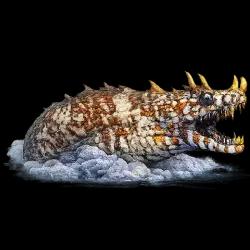
Dragon Moray at a glance
Reptile · North Pacific · Rocky and coral reefs in · Uncommon
Known for: Long tube-like front nostrils projecting like small, Hooked jaws that never fully close, Orange to reddish-brown body covered in dark-edged, Grows to around 80 to 90 cm long
Its Power
Fierce Threshold
Lives in reef crevices with dramatic jaws, markings, and a powerful ambush presence.
Some guardianship works by making the entrance feel serious.
“Guard the threshold.”
Capture a Dragon Moray, and it's yours when you finish one step it gives you.
Biological basis
Dragon morays are striking moray eels with vivid patterning and sharp jaws, often sheltering in reef holes and crevices.
Put it into practice
Make the entrance to important work clear enough that careless people think twice before crossing it.
What does the dragon moray symbolize?
The dragon moray symbolizes fierce threshold: lives in reef crevices with dramatic jaws, markings, and a powerful ambush presence. It represents boundaries, protective strength and decisive action. Its AnimalDex motto: "Guard the threshold."
The dragon moray as a spirit animal
If the dragon moray is your spirit animal, the AnimalDex reading is Fierce Threshold: some guardianship works by making the entrance feel serious. It suggests a strength in boundaries and protective strength, and a reminder to use it on purpose.
What can the dragon moray help you with in life?
The dragon moray is a guide for boundaries, protective strength and decisive action. Its lesson applies wherever boundaries matters: some guardianship works by making the entrance feel serious.
- Boundaries
- Protective Strength
- Decisive Action
In practice: Make the entrance to important work clear enough that careless people think twice before crossing it.
What can we learn from the Dragon Moray?What does it mean to dream about or encounter a wild dragon moray?
Dreaming about a wild dragon moray, or coming across one, usually points to boundaries and protective strength: the qualities the dragon moray lives by. In AnimalDex, the dragon moray's principle is Fierce Threshold: lives in reef crevices with dramatic jaws, markings, and a powerful ambush presence. Read the moment through its core lesson: Some guardianship works by making the entrance feel serious.
Neither good nor bad on its own. How the dragon moray acts matters: at ease, it reflects boundaries; hostile, it flags boundaries out of balance.
Spotting a dragon moray in the wild
A real encounter is the plainest version of the sign: notice what the dragon moray was doing. Lives in reef crevices with dramatic jaws, markings, and a powerful ambush presence. That is the boundaries worth borrowing today.
A dragon moray that keeps appearing
Repeated sightings of a dragon moray usually mean the Fierce Threshold lesson is still open: some guardianship works by making the entrance feel serious.
Dreaming of being chased by a dragon moray
A chase often means a demand for boundaries is catching up with you. The dragon moray's lesson, "Some guardianship works by making the entrance feel serious", is the part you may be running from.
Dreaming that a dragon moray attacks you
An attack points to boundaries turned against you: someone using it on you, or your own boundaries overused until it costs you.
A calm or friendly dragon moray
Meeting a peaceful dragon moray is usually encouraging: protective strength and decisive action are within reach.
A dead or injured dragon moray
Seeing the dragon moray hurt may point to protective strength that has been neglected. Ask what it would take to restore it.
These readings are reflective prompts drawn from how the dragon moray really lives, not predictions. If you meet one in the wild, watch from a distance and leave it undisturbed.
Capture your own Dragon Moray
Photograph or film one in the wild, at a zoo or at home with the app. It becomes yours: it remembers you, gives you steps, and can debate your problems with your other animals.
Animal field guide
Dragon Moray
Sign in to hear this read by a natural AI voice instead of your browser's.
The Dragon Moray teaches threshold power. It does not need to patrol everywhere; it makes its chosen entrance unforgettable.
Native range
Natural range, not this capture location
Rocky and coral reefs in warm-temperate and tropical waters of the western and central Pacific, including southern Japan, Taiwan and Hawaii. It usually lives from a few metres down to several tens of metres, sheltering in holes and crevices.
Search near meAnimalDex stats
Size scale
Understand the animal
Understand the Dragon Moray
Factual biology first: what this animal is like, where it lives, how it survives, and why those traits exist.
01
Introduction to Dragon Moray
The Dragon Moray teaches threshold power. It does not need to patrol everywhere; it makes its chosen entrance unforgettable.
How to identify a Dragon Moray
- Long tube-like front nostrils projecting like small horns
- Hooked jaws that never fully close, exposing fang-like teeth
- Orange to reddish-brown body covered in dark-edged white spots
- Grows to around 80 to 90 cm long
Why Dragon Moray are interesting
- Its species name, pardalis, means leopard-like and refers to the bold spotted pattern.
- A second set of jaws in its throat shoots forward to grip prey and drag it into the gullet, as in other morays.
- Temminck and Schlegel described it scientifically from Japan in 1847, in their Fauna Japonica.
- Its colours and rarity mean it often sells for high prices in the aquarium trade.
02
Adaptations and biological abilities
03
Why does Dragon Moray behave this way?
- Long tube-like front nostrils projecting like small horns
- Hooked jaws that never fully close, exposing fang-like teeth
- Orange to reddish-brown body covered in dark-edged white spots
- Grows to around 80 to 90 cm long
Thought to be most active at night, when it leaves its hole to hunt. By day it usually rests in a crevice with only the head showing. No seasonal dormancy is known, and its daily rhythm has not been studied in detail.
04
Why Rocky and coral reefs in warm-temperate and tropical waters of the western and central Pacific?
Habitat: Rocky and coral reefs in warm-temperate and tropical waters of the western and central Pacific, including southern Japan, Taiwan and Hawaii. It usually lives from a few metres down to several tens of metres, sheltering in holes and crevices.
Native range: North Pacific, Coral Triangle
Native range
Natural range, not this specific capture location.
Some regional overlays are unavailable in this web build.
Rocky and coral reefs in warm-temperate and tropical waters of the western and central Pacific, including southern Japan, Taiwan and Hawaii. It usually lives from a few metres down to several tens of metres, sheltering in holes and crevices.
05
Why this diet?
06
Activity, rest, and lifespan
Thought to be most active at night, when it leaves its hole to hunt. By day it usually rests in a crevice with only the head showing. No seasonal dormancy is known, and its daily rhythm has not been studied in detail.
Enchelycore pardalis lifespan are not published from otolith or aquarium series; the moray's hooked jaws and spotted pattern mark Indo-Pacific reef crevices.
07
Dragon Moray reproduction
Reproduction has not been studied in detail. Like other morays it is thought to release eggs into open water, where they hatch into transparent, leaf-shaped larvae that drift before settling on a reef.
The sexes cannot be told apart in the field, and no external differences have been documented.
08
Predators, threats, and defense
09
Conservation and rarity
Rarity: Uncommon · 55/100. AnimalDex canonical rarity score: 55/100, maintained by the live indexed species profile.
- Observe from a respectful distance and avoid changing the animal's behavior.
- Do not block feeding, shelter, nesting, or travel routes.
- Use a live camera capture without handling or staging wildlife.
Talk to it
Talk to the Dragon Moray
It answers as itself: ask about how it lives, or bring it something of yours and hear what it would do, from its own Power.
Anonymous: 6/day. Signed-in: 10/day. Pro: 100/day.
Side by side
The Dragon Moray, side by side
Nothing written side by side for the Dragon Moray yet. Pick any animal to compare it with. Compare with any animal →
Where to find them
Where to find Dragon Moray
To find Dragon Moray in the wild, focus on the exact habitat patches that match its body design and daily behavior, not just the broad country where it exists. You usually do better by working one good piece of habitat inside north Pacific, Coral Triangle than by covering too much ground.
- Headlands, reef edges, island colonies, tidal channels, or productive coastal water
- Protected habitat blocks within north Pacific, Coral Triangle
In the Ark
No Dragon Moray is aboard yet.
None have come aboard or left since November 17.
The Ark is a live, shared animal world. Animals come aboard when people capture them, and live there by rules based on their field guides.
Scientific name
Enchelycore pardalis
Category
Reptile
Habitat
Rocky and coral reefs in warm-temperate and tropical waters of the western and central Pacific, including southern Japan, Taiwan and Hawaii. It usually lives from a few metres down to several tens of metres, sheltering in holes and crevices.
Rarity
Uncommon · 55/100
Native range
North Pacific, Coral Triangle
Take the encyclopedia outside
AnimalDex helps you scan real animals, identify species, collect cards, and learn from nature wherever you are.