
Animal field guide
Eastern Boxelder Bug
Boisea trivittata
As autumn days shorten, adults of this black and red true bug, 11 to 14 mm long, leave their host trees and mass on sunlit south- and west-facing surfaces, sometimes in thousands. They then crawl into dry gaps and pass the winter dormant.
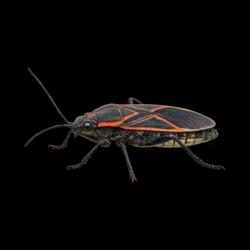
Eastern Boxelder Bug at a glance
Animal · North America · Boxelder/maple trees · Relatively common
Known for: Three red lines run lengthwise on the black plate, Dark wings lie flat over the back, Flat, Nymphs are bright red and wingless
Its Power
Seasonal Gathering
Find warmth by gathering when the season shifts.
Sometimes survival means clustering around the right place at the right time.
“Gather for warmth.”
Capture a Eastern Boxelder Bug, and it's yours when you finish one step it gives you.
Biological basis
Eastern Boxelder Bugs often gather in large numbers on warm surfaces and overwinter around sheltered human structures.
Put it into practice
You feel isolated, so you join the place where support already gathers.
What does the eastern boxelder bug symbolize?
The eastern boxelder bug symbolizes seasonal gathering: find warmth by gathering when the season shifts. It represents knowing the season, community and safety in numbers. Its AnimalDex motto: "Gather for warmth."
The eastern boxelder bug as a spirit animal
If the eastern boxelder bug is your spirit animal, the AnimalDex reading is Seasonal Gathering: sometimes survival means clustering around the right place at the right time. It suggests a strength in knowing the season and community, and a reminder to use it on purpose.
What can the eastern boxelder bug help you with in life?
The eastern boxelder bug is a guide for knowing the season, community and safety in numbers. Its lesson applies wherever knowing the season matters: sometimes survival means clustering around the right place at the right time.
- Knowing the Season
- Community
- Safety in Numbers
In practice: You feel isolated, so you join the place where support already gathers.
What can we learn from the Eastern Boxelder Bug?What does it mean to dream about or encounter a wild eastern boxelder bug?
Dreaming about a wild eastern boxelder bug, or coming across one, usually points to knowing the season and community: the qualities the eastern boxelder bug lives by. In AnimalDex, the eastern boxelder bug's principle is Seasonal Gathering: find warmth by gathering when the season shifts. Read the moment through its core lesson: Sometimes survival means clustering around the right place at the right time.
It depends on how the eastern boxelder bug behaved. Calm or close by, it reads as community within reach; aggressive or fleeing, it points to knowing the season you are resisting.
Spotting an eastern boxelder bug in the wild
If an eastern boxelder bug crosses your path, take it as a cue to look at where knowing the season fits your day. Its AnimalDex motto: "Gather for warmth."
An eastern boxelder bug that keeps appearing
Seeing the eastern boxelder bug again and again, in dreams or outside, suggests knowing the season is a theme you have not settled yet.
Dreaming of being chased by an eastern boxelder bug
If the eastern boxelder bug pursues you, look at where community is being asked of you and you are stepping away instead of meeting it.
Dreaming that an eastern boxelder bug attacks you
An aggressive eastern boxelder bug can mirror a conflict where knowing the season has become a weapon rather than a strength.
A calm or friendly eastern boxelder bug
A relaxed eastern boxelder bug near you, in a dream or in person, reads as readiness: Seasonal Gathering is available to you now, as its motto puts it, "Gather for warmth.".
A dead or injured eastern boxelder bug
Seeing the eastern boxelder bug hurt may point to community that has been neglected. Ask what it would take to restore it.
These readings are reflective prompts drawn from how the eastern boxelder bug really lives, not predictions. If you meet one in the wild, watch from a distance and leave it undisturbed.
Capture your own Eastern Boxelder Bug
Photograph or film one in the wild, at a zoo or at home with the app. It becomes yours: it remembers you, gives you steps, and can debate your problems with your other animals.
Animal field guide
Eastern Boxelder Bug
Sign in to hear this read by a natural AI voice instead of your browser's.
As autumn days shorten, adults of this black and red true bug, 11 to 14 mm long, leave their host trees and mass on sunlit south- and west-facing surfaces, sometimes in thousands. They then crawl into dry gaps and pass the winter dormant.
Native range
Natural range, not this capture location
Boxelder/maple trees, warm walls, siding, and sheltered winter cracks.
Search near meAnimalDex stats
Size scale
Understand the animal
Understand the Eastern Boxelder Bug
Factual biology first: what this animal is like, where it lives, how it survives, and why those traits exist.
01
Introduction to Eastern Boxelder Bug
As autumn days shorten, adults of this black and red true bug, 11 to 14 mm long, leave their host trees and mass on sunlit south- and west-facing surfaces, sometimes in thousands. They then crawl into dry gaps and pass the winter dormant.
How to identify a Eastern Boxelder Bug
- Three red lines run lengthwise on the black plate behind the head
- Dark wings lie flat over the back, edged in red
- Flat, narrow oval body
- Nymphs are bright red and wingless, darkening as wing pads grow
- Red abdomen shows when the wings open in flight
Why Eastern Boxelder Bug are interesting
- It breeds mainly on seed-bearing female boxelder trees, so male trees nearby usually carry far fewer bugs.
- There is one generation a year in the north of the range and two where summers are longer.
- Feeding leaves only small yellow spots on leaves, and host trees are rarely harmed even when the bugs are numerous.
- Although it belongs to the family known as scentless plant bugs, a crushed boxelder bug gives off a pungent smell.
- Its mouthparts form a slender beak folded under the body, which it pushes into seeds, leaves and young twigs to suck out the sap.
02
Adaptations and biological abilities
03
Why does Eastern Boxelder Bug behave this way?
- Three red lines run lengthwise on the black plate behind the head
- Dark wings lie flat over the back, edged in red
- Flat, narrow oval body
- Nymphs are bright red and wingless, darkening as wing pads grow
- Red abdomen shows when the wings open in flight
Feeds and basks in sunshine through the day. At night and in cool or wet weather it stays tucked into bark crevices, leaf litter or gaps in buildings.
04
Why Boxelder/maple trees?
Habitat: Boxelder/maple trees, warm walls, siding, and sheltered winter cracks.
Native range: North America
Native range
Natural range, not this specific capture location.
Boxelder/maple trees, warm walls, siding, and sheltered winter cracks.
05
Why this diet?
Boxelder and maple seeds, leaves, and plant fluids.
06
Activity, rest, and lifespan
Feeds and basks in sunshine through the day. At night and in cool or wet weather it stays tucked into bark crevices, leaf litter or gaps in buildings.
About one year from egg to death for adults of the late-summer generation, which breed the following spring and then die.
07
Eastern Boxelder Bug reproduction
Females lay small clusters of rust-red eggs in bark crevices and on leaves of host trees in spring. Eggs hatch in about 10 to 14 days, and the nymphs pass through five moults before becoming winged adults in summer. There is no parental care.
Sexes are similar, with size and abdomen differences subtle.
08
Predators, threats, and defense
Birds, spiders, predatory insects, and humans threaten it.
09
Conservation and rarity
Rarity: Relatively common · 7/100. AnimalDex canonical rarity score: 7/100, maintained by the live indexed species profile.
- Observe from a respectful distance and avoid changing the animal's behavior.
- Do not block feeding, shelter, nesting, or travel routes.
- Use a live camera capture without handling or staging wildlife.
Talk to it
Talk to the Eastern Boxelder Bug
It answers as itself: ask about how it lives, or bring it something of yours and hear what it would do, from its own Power.
Anonymous: 6/day. Signed-in: 10/day. Pro: 100/day.
Side by side
The Eastern Boxelder Bug, side by side
Nothing written side by side for the Eastern Boxelder Bug yet. Pick any animal to compare it with. Compare with any animal →
Where to find them
Where to find Eastern Boxelder Bug
To find Eastern Boxelder Bug in the wild, focus on the exact habitat patches that match its body design and daily behavior, not just the broad country where it exists. You usually do better by working one good piece of habitat inside north America than by covering too much ground.
- Sunlit logs, exposed branches, warm rocks, or regular perch sites used for scanning
- Protected habitat blocks within north America
Where explorers saw it
- Wilson-Goburn-Roosevelt-Territorial, Battle Creek, United StatesJun · 1 sighting
Guides to seeing Eastern Boxelder Bug
In the Ark
3 Eastern Boxelder Bugs are aboard right now.
Since November 17: 2 died of old age.
The Ark is a live, shared animal world. Animals come aboard when people capture them, and live there by rules based on their field guides.
Scientific name
Boisea trivittata
Category
Animal
Habitat
Boxelder/maple trees, warm walls, siding, and sheltered winter cracks.
Rarity
Relatively common · 7/100
Native range
North America
Take the encyclopedia outside
AnimalDex helps you scan real animals, identify species, collect cards, and learn from nature wherever you are.