
Animal field guide
Electric Blue Acara
Andinoacara pulcher
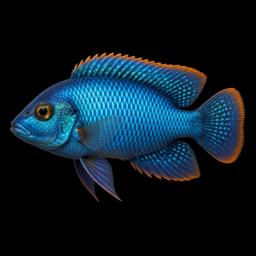
A vivid, almost uniformly metallic-blue form of the blue acara, a South American cichlid, produced by selective breeding in aquariums. Wild blue acaras are greyer, with dark bars and shining blue lines and spots on the face and flanks. The electric blue form does not occur naturally in the wild.
Electric Blue Acara at a glance
Animal · South America · The wild species lives in slow · Relatively common
Known for: Bright metallic blue over the whole body and fins, Deep, Long dorsal fin with spiny front rays, Adults usually about 10 to 15 centimetres long
Its Power
Colorful Boundary
Use vivid signals to assert your space and intentions.
When your boundaries are tested, make your position clear with bold, unmistakable signals.
“Signal Your Space.”
Capture a Electric Blue Acara, and it's yours when you finish one step it gives you.
Biological basis
The Electric Blue Acara uses its vibrant coloration to assert dominance and defend its territory from intruders.
Put it into practice
During a meeting, she clearly outlines her role and expectations, leaving no room for misinterpretation.
What does the electric blue acara symbolize?
The electric blue acara symbolizes colorful boundary: use vivid signals to assert your space and intentions. It represents boundaries, confident display and conflict prevention. Its AnimalDex motto: "Signal Your Space."
The electric blue acara as a spirit animal
If the electric blue acara is your spirit animal, the AnimalDex reading is Colorful Boundary: when your boundaries are tested, make your position clear with bold, unmistakable signals. It suggests a strength in boundaries and confident display, and a reminder to use it on purpose.
What can the electric blue acara help you with in life?
The electric blue acara is a guide for boundaries, confident display and conflict prevention. Its lesson applies wherever boundaries matters: when your boundaries are tested, make your position clear with bold, unmistakable signals.
- Boundaries
- Confident Display
- Conflict Prevention
In practice: During a meeting, she clearly outlines her role and expectations, leaving no room for misinterpretation.
What can we learn from the Electric Blue Acara?What does it mean to dream about or encounter a wild electric blue acara?
Dreaming about a wild electric blue acara, or coming across one, usually points to boundaries and confident display: the qualities the electric blue acara lives by. In AnimalDex, the electric blue acara's principle is Colorful Boundary: use vivid signals to assert your space and intentions. Read the moment through its core lesson: When your boundaries are tested, make your position clear with bold, unmistakable signals.
Neither good nor bad on its own. How the electric blue acara acts matters: at ease, it reflects boundaries; hostile, it flags boundaries out of balance.
Spotting an electric blue acara in the wild
Coming across an electric blue acara in person asks for attention more than interpretation. Watch it for a minute; the electric blue acara's way of working is Colorful Boundary, and the lesson is: when your boundaries are tested, make your position clear with bold, unmistakable signals.
An electric blue acara that keeps appearing
Repeated sightings of an electric blue acara usually mean the Colorful Boundary lesson is still open: when your boundaries are tested, make your position clear with bold, unmistakable signals.
Dreaming of being chased by an electric blue acara
Being chased suggests you are avoiding the Colorful Boundary the electric blue acara stands for: when your boundaries are tested, make your position clear with bold, unmistakable signals. Ask what you keep postponing that needs boundaries.
Dreaming that an electric blue acara attacks you
When the electric blue acara attacks, the dream may be about pressure: confident display or conflict prevention applied too hard, by you or by someone close to you.
A calm or friendly electric blue acara
Meeting a peaceful electric blue acara is usually encouraging: confident display and conflict prevention are within reach.
A dead or injured electric blue acara
A dead or injured electric blue acara, dreamed or found, can mark boundaries you have let lapse, or a phase built on Colorful Boundary coming to an end.
These readings are reflective prompts drawn from how the electric blue acara really lives, not predictions. If you meet one in the wild, watch from a distance and leave it undisturbed.
Capture your own Electric Blue Acara
Photograph or film one in the wild, at a zoo or at home with the app. It becomes yours: it remembers you, gives you steps, and can debate your problems with your other animals.
Animal field guide
Electric Blue Acara
Sign in to hear this read by a natural AI voice instead of your browser's.
A vivid, almost uniformly metallic-blue form of the blue acara, a South American cichlid, produced by selective breeding in aquariums. The electric blue form does not occur naturally in the wild.
Native range
Natural range, not this capture location
The wild species lives in slow streams, ditches, ponds and swampy lowland waters, often turbid and with plants or leaf litter, in northern South America including Venezuela, Trinidad and Colombia. The electric blue form is kept in aquariums.
Search near meAnimalDex stats
Size scale
Understand the animal
Understand the Electric Blue Acara
Factual biology first: what this animal is like, where it lives, how it survives, and why those traits exist.
01
Introduction to Electric Blue Acara
A vivid, almost uniformly metallic-blue form of the blue acara, a South American cichlid, produced by selective breeding in aquariums. Wild blue acaras are greyer, with dark bars and shining blue lines and spots on the face and flanks. The electric blue form does not occur naturally in the wild.
How to identify a Electric Blue Acara
- Bright metallic blue over the whole body and fins
- Deep, oval body typical of a cichlid
- Long dorsal fin with spiny front rays
- Adults usually about 10 to 15 centimetres long
Why Electric Blue Acara are interesting
- The wild species was long known as Aequidens pulcher before being moved to the genus Andinoacara in 2009.
- The exact origin of the electric blue form is debated, and some fishkeepers believe hybridisation played a part.
- Parents often move newly hatched young into small pits dug in the gravel until the fry can swim freely.
- Blue acaras have been kept and bred by fishkeepers for about a century, making them one of the longest-kept cichlids.
02
Adaptations and biological abilities
03
Why does Electric Blue Acara behave this way?
- Bright metallic blue over the whole body and fins
- Deep, oval body typical of a cichlid
- Long dorsal fin with spiny front rays
- Adults usually about 10 to 15 centimetres long
Active by day. At night it rests near the bottom or among cover with its colours paler, and guarding parents stay close to the brood.
04
Why The wild species lives in slow streams?
Habitat: The wild species lives in slow streams, ditches, ponds and swampy lowland waters, often turbid and with plants or leaf litter, in northern South America including Venezuela, Trinidad and Colombia. The electric blue form is kept in aquariums.
Native range: South America
Native range
Natural range, not this specific capture location.
The wild species lives in slow streams, ditches, ponds and swampy lowland waters, often turbid and with plants or leaf litter, in northern South America including Venezuela, Trinidad and Colombia. The electric blue form is kept in aquariums.
05
Why this diet?
Omnivorous. Wild fish pick small insects, worms, crustaceans and plant matter from the bottom and sometimes take small fish; aquarium fish take pellets, frozen and live foods.
06
Activity, rest, and lifespan
Active by day. At night it rests near the bottom or among cover with its colours paler, and guarding parents stay close to the brood.
Commonly about 8 to 10 years in aquariums; lifespan of the wild species has not been documented.
07
Electric Blue Acara reproduction
A pair cleans a flat stone or log and the female lays a few hundred sticky eggs on it for the male to fertilise. Both parents fan and guard them; they hatch in two to three days, and the fry are guarded for several weeks.
Males grow larger, with longer, more pointed dorsal and anal fins. Females are smaller and rounder, and show a short, blunt breeding tube when spawning.
08
Predators, threats, and defense
Wild blue acaras are eaten by larger fish and by herons, kingfishers and other fish-eating birds. Parents defend eggs and fry by display and by charging intruders; in aquariums, aggressive tankmates are the main threat.
09
Conservation and rarity
Rarity: Relatively common · 12/100. AnimalDex canonical rarity score: 12/100, maintained by the live indexed species profile.
- Observe from a respectful distance and avoid changing the animal's behavior.
- Do not block feeding, shelter, nesting, or travel routes.
- Use a live camera capture without handling or staging wildlife.
Talk to it
Talk to the Electric Blue Acara
It answers as itself: ask about how it lives, or bring it something of yours and hear what it would do, from its own Power.
Anonymous: 6/day. Signed-in: 10/day. Pro: 100/day.
Side by side
The Electric Blue Acara, side by side
Nothing written side by side for the Electric Blue Acara yet. Pick any animal to compare it with. Compare with any animal →
Where to find them
Where to find Electric Blue Acara
To find Electric Blue Acara in the wild, focus on the exact habitat patches that match its body design and daily behavior, not just the broad country where it exists. You usually do better by working one good piece of habitat inside south America than by covering too much ground.
- Quiet marsh edges, reedbeds, river bends, or shallow wetland margins
- Burrow systems, sandy banks, fallen logs, or ground with clear den entrances
- Protected habitat blocks within south America
In the Ark
1 Electric Blue Acara is aboard right now.
None have come aboard or left since November 17.
The Ark is a live, shared animal world. Animals come aboard when people capture them, and live there by rules based on their field guides.
Scientific name
Andinoacara pulcher
Category
Animal
Habitat
The wild species lives in slow streams, ditches, ponds and swampy lowland waters, often turbid and with plants or leaf litter, in northern South America including Venezuela, Trinidad and Colombia. The electric blue form is kept in aquariums.
Rarity
Relatively common · 12/100
Native range
South America
Take the encyclopedia outside
AnimalDex helps you scan real animals, identify species, collect cards, and learn from nature wherever you are.