
Animal field guide
Emerald Moth
Hemithea tritonaria
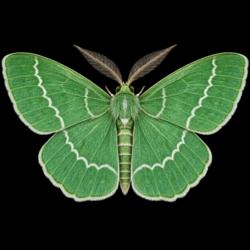
A small emerald moth of warm Asian forests, with a wingspan of roughly two centimetres. Resting flat on the upper side of a leaf, the green wings crossed by pale lines blend with the leaf surface and its veins, so a sitting moth is easily overlooked by day.
Emerald Moth at a glance
Invertebrate · South Asia · Forest edges · Relatively common
Known for: Small, Wings bright green, Fine whitish cross-lines on forewing and hindwing, Hindwing outer edge drawn out into a short point
Its Power
Camouflage Mastery
Pigment-Green Rest Among Leaves
The emerald moth's ability to blend seamlessly with its surroundings teaches us the value of strategic invisibility for gaining insights without interference.
“Invisible Insight.”
Capture a Emerald Moth, and it's yours when you finish one step it gives you.
Biological basis
Emerald moths are known for their green coloration, which allows them to camouflage effectively among leaves and foliage, evading predators.
Put it into practice
A head teacher sits at the back of the class in plain clothes to see a normal lesson.
What does the emerald moth symbolize?
The emerald moth symbolizes camouflage mastery: pigment-Green Rest Among Leaves. It represents blending in, sharp observation and discretion. Its AnimalDex motto: "Invisible Insight."
The emerald moth as a spirit animal
If the emerald moth is your spirit animal, the AnimalDex reading is Camouflage Mastery: the emerald moth's ability to blend seamlessly with its surroundings teaches us the value of strategic invisibility for gaining insights without interference. It suggests a strength in blending in and sharp observation, and a reminder to use it on purpose.
What can the emerald moth help you with in life?
The emerald moth is a guide for blending in, sharp observation and discretion. Its lesson applies wherever blending in matters: the emerald moth's ability to blend seamlessly with its surroundings teaches us the value of strategic invisibility for gaining insights without interference.
- Blending In
- Sharp Observation
- Discretion
In practice: A head teacher sits at the back of the class in plain clothes to see a normal lesson.
What can we learn from the Emerald Moth?What does it mean to dream about or encounter a wild emerald moth?
A wild emerald moth, whether in a dream or in front of you, tends to show up when blending in or sharp observation is on your mind. In AnimalDex, the emerald moth's principle is Camouflage Mastery: pigment-Green Rest Among Leaves. Read the moment through its core lesson: The emerald moth's ability to blend seamlessly with its surroundings teaches us the value of strategic invisibility for gaining insights without interference.
Mostly a prompt rather than a warning. A calm emerald moth suggests blending in you already have; a threatening one suggests blending in is being tested or pushed too far.
Spotting an emerald moth in the wild
If an emerald moth crosses your path, take it as a cue to look at where blending in fits your day. Its AnimalDex motto: "Invisible Insight."
An emerald moth that keeps appearing
An emerald moth that keeps turning up points to sharp observation you keep circling back to. The repetition is the message.
Dreaming of being chased by an emerald moth
Being chased suggests you are avoiding the Camouflage Mastery the emerald moth stands for: the emerald moth's ability to blend seamlessly with its surroundings teaches us the value of strategic invisibility for gaining insights without interference. Ask what you keep postponing that needs blending in.
Dreaming that an emerald moth attacks you
An aggressive emerald moth can mirror a conflict where blending in has become a weapon rather than a strength.
A calm or friendly emerald moth
A calm emerald moth suggests you have made peace with blending in and can use it without force.
A dead or injured emerald moth
A dead or injured emerald moth, dreamed or found, can mark blending in you have let lapse, or a phase built on Camouflage Mastery coming to an end.
These readings are reflective prompts drawn from how the emerald moth really lives, not predictions. If you meet one in the wild, watch from a distance and leave it undisturbed.
Capture your own Emerald Moth
Photograph or film one in the wild, at a zoo or at home with the app. It becomes yours: it remembers you, gives you steps, and can debate your problems with your other animals.
Animal field guide
Emerald Moth
Sign in to hear this read by a natural AI voice instead of your browser's.
A small emerald moth of warm Asian forests, with a wingspan of roughly two centimetres. Resting flat on the upper side of a leaf, the green wings crossed by pale lines blend with the leaf surface and its veins, so a sitting moth is easily overlooked by day.
Native range
Natural range, not this capture location
Forest edges, secondary growth, scrub, orchards and gardens in warm, humid lowlands and hills; adults rest among foliage by day and come to lights at night.
Search near meAnimalDex stats
Size scale
Understand the animal
Understand the Emerald Moth
Factual biology first: what this animal is like, where it lives, how it survives, and why those traits exist.
01
Introduction to Emerald Moth
A small emerald moth of warm Asian forests, with a wingspan of roughly two centimetres. Resting flat on the upper side of a leaf, the green wings crossed by pale lines blend with the leaf surface and its veins, so a sitting moth is easily overlooked by day.
How to identify a Emerald Moth
- Small, slender-bodied moth
- Wings bright green, fading to yellowish in worn moths
- Fine whitish cross-lines on forewing and hindwing
- Hindwing outer edge drawn out into a short point
- Rests with wings spread flat against leaves
Why Emerald Moth are interesting
- The green of emerald moths comes from an unstable pigment that fades with light and age, so old museum specimens often look pale.
- Its caterpillar is a looper, moving by drawing its hind end up to its front legs, as in other geometer moths.
- Like related emeralds, the caterpillar rests stretched stiffly along twigs, where it looks like a small shoot or bud.
- It belongs to the Geometrinae, a subfamily of geometer moths in which most species are green.
02
Adaptations and biological abilities
03
Why does Emerald Moth behave this way?
- Small, slender-bodied moth
- Wings bright green, fading to yellowish in worn moths
- Fine whitish cross-lines on forewing and hindwing
- Hindwing outer edge drawn out into a short point
- Rests with wings spread flat against leaves
Adults are active at night and fly to lights; by day they rest on leaves among the foliage.
04
Why Forest edges?
Habitat: Forest edges, secondary growth, scrub, orchards and gardens in warm, humid lowlands and hills; adults rest among foliage by day and come to lights at night.
Native range: South Asia, Southeast Asia, East Asia
Native range
Natural range, not this specific capture location.
Forest edges, secondary growth, scrub, orchards and gardens in warm, humid lowlands and hills; adults rest among foliage by day and come to lights at night.
05
Why this diet?
Caterpillars chew the leaves of woody plants; like several of their relatives they are thought to feed on a range of trees and shrubs. Adults may sip nectar and other sugary fluids.
06
Activity, rest, and lifespan
Adults are active at night and fly to lights; by day they rest on leaves among the foliage.
Lifespan has not been documented for this species; adults probably live only one to two weeks.
07
Emerald Moth reproduction
Females lay eggs on the leaves or twigs of the food plant. The looper caterpillars grow through several moults and pupate among leaves or litter, and in warm regions several generations may follow in a year.
The sexes look alike in colour and pattern; males may be told by their more feathery antennae under a lens.
08
Predators, threats, and defense
Birds search foliage for resting adults and caterpillars, and bats and spiders catch moths at night. Parasitic wasps and flies attack caterpillars. Colour-matching and stillness are the main defences of both adult and caterpillar.
09
Conservation and rarity
Rarity: Relatively common · 44/100. AnimalDex canonical rarity score: 44/100, maintained by the live indexed species profile.
- Observe from a respectful distance and avoid changing the animal's behavior.
- Do not block feeding, shelter, nesting, or travel routes.
- Use a live camera capture without handling or staging wildlife.
Talk to it
Talk to the Emerald Moth
It answers as itself: ask about how it lives, or bring it something of yours and hear what it would do, from its own Power.
Anonymous: 6/day. Signed-in: 10/day. Pro: 100/day.
Side by side
The Emerald Moth, side by side
Nothing written side by side for the Emerald Moth yet. Pick any animal to compare it with. Compare with any animal →
Where to find them
Where to find Emerald Moth
To find Emerald Moth in the wild, focus on the exact habitat patches that match its body design and daily behavior, not just the broad country where it exists. You usually do better by working one good piece of habitat inside south Asia, Southeast Asia, East Asia than by covering too much ground.
- Forest edge, canopy gaps, fruiting trees, or shaded trails where cover and food meet
- Protected habitat blocks within south Asia, Southeast Asia, East Asia
In the Ark
1 Emerald Moth is aboard right now.
Since November 17: 1 died of old age.
The Ark is a live, shared animal world. Animals come aboard when people capture them, and live there by rules based on their field guides.
Scientific name
Hemithea tritonaria
Category
Invertebrate
Habitat
Forest edges, secondary growth, scrub, orchards and gardens in warm, humid lowlands and hills; adults rest among foliage by day and come to lights at night.
Rarity
Relatively common · 44/100
Native range
South Asia, Southeast Asia, East Asia
Take the encyclopedia outside
AnimalDex helps you scan real animals, identify species, collect cards, and learn from nature wherever you are.