
Animal field guide
Eurasian Sparrowhawk
Accipiter nisus
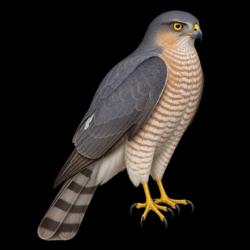
A small woodland hawk whose short, rounded wings and long tail let it jink through branches at speed. Long, thin yellow legs and a very long middle toe reach out to seize small birds in flight.
Eurasian Sparrowhawk at a glance
Animal · Europe · Woodland of all kinds · Relatively common
Known for: Long, Fine horizontal barring across the underparts, Bright yellow to orange eyes, Flap-flap-glide flight pattern
Its Power
Stealth Hunting
Approach your goals with quiet precision and focus.
The Eurasian Sparrowhawk excels at stealth hunting, using silent flight and surprise to capture prey, teaching us the value of focused and discreet action.
“Silent and Focused.”
Capture a Eurasian Sparrowhawk, and it's yours when you finish one step it gives you.
Biological basis
Eurasian Sparrowhawks are known for their ability to fly silently and use cover to ambush prey, often catching them by surprise.
Put it into practice
A job seeker tells nobody about the interview and shares the news only once the offer is signed.
What does the Eurasian sparrowhawk symbolize?
The Eurasian sparrowhawk symbolizes stealth hunting: approach your goals with quiet precision and focus. It represents quiet strategy, element of surprise and focus. Its AnimalDex motto: "Silent and Focused."
The Eurasian sparrowhawk as a spirit animal
If the Eurasian sparrowhawk is your spirit animal, the AnimalDex reading is Stealth Hunting: the Eurasian Sparrowhawk excels at stealth hunting, using silent flight and surprise to capture prey, teaching us the value of focused and discreet action. It suggests a strength in quiet strategy and element of surprise, and a reminder to use it on purpose.
What can the Eurasian sparrowhawk help you with in life?
The Eurasian sparrowhawk is a guide for quiet strategy, element of surprise and focus. Its lesson applies wherever quiet strategy matters: the Eurasian Sparrowhawk excels at stealth hunting, using silent flight and surprise to capture prey, teaching us the value of focused and discreet action.
- Quiet Strategy
- Element of Surprise
- Focus
In practice: A job seeker tells nobody about the interview and shares the news only once the offer is signed.
What can we learn from the Eurasian Sparrowhawk?What does it mean to dream about or encounter a wild Eurasian sparrowhawk?
Meeting a wild Eurasian sparrowhawk, asleep or awake, is often a nudge toward quiet strategy, the quality the Eurasian sparrowhawk is built around. In AnimalDex, the Eurasian sparrowhawk's principle is Stealth Hunting: approach your goals with quiet precision and focus. Read the moment through its core lesson: The Eurasian Sparrowhawk excels at stealth hunting, using silent flight and surprise to capture prey, teaching us the value of focused and discreet action.
Mostly a prompt rather than a warning. A calm Eurasian sparrowhawk suggests quiet strategy you already have; a threatening one suggests quiet strategy is being tested or pushed too far.
Spotting an Eurasian sparrowhawk in the wild
If an Eurasian sparrowhawk crosses your path, take it as a cue to look at where quiet strategy fits your day. Its AnimalDex motto: "Silent and Focused."
An Eurasian sparrowhawk that keeps appearing
Repeated sightings of an Eurasian sparrowhawk usually mean the Stealth Hunting lesson is still open: the Eurasian Sparrowhawk excels at stealth hunting, using silent flight and surprise to capture prey, teaching us the value of focused and discreet action.
Dreaming of being chased by an Eurasian sparrowhawk
A chase often means a demand for quiet strategy is catching up with you. The Eurasian sparrowhawk's lesson, "The Eurasian Sparrowhawk excels at stealth hunting, using silent flight and surprise to capture prey, teaching us the value of focused and discreet action", is the part you may be running from.
Dreaming that an Eurasian sparrowhawk attacks you
An aggressive Eurasian sparrowhawk can mirror a conflict where quiet strategy has become a weapon rather than a strength.
A calm or friendly Eurasian sparrowhawk
A relaxed Eurasian sparrowhawk near you, in a dream or in person, reads as readiness: Stealth Hunting is available to you now, as its motto puts it, "Silent and Focused.".
A dead or injured Eurasian sparrowhawk
Seeing the Eurasian sparrowhawk hurt may point to element of surprise that has been neglected. Ask what it would take to restore it.
These readings are reflective prompts drawn from how the Eurasian sparrowhawk really lives, not predictions. If you meet one in the wild, watch from a distance and leave it undisturbed.
Capture your own Eurasian Sparrowhawk
Photograph or film one in the wild, at a zoo or at home with the app. It becomes yours: it remembers you, gives you steps, and can debate your problems with your other animals.
Animal field guide
Eurasian Sparrowhawk
Sign in to hear this read by a natural AI voice instead of your browser's.
A small woodland hawk whose short, rounded wings and long tail let it jink through branches at speed. Long, thin yellow legs and a very long middle toe reach out to seize small birds in flight.
Native range
Natural range, not this capture location
Woodland of all kinds, especially conifer plantations and mixed woods near open ground, plus farmland with hedgerows, parks, gardens and suburbs. It occurs from the lowlands up to the tree line.
Search near meAnimalDex stats
Size scale
Understand the animal
Understand the Eurasian Sparrowhawk
Factual biology first: what this animal is like, where it lives, how it survives, and why those traits exist.
01
Introduction to Eurasian Sparrowhawk
A small woodland hawk whose short, rounded wings and long tail let it jink through branches at speed. Long, thin yellow legs and a very long middle toe reach out to seize small birds in flight.
How to identify a Eurasian Sparrowhawk
- Long, square-ended tail crossed by dark bars
- Fine horizontal barring across the underparts
- Bright yellow to orange eyes
- Flap-flap-glide flight pattern
- Small, rounded head on a slim body
Why Eurasian Sparrowhawk are interesting
- Organochlorine pesticides caused steep declines in the mid-twentieth century; after their ban numbers recovered, and long-term British studies found little evidence that this hurt most songbird populations.
- On the ground it often mantles a fresh kill, spreading its wings over the prey to hide it.
- Large numbers of northern migrants pass the Falsterbo peninsula in southern Sweden each autumn.
- Falconers have long flown it at small birds such as larks and blackbirds.
02
Adaptations and biological abilities
03
Why does Eurasian Sparrowhawk behave this way?
- Long, square-ended tail crossed by dark bars
- Fine horizontal barring across the underparts
- Bright yellow to orange eyes
- Flap-flap-glide flight pattern
- Small, rounded head on a slim body
Hunts through the day, with peaks around dawn and in the evening. At night it roosts on a branch close to the trunk in dense trees.
04
Why Woodland of all kinds?
Habitat: Woodland of all kinds, especially conifer plantations and mixed woods near open ground, plus farmland with hedgerows, parks, gardens and suburbs. It occurs from the lowlands up to the tree line.
Native range: Europe, Central Asia, East Asia
Native range
Natural range, not this specific capture location.
Woodland of all kinds, especially conifer plantations and mixed woods near open ground, plus farmland with hedgerows, parks, gardens and suburbs. It occurs from the lowlands up to the tree line.
05
Why this diet?
06
Activity, rest, and lifespan
Hunts through the day, with peaks around dawn and in the evening. At night it roosts on a branch close to the trunk in dense trees.
Most young die in their first year, and survivors typically live about 3 to 4 years; ringing records show a few birds passing 15 years.
07
Eurasian Sparrowhawk reproduction
The pair builds a flat stick platform against a trunk in dense trees. The female lays usually 4 to 6 eggs and incubates them for about five weeks while the male hunts for her; the young fly at about four weeks.
Females are up to about twice the weight of males, brown-grey above with grey-barred underparts. Males are slate-blue above with orange-barred underparts and orange cheeks.
08
Predators, threats, and defense
The Northern Goshawk is its most serious predator, and sparrowhawks are reported to avoid nesting close to occupied Goshawk nests. Eagle Owls and Tawny Owls take some birds, and pine martens raid nests.
09
Conservation and rarity
Rarity: Relatively common · 27/100. AnimalDex canonical rarity score: 27/100, maintained by the live indexed species profile.
- Observe from a respectful distance and avoid changing the animal's behavior.
- Do not block feeding, shelter, nesting, or travel routes.
- Use a live camera capture without handling or staging wildlife.
Talk to it
Talk to the Eurasian Sparrowhawk
It answers as itself: ask about how it lives, or bring it something of yours and hear what it would do, from its own Power.
Anonymous: 6/day. Signed-in: 10/day. Pro: 100/day.
Side by side
The Eurasian Sparrowhawk, side by side
Nothing written side by side for the Eurasian Sparrowhawk yet. Pick any animal to compare it with. Compare with any animal →
Where to find them
Where to find Eurasian Sparrowhawk
To find Eurasian Sparrowhawk in the wild, focus on the exact habitat patches that match its body design and daily behavior, not just the broad country where it exists. You usually do better by working one good piece of habitat inside europe, Central Asia, East Asia than by covering too much ground.
- Forest edge, canopy gaps, fruiting trees, or shaded trails where cover and food meet
- Sunlit logs, exposed branches, warm rocks, or regular perch sites used for scanning
- Protected habitat blocks within europe, Central Asia, East Asia
Where explorers saw it
- Santa Maria da Feira, Aveiro, PortugalAug · 1 sighting
In the Ark
1 Eurasian Sparrowhawk is aboard right now.
None have come aboard or left since November 17.
The Ark is a live, shared animal world. Animals come aboard when people capture them, and live there by rules based on their field guides.
Scientific name
Accipiter nisus
Category
Animal
Habitat
Woodland of all kinds, especially conifer plantations and mixed woods near open ground, plus farmland with hedgerows, parks, gardens and suburbs. It occurs from the lowlands up to the tree line.
Rarity
Relatively common · 27/100
Native range
Europe, Central Asia, East Asia
Take the encyclopedia outside
AnimalDex helps you scan real animals, identify species, collect cards, and learn from nature wherever you are.