
Animal field guide
European Sturgeon
Acipenser sturio
Large rivers along the Atlantic, North Sea, Mediterranean and Black Sea coasts of Europe once had runs of this sea-going sturgeon, which has reached more than three metres in length. It now survives as a single population based on the Gironde, Garonne and Dordogne in France.
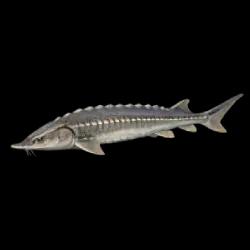
European Sturgeon at a glance
Animal · Europe · At sea it keeps to sandy and muddy · Very rare
Known for: Five rows of pale bony plates along back, Long, Small toothless mouth set under the head, Shark-like tail with the upper lobe much the longer
Its Power
One River Left
Single-Catchment Survival
Even an ancient survivor can be lost when everything comes to depend on one last place.
“Keep a second river.”
Capture a European Sturgeon, and it's yours when you finish one step it gives you.
Biological basis
Acipenser sturio once spawned in rivers across Europe, but dams, dredging, pollution and fishing left only the Gironde-Garonne-Dordogne population, which now supplies every reintroduction.
Put it into practice
A club that meets in only one hall finds a second place to meet before the lease runs out.
What does the European sturgeon symbolize?
The European sturgeon symbolizes one river left: single-Catchment Survival. It represents resilience, adaptability and long-term endurance. Its AnimalDex motto: "Keep a second river."
The European sturgeon as a spirit animal
If the European sturgeon is your spirit animal, the AnimalDex reading is One River Left: even an ancient survivor can be lost when everything comes to depend on one last place. It suggests a strength in resilience and adaptability, and a reminder to use it on purpose.
What can the European sturgeon help you with in life?
The European sturgeon is a guide for resilience, adaptability and long-term endurance. Its lesson applies wherever resilience matters: even an ancient survivor can be lost when everything comes to depend on one last place.
- Resilience
- Adaptability
- Long-Term Endurance
In practice: A club that meets in only one hall finds a second place to meet before the lease runs out.
What can we learn from the European Sturgeon?What does it mean to dream about or encounter a wild European sturgeon?
Dreaming about a wild European sturgeon, or coming across one, usually points to resilience and adaptability: the qualities the European sturgeon lives by. In AnimalDex, the European sturgeon's principle is One River Left: single-Catchment Survival. Read the moment through its core lesson: Even an ancient survivor can be lost when everything comes to depend on one last place.
Mostly a prompt rather than a warning. A calm European sturgeon suggests resilience you already have; a threatening one suggests resilience is being tested or pushed too far.
Spotting an European sturgeon in the wild
Coming across an European sturgeon in person asks for attention more than interpretation. Watch it for a minute; the European sturgeon's way of working is One River Left, and the lesson is: even an ancient survivor can be lost when everything comes to depend on one last place.
An European sturgeon that keeps appearing
An European sturgeon that keeps turning up points to adaptability you keep circling back to. The repetition is the message.
Dreaming of being chased by an European sturgeon
Being chased suggests you are avoiding the One River Left the European sturgeon stands for: even an ancient survivor can be lost when everything comes to depend on one last place. Ask what you keep postponing that needs resilience.
Dreaming that an European sturgeon attacks you
An attack points to resilience turned against you: someone using it on you, or your own resilience overused until it costs you.
A calm or friendly European sturgeon
A calm European sturgeon suggests you have made peace with resilience and can use it without force.
A dead or injured European sturgeon
Seeing the European sturgeon hurt may point to adaptability that has been neglected. Ask what it would take to restore it.
These readings are reflective prompts drawn from how the European sturgeon really lives, not predictions. If you meet one in the wild, watch from a distance and leave it undisturbed.
Capture your own European Sturgeon
Photograph or film one in the wild, at a zoo or at home with the app. It becomes yours: it remembers you, gives you steps, and can debate your problems with your other animals.
Animal field guide
European Sturgeon
Sign in to hear this read by a natural AI voice instead of your browser's.
Large rivers along the Atlantic, North Sea, Mediterranean and Black Sea coasts of Europe once had runs of this sea-going sturgeon, which has reached more than three metres in length. It now survives as a single population based on the Gironde, Garonne and Dordogne in France.
Native range
Natural range, not this capture location
At sea it keeps to sandy and muddy bottoms of the continental shelf, mostly in fairly shallow coastal water from the Bay of Biscay north to the North Sea. Young fish spend several years in the brackish Gironde estuary before moving out to sea.
Search near meAnimalDex stats
Size scale
Understand the animal
Understand the European Sturgeon
Factual biology first: what this animal is like, where it lives, how it survives, and why those traits exist.
01
Introduction to European Sturgeon
Large rivers along the Atlantic, North Sea, Mediterranean and Black Sea coasts of Europe once had runs of this sea-going sturgeon, which has reached more than three metres in length. It now survives as a single population based on the Gironde, Garonne and Dordogne in France.
How to identify a European Sturgeon
- Five rows of pale bony plates along back, flanks and belly
- Long, pointed snout with four barbels ahead of the mouth
- Small toothless mouth set under the head
- Shark-like tail with the upper lobe much the longer
- Olive-grey to brown back shading to a pale belly
Why European Sturgeon are interesting
- It is classed as Critically Endangered and is legally protected across the European Union.
- The last natural spawning known from the Gironde basin was in 1994, and young sturgeon bred in captivity have since been released there to rebuild the population.
- Pits on the underside of the snout sense the weak electric fields of prey buried in the sediment, as in other sturgeons.
- In England a sturgeon landed from the sea has counted as a royal fish, belonging to the Crown, since a statute of the fourteenth century.
- Its roe was sold as caviar, and fishing for it helped to empty the Gironde of adult sturgeon during the twentieth century.
02
Adaptations and biological abilities
03
Why does European Sturgeon behave this way?
- Five rows of pale bony plates along back, flanks and belly
- Long, pointed snout with four barbels ahead of the mouth
- Small toothless mouth set under the head
- Shark-like tail with the upper lobe much the longer
- Olive-grey to brown back shading to a pale belly
Its daily cycle of activity and rest has not been described, and no regular resting time or place is known.
04
Why At sea it keeps to sandy and muddy bottoms of the continental shelf?
Habitat: At sea it keeps to sandy and muddy bottoms of the continental shelf, mostly in fairly shallow coastal water from the Bay of Biscay north to the North Sea. Young fish spend several years in the brackish Gironde estuary before moving out to sea.
Native range: Europe
Native range
Natural range, not this specific capture location.
At sea it keeps to sandy and muddy bottoms of the continental shelf, mostly in fairly shallow coastal water from the Bay of Biscay north to the North Sea. Young fish spend several years in the brackish Gironde estuary before moving out to sea.
05
Why this diet?
06
Activity, rest, and lifespan
Its daily cycle of activity and rest has not been described, and no regular resting time or place is known.
Thought to live for 60 years or more; ages near 100 have been claimed but are not well verified.
07
European Sturgeon reproduction
A large female sheds from several hundred thousand to more than a million sticky eggs in one spawning, and they cling to the river bed and hatch in about a week. Neither parent guards them. Females breed only once every few years.
The sexes look alike from outside. Females grow larger and mature several years later than males, but an individual fish cannot be sexed by eye.
08
Predators, threats, and defense
A grown sturgeon has almost no natural predators, though eggs and fry are eaten by other fish. The losses that matter are caused by people: accidental capture in trawls and gill nets, dams that block spawning rivers, gravel extraction and pollution.
09
Conservation and rarity
Rarity: Very rare · 88/100. AnimalDex canonical rarity score: 88/100, maintained by the live indexed species profile.
- Observe from a respectful distance and avoid changing the animal's behavior.
- Do not block feeding, shelter, nesting, or travel routes.
- Use a live camera capture without handling or staging wildlife.
Talk to it
Talk to the European Sturgeon
It answers as itself: ask about how it lives, or bring it something of yours and hear what it would do, from its own Power.
Anonymous: 6/day. Signed-in: 10/day. Pro: 100/day.
Side by side
The European Sturgeon, side by side
Nothing written side by side for the European Sturgeon yet. Pick any animal to compare it with. Compare with any animal →
Where to find them
Where to find European Sturgeon
To find European Sturgeon in the wild, focus on the exact habitat patches that match its body design and daily behavior, not just the broad country where it exists. You usually do better by working one good piece of habitat inside europe than by covering too much ground.
- Quiet marsh edges, reedbeds, river bends, or shallow wetland margins
- Headlands, reef edges, island colonies, tidal channels, or productive coastal water
- Protected habitat blocks within europe
In the Ark
2 European Sturgeons are aboard right now.
Since November 5: 2 came aboard.
The Ark is a live, shared animal world. Animals come aboard when people capture them, and live there by rules based on their field guides.
Scientific name
Acipenser sturio
Category
Animal
Habitat
At sea it keeps to sandy and muddy bottoms of the continental shelf, mostly in fairly shallow coastal water from the Bay of Biscay north to the North Sea. Young fish spend several years in the brackish Gironde estuary before moving out to sea.
Rarity
Very rare · 88/100
Native range
Europe
Take the encyclopedia outside
AnimalDex helps you scan real animals, identify species, collect cards, and learn from nature wherever you are.