
Animal field guide
Flat-nosed Pit Viper
Trimeresurus puniceus
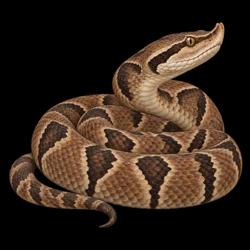
A small, stout pit viper of western Indonesian rainforests, named for its flattened, slightly upturned snout. Unlike the green pit vipers, it is mottled in grey, brown and reddish tones that match bark and dead leaves.
Flat-nosed Pit Viper at a glance
Animal · Southeast Asia · Humid lowland and hill rainforest · Uncommon
Known for: Short, Snout flattened and turned slightly upwards at the, Mottled grey, Heat-sensing pit between eye and nostril
Its Power
Patient Ambush
Choose one perch with care, then hold it until prey arrives.
The flat-nosed pit viper excels at waiting patiently in camouflage until prey comes within striking distance, teaching the value of timing and precision.
“Strike at the right time.”
Capture a Flat-nosed Pit Viper, and it's yours when you finish one step it gives you.
Biological basis
Flat-nosed pit vipers are ambush predators, using their camouflage and heat-sensing pits to detect and strike prey with precision.
Put it into practice
A shopper tracks the price of one sofa for months and buys within the hour it finally drops.
What does the flat-nosed pit viper symbolize?
The flat-nosed pit viper symbolizes patient ambush: choose one perch with care, then hold it until prey arrives. It represents right timing, patient progress and decisive action. Its AnimalDex motto: "Strike at the right time."
The flat-nosed pit viper as a spirit animal
If the flat-nosed pit viper is your spirit animal, the AnimalDex reading is Patient Ambush: the flat-nosed pit viper excels at waiting patiently in camouflage until prey comes within striking distance, teaching the value of timing and precision. It suggests a strength in right timing and patient progress, and a reminder to use it on purpose.
What can the flat-nosed pit viper help you with in life?
The flat-nosed pit viper is a guide for right timing, patient progress and decisive action. Its lesson applies wherever right timing matters: the flat-nosed pit viper excels at waiting patiently in camouflage until prey comes within striking distance, teaching the value of timing and precision.
- Right Timing
- Patient Progress
- Decisive Action
In practice: A shopper tracks the price of one sofa for months and buys within the hour it finally drops.
What can we learn from the Flat-nosed Pit Viper?What does it mean to dream about or encounter a wild flat-nosed pit viper?
A wild flat-nosed pit viper, whether in a dream or in front of you, tends to show up when right timing or patient progress is on your mind. In AnimalDex, the flat-nosed pit viper's principle is Patient Ambush: choose one perch with care, then hold it until prey arrives. Read the moment through its core lesson: The flat-nosed pit viper excels at waiting patiently in camouflage until prey comes within striking distance, teaching the value of timing and precision.
Neither good nor bad on its own. How the flat-nosed pit viper acts matters: at ease, it reflects right timing; hostile, it flags right timing out of balance.
Spotting a flat-nosed pit viper in the wild
Coming across a flat-nosed pit viper in person asks for attention more than interpretation. Watch it for a minute; the flat-nosed pit viper's way of working is Patient Ambush, and the lesson is: the flat-nosed pit viper excels at waiting patiently in camouflage until prey comes within striking distance, teaching the value of timing and precision.
A flat-nosed pit viper that keeps appearing
Repeated sightings of a flat-nosed pit viper usually mean the Patient Ambush lesson is still open: the flat-nosed pit viper excels at waiting patiently in camouflage until prey comes within striking distance, teaching the value of timing and precision.
Dreaming of being chased by a flat-nosed pit viper
Being chased suggests you are avoiding the Patient Ambush the flat-nosed pit viper stands for: the flat-nosed pit viper excels at waiting patiently in camouflage until prey comes within striking distance, teaching the value of timing and precision. Ask what you keep postponing that needs right timing.
Dreaming that a flat-nosed pit viper attacks you
When the flat-nosed pit viper attacks, the dream may be about pressure: patient progress or decisive action applied too hard, by you or by someone close to you.
A calm or friendly flat-nosed pit viper
Meeting a peaceful flat-nosed pit viper is usually encouraging: patient progress and decisive action are within reach.
A dead or injured flat-nosed pit viper
A dead or injured flat-nosed pit viper, dreamed or found, can mark right timing you have let lapse, or a phase built on Patient Ambush coming to an end.
These readings are reflective prompts drawn from how the flat-nosed pit viper really lives, not predictions. If you meet one in the wild, watch from a distance and leave it undisturbed.
Capture your own Flat-nosed Pit Viper
Photograph or film one in the wild, at a zoo or at home with the app. It becomes yours: it remembers you, gives you steps, and can debate your problems with your other animals.
Animal field guide
Flat-nosed Pit Viper
Sign in to hear this read by a natural AI voice instead of your browser's.
A small, stout pit viper of western Indonesian rainforests, named for its flattened, slightly upturned snout. Unlike the green pit vipers, it is mottled in grey, brown and reddish tones that match bark and dead leaves.
Native range
Natural range, not this capture location
Humid lowland and hill rainforest in western Indonesia, including Java and Sumatra, where it keeps to leaf litter, fallen logs and low vegetation, often near streams.
Search near meAnimalDex stats
Size scale
Understand the animal
Understand the Flat-nosed Pit Viper
Factual biology first: what this animal is like, where it lives, how it survives, and why those traits exist.
01
Introduction to Flat-nosed Pit Viper
A small, stout pit viper of western Indonesian rainforests, named for its flattened, slightly upturned snout. Unlike the green pit vipers, it is mottled in grey, brown and reddish tones that match bark and dead leaves.
How to identify a Flat-nosed Pit Viper
- Short, stout body with a broad triangular head
- Snout flattened and turned slightly upwards at the tip
- Mottled grey, brown or reddish colouring
- Heat-sensing pit between eye and nostril
Why Flat-nosed Pit Viper are interesting
- Its species name, puniceus, is Latin for reddish or purple-red, after the rusty tones seen in many individuals.
- Some herpetologists place it in the genus Craspedocephalus, together with the Bornean, Malabar and other related Asian pit vipers.
- It is reported to be mainly active at night, spending the day coiled motionless on the forest floor or a low perch.
- Its venom has barely been studied, and documented bites to people are few, reflecting its secretive habits in dense rainforest.
02
Adaptations and biological abilities
03
Why does Flat-nosed Pit Viper behave this way?
- Short, stout body with a broad triangular head
- Snout flattened and turned slightly upwards at the tip
- Mottled grey, brown or reddish colouring
- Heat-sensing pit between eye and nostril
Thought to be largely nocturnal, hunting after dark. During the day it rests coiled among leaf litter or on a low perch.
04
Why Humid lowland and hill rainforest in western Indonesia?
Habitat: Humid lowland and hill rainforest in western Indonesia, including Java and Sumatra, where it keeps to leaf litter, fallen logs and low vegetation, often near streams.
Native range: Southeast Asia
Native range
Natural range, not this specific capture location.
Humid lowland and hill rainforest in western Indonesia, including Java and Sumatra, where it keeps to leaf litter, fallen logs and low vegetation, often near streams.
05
Why this diet?
06
Activity, rest, and lifespan
07
Flat-nosed Pit Viper reproduction
08
Predators, threats, and defense
09
Conservation and rarity
Rarity: Uncommon · 67/100. AnimalDex canonical rarity score: 67/100, maintained by the live indexed species profile.
- Observe from a respectful distance and avoid changing the animal's behavior.
- Do not block feeding, shelter, nesting, or travel routes.
- Use a live camera capture without handling or staging wildlife.
Talk to it
Talk to the Flat-nosed Pit Viper
It answers as itself: ask about how it lives, or bring it something of yours and hear what it would do, from its own Power.
Anonymous: 6/day. Signed-in: 10/day. Pro: 100/day.
Side by side
The Flat-nosed Pit Viper, side by side
Nothing written side by side for the Flat-nosed Pit Viper yet. Pick any animal to compare it with. Compare with any animal →
Where to find them
Where to find Flat-nosed Pit Viper
To find Flat-nosed Pit Viper in the wild, focus on the exact habitat patches that match its body design and daily behavior, not just the broad country where it exists. You usually do better by working one good piece of habitat inside southeast Asia than by covering too much ground.
- Forest edge, canopy gaps, fruiting trees, or shaded trails where cover and food meet
- Protected habitat blocks within southeast Asia
In the Ark
1 Flat-nosed Pit Viper is aboard right now.
None have come aboard or left since November 17.
The Ark is a live, shared animal world. Animals come aboard when people capture them, and live there by rules based on their field guides.
Scientific name
Trimeresurus puniceus
Category
Animal
Habitat
Humid lowland and hill rainforest in western Indonesia, including Java and Sumatra, where it keeps to leaf litter, fallen logs and low vegetation, often near streams.
Rarity
Uncommon · 67/100
Native range
Southeast Asia
Take the encyclopedia outside
AnimalDex helps you scan real animals, identify species, collect cards, and learn from nature wherever you are.