
Animal field guide
Freshwater Eel
Anguilliformes
Freshwater eels are elongated fishes best known for long migrations between rivers or lakes and ocean spawning grounds.
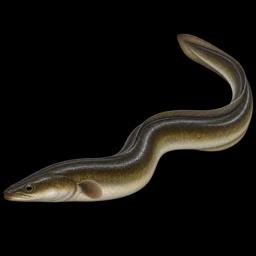
Freshwater Eel at a glance
Fish · North America · Rivers · Relatively common
Known for: Long snake-like body, Continuous dorsal, Small embedded scales, Strong nocturnal movement
Its Power
Long-Range Transition
Prepare for the destination before beginning a demanding transition.
Large transitions become possible when timing, reserves, and direction align.
“Change waters with purpose.”
Capture a Freshwater Eel, and it's yours when you finish one step it gives you.
Biological basis
Freshwater eels undergo dramatic migrations between continental waters and distant ocean spawning areas.
Put it into practice
Before moving to a new school across the country, a family saves, plans the route and learns about the town first.
What does the freshwater eel symbolize?
The freshwater eel symbolizes long-range transition: prepare for the destination before beginning a demanding transition. It represents preparation, purpose and the long journey. Its AnimalDex motto: "Change waters with purpose."
The freshwater eel as a spirit animal
If the freshwater eel is your spirit animal, the AnimalDex reading is Long-Range Transition: large transitions become possible when timing, reserves, and direction align. It suggests a strength in preparation and purpose, and a reminder to use it on purpose.
What can the freshwater eel help you with in life?
The freshwater eel is a guide for preparation, purpose and the long journey. Its lesson applies wherever preparation matters: large transitions become possible when timing, reserves, and direction align.
- Preparation
- Purpose
- The Long Journey
In practice: Before moving to a new school across the country, a family saves, plans the route and learns about the town first.
What can we learn from the Freshwater Eel?What does it mean to dream about or encounter a wild freshwater eel?
Meeting a wild freshwater eel, asleep or awake, is often a nudge toward preparation, the quality the freshwater eel is built around. In AnimalDex, the freshwater eel's principle is Long-Range Transition: prepare for the destination before beginning a demanding transition. Read the moment through its core lesson: Large transitions become possible when timing, reserves, and direction align.
Mostly a prompt rather than a warning. A calm freshwater eel suggests preparation you already have; a threatening one suggests preparation is being tested or pushed too far.
Spotting a freshwater eel in the wild
A real encounter is the plainest version of the sign: notice what the freshwater eel was doing. Prepare for the destination before beginning a demanding transition. That is the preparation worth borrowing today.
A freshwater eel that keeps appearing
A freshwater eel that keeps turning up points to purpose you keep circling back to. The repetition is the message.
Dreaming of being chased by a freshwater eel
If the freshwater eel pursues you, look at where purpose is being asked of you and you are stepping away instead of meeting it.
Dreaming that a freshwater eel attacks you
When the freshwater eel attacks, the dream may be about pressure: purpose or the long journey applied too hard, by you or by someone close to you.
A calm or friendly freshwater eel
Meeting a peaceful freshwater eel is usually encouraging: purpose and the long journey are within reach.
A dead or injured freshwater eel
Seeing the freshwater eel hurt may point to purpose that has been neglected. Ask what it would take to restore it.
These readings are reflective prompts drawn from how the freshwater eel really lives, not predictions. If you meet one in the wild, watch from a distance and leave it undisturbed.
Capture your own Freshwater Eel
Photograph or film one in the wild, at a zoo or at home with the app. It becomes yours: it remembers you, gives you steps, and can debate your problems with your other animals.
Animal field guide
Freshwater Eel
Sign in to hear this read by a natural AI voice instead of your browser's.
Freshwater eels are elongated fishes best known for long migrations between rivers or lakes and ocean spawning grounds.
Native range
Natural range, not this capture location
Rivers, lakes, estuaries, wetlands, and connected coastal waters.
Search near meAnimalDex stats
Size scale
Understand the animal
Understand the Freshwater Eel
Factual biology first: what this animal is like, where it lives, how it survives, and why those traits exist.
01
Introduction to Freshwater Eel
Freshwater eels are elongated fishes best known for long migrations between rivers or lakes and ocean spawning grounds.
How to identify a Freshwater Eel
- Long snake-like body
- Continuous dorsal, tail, and anal fins
- Small embedded scales
- Strong nocturnal movement
Why Freshwater Eel are interesting
- Some species, such as the European eel, can wriggle across damp ground for short distances between waters.
- Their transparent juvenile stage is called a glass eel.
- Many travel thousands of kilometres to spawn at sea, as European and American eels do in the Sargasso Sea.
- Freshwater eels hatch at sea as leaf-shaped larvae called leptocephali, which drift on ocean currents toward coasts.
02
Adaptations and biological abilities
03
Why does Freshwater Eel behave this way?
04
Why Rivers?
Habitat: Rivers, lakes, estuaries, wetlands, and connected coastal waters.
Native range: North America, South America, Europe, North Africa & Middle East, Sub-Saharan Africa, South Asia, Southeast Asia, East Asia, Australia & Oceania
Native range
Natural range, not this specific capture location.
Rivers, lakes, estuaries, wetlands, and connected coastal waters.
05
Why this diet?
Aquatic invertebrates, crustaceans, fishes, and other available animal prey.
06
Activity, rest, and lifespan
Often nocturnal, hiding under banks, rocks, roots, or sediment by day.
Commonly decades; lifespan varies greatly among species.
07
Freshwater Eel reproduction
Females grow large and release vast numbers of eggs during a final ocean migration.
Females commonly grow larger and remain in fresh water longer than males.
08
Predators, threats, and defense
09
Conservation and rarity
Rarity: Relatively common · 15/100. AnimalDex canonical rarity score: 15/100, maintained by the live indexed species profile.
- Observe from a respectful distance and avoid changing the animal's behavior.
- Do not block feeding, shelter, nesting, or travel routes.
- Use a live camera capture without handling or staging wildlife.
Talk to it
Talk to the Freshwater Eel
It answers as itself: ask about how it lives, or bring it something of yours and hear what it would do, from its own Power.
Anonymous: 6/day. Signed-in: 10/day. Pro: 100/day.
Side by side
The Freshwater Eel, side by side
Nothing written side by side for the Freshwater Eel yet. Pick any animal to compare it with. Compare with any animal →
Where to find them
Where to find Freshwater Eel
To find Freshwater Eel in the wild, focus on the exact habitat patches that match its body design and daily behavior, not just the broad country where it exists. You usually do better by working one good piece of habitat inside north America, South America, Europe, North Africa & Middle East, Sub-Saharan Africa, South Asia, Southeast Asia, East Asia, Australia & Oceania than by covering too much ground.
- Quiet marsh edges, reedbeds, river bends, or shallow wetland margins
- Headlands, reef edges, island colonies, tidal channels, or productive coastal water
- Protected habitat blocks within north America, South America, Europe, North Africa & Middle East, Sub-Saharan Africa, South Asia, Southeast Asia, East Asia, Australia & Oceania
Where explorers saw it
- Cinangka, Banten, IndonesiaAug · 1 sighting
In the Ark
No Freshwater Eel is aboard yet.
None have come aboard or left since November 6.
The Ark is a live, shared animal world. Animals come aboard when people capture them, and live there by rules based on their field guides.
Scientific name
Anguilliformes
Category
Fish
Habitat
Rivers, lakes, estuaries, wetlands, and connected coastal waters.
Rarity
Relatively common · 15/100
Native range
North America, South America, Europe, North Africa & Middle East, Sub-Saharan Africa, South Asia, Southeast Asia, East Asia, Australia & Oceania
Take the encyclopedia outside
AnimalDex helps you scan real animals, identify species, collect cards, and learn from nature wherever you are.