
Animal field guide
Hottentot Teal
Spatula hottentota
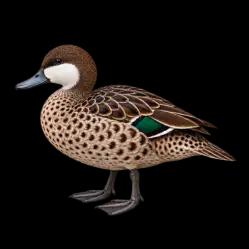
Barely 30 to 35 centimetres long and weighing roughly a quarter of a kilogram, this is one of Africa's smallest ducks. When it flushes from cover it rises on fast, whirring wings that show a glossy green patch edged with white at the rear.
Hottentot Teal at a glance
Animal · Sub-Saharan Africa · Shallow fresh water thick with · Relatively common
Known for: Blue-grey bill, Dark brown cap reaching down to eye level, Pale buff cheeks with a dark smudge over the ear, Buff-brown breast and flanks spotted and barred
Its Power
Ebbing-Marsh Dabbler
Embrace change and adjust your approach fluidly.
The Hottentot Teal adapts to varying water levels and habitats, showcasing the importance of flexibility and resilience in changing environments.
“Sieve the shallow water.”
Capture a Hottentot Teal, and it's yours when you finish one step it gives you.
Biological basis
Hottentot Teals are known for their adaptability to different wetland conditions, including seasonal changes in water availability.
Put it into practice
A farm family tightens the budget in dry years and saves hard in the good ones.
What does the hottentot teal symbolize?
The hottentot teal symbolizes ebbing-marsh dabbler: embrace change and adjust your approach fluidly. It represents adaptability, discernment and resilience. Its AnimalDex motto: "Sieve the shallow water."
The hottentot teal as a spirit animal
If the hottentot teal is your spirit animal, the AnimalDex reading is Ebbing-Marsh Dabbler: the Hottentot Teal adapts to varying water levels and habitats, showcasing the importance of flexibility and resilience in changing environments. It suggests a strength in adaptability and discernment, and a reminder to use it on purpose.
What can the hottentot teal help you with in life?
The hottentot teal is a guide for adaptability, discernment and resilience. Its lesson applies wherever adaptability matters: the Hottentot Teal adapts to varying water levels and habitats, showcasing the importance of flexibility and resilience in changing environments.
- Adaptability
- Discernment
- Resilience
In practice: A farm family tightens the budget in dry years and saves hard in the good ones.
What can we learn from the Hottentot Teal?What does it mean to dream about or encounter a wild hottentot teal?
A wild hottentot teal, whether in a dream or in front of you, tends to show up when adaptability or discernment is on your mind. In AnimalDex, the hottentot teal's principle is Ebbing-Marsh Dabbler: embrace change and adjust your approach fluidly. Read the moment through its core lesson: The Hottentot Teal adapts to varying water levels and habitats, showcasing the importance of flexibility and resilience in changing environments.
Mostly a prompt rather than a warning. A calm hottentot teal suggests adaptability you already have; a threatening one suggests adaptability is being tested or pushed too far.
Spotting a hottentot teal in the wild
If a hottentot teal crosses your path, take it as a cue to look at where adaptability fits your day. Its AnimalDex motto: "Sieve the shallow water."
A hottentot teal that keeps appearing
A hottentot teal that keeps turning up points to discernment you keep circling back to. The repetition is the message.
Dreaming of being chased by a hottentot teal
A chase often means a demand for adaptability is catching up with you. The hottentot teal's lesson, "The Hottentot Teal adapts to varying water levels and habitats, showcasing the importance of flexibility and resilience in changing environments", is the part you may be running from.
Dreaming that a hottentot teal attacks you
An attack points to adaptability turned against you: someone using it on you, or your own adaptability overused until it costs you.
A calm or friendly hottentot teal
Meeting a peaceful hottentot teal is usually encouraging: discernment and resilience are within reach.
A dead or injured hottentot teal
A dead or injured hottentot teal, dreamed or found, can mark adaptability you have let lapse, or a phase built on Ebbing-Marsh Dabbler coming to an end.
These readings are reflective prompts drawn from how the hottentot teal really lives, not predictions. If you meet one in the wild, watch from a distance and leave it undisturbed.
Capture your own Hottentot Teal
Photograph or film one in the wild, at a zoo or at home with the app. It becomes yours: it remembers you, gives you steps, and can debate your problems with your other animals.
Animal field guide
Hottentot Teal
Sign in to hear this read by a natural AI voice instead of your browser's.
Barely 30 to 35 centimetres long and weighing roughly a quarter of a kilogram, this is one of Africa's smallest ducks. When it flushes from cover it rises on fast, whirring wings that show a glossy green patch edged with white at the rear.
Native range
Natural range, not this capture location
Shallow fresh water thick with emergent and floating plants: marshes, reed and papyrus fringes, seasonal pans, floodplain pools and vegetated farm dams, mainly in lowlands and on plateaus. Open, deep water is generally avoided.
Search near meAnimalDex stats
Size scale
Understand the animal
Understand the Hottentot Teal
Factual biology first: what this animal is like, where it lives, how it survives, and why those traits exist.
01
Introduction to Hottentot Teal
Barely 30 to 35 centimetres long and weighing roughly a quarter of a kilogram, this is one of Africa's smallest ducks. When it flushes from cover it rises on fast, whirring wings that show a glossy green patch edged with white at the rear.
How to identify a Hottentot Teal
- Blue-grey bill, broad towards the tip
- Dark brown cap reaching down to eye level
- Pale buff cheeks with a dark smudge over the ear
- Buff-brown breast and flanks spotted and barred darker
Why Hottentot Teal are interesting
- It was long placed in the genus Anas and was moved to Spatula, alongside the shovelers, after DNA studies of dabbling duck relationships.
- Its range includes Madagascar as well as much of eastern and southern Africa.
- Many ornithologists now prefer the name Blue-billed Teal, because the old name comes from an offensive term for the Khoikhoi people.
- The first scientific description is usually credited to Thomas Eyton, in 1838.
02
Adaptations and biological abilities
03
Why does Hottentot Teal behave this way?
- Blue-grey bill, broad towards the tip
- Dark brown cap reaching down to eye level
- Pale buff cheeks with a dark smudge over the ear
- Buff-brown breast and flanks spotted and barred darker
Much of the day is spent loafing quietly in pairs or small groups, resting at the water's edge or afloat in shade. Feeding is reported to peak at dusk, through part of the night and in the early morning.
04
Why Shallow fresh water thick with emergent and floating plants?
Habitat: Shallow fresh water thick with emergent and floating plants: marshes, reed and papyrus fringes, seasonal pans, floodplain pools and vegetated farm dams, mainly in lowlands and on plateaus. Open, deep water is generally avoided.
Native range: Sub-Saharan Africa
Native range
Natural range, not this specific capture location.
Shallow fresh water thick with emergent and floating plants: marshes, reed and papyrus fringes, seasonal pans, floodplain pools and vegetated farm dams, mainly in lowlands and on plateaus. Open, deep water is generally avoided.
05
Why this diet?
Dabbles at the surface and upends in the shallows for seeds of sedges, grasses and water plants, together with aquatic insects and their larvae, small snails and crustaceans.
06
Activity, rest, and lifespan
Much of the day is spent loafing quietly in pairs or small groups, resting at the water's edge or afloat in shade. Feeding is reported to peak at dusk, through part of the night and in the early morning.
A typical wild lifespan for Spatula hottentota remains unpublished; this tiny dabbler nests in dense marsh cover across much of sub-Saharan Africa.
07
Hottentot Teal reproduction
The nest is hidden in dense vegetation over or beside water, often in a sedge or grass tussock. Clutches are usually about 6 to 8 cream eggs, incubated by the female for around 25 days; the ducklings leave the nest soon after hatching and feed themselves.
The sexes look much alike. Males are slightly brighter, with a blacker cap and cleaner cheeks, while females are browner and duller with a fainter face pattern.
08
Predators, threats, and defense
Likely predators include raptors such as marsh harriers, large herons, crocodiles and monitor lizards, while mongooses and snakes can take eggs. Eggs and small ducklings are the most vulnerable stages.
09
Conservation and rarity
Rarity: Relatively common · 47/100. AnimalDex canonical rarity score: 47/100, maintained by the live indexed species profile.
- Observe from a respectful distance and avoid changing the animal's behavior.
- Do not block feeding, shelter, nesting, or travel routes.
- Use a live camera capture without handling or staging wildlife.
Talk to it
Talk to the Hottentot Teal
It answers as itself: ask about how it lives, or bring it something of yours and hear what it would do, from its own Power.
Anonymous: 6/day. Signed-in: 10/day. Pro: 100/day.
Side by side
The Hottentot Teal, side by side
Nothing written side by side for the Hottentot Teal yet. Pick any animal to compare it with. Compare with any animal →
Where to find them
Where to find Hottentot Teal
To find Hottentot Teal in the wild, focus on the exact habitat patches that match its body design and daily behavior, not just the broad country where it exists. You usually do better by working one good piece of habitat inside sub-Saharan Africa than by covering too much ground.
- Quiet marsh edges, reedbeds, river bends, or shallow wetland margins
- Rocky slopes, ridge lines, cliff ledges, or open mountain meadows with a wide view
- Open grassland edges, lightly wooded plains, or raised ground where you can scan long distances
In the Ark
1 Hottentot Teal is aboard right now.
None have come aboard or left since November 17.
The Ark is a live, shared animal world. Animals come aboard when people capture them, and live there by rules based on their field guides.
Scientific name
Spatula hottentota
Category
Animal
Habitat
Shallow fresh water thick with emergent and floating plants: marshes, reed and papyrus fringes, seasonal pans, floodplain pools and vegetated farm dams, mainly in lowlands and on plateaus. Open, deep water is generally avoided.
Rarity
Relatively common · 47/100
Native range
Sub-Saharan Africa
Take the encyclopedia outside
AnimalDex helps you scan real animals, identify species, collect cards, and learn from nature wherever you are.