Animal field guide
Hoverfly
Syrphidae
Holding a fixed point in mid-air, then darting sideways or backwards between flowers, is what gives hoverflies their name. About 6,000 species of these true flies are known. Adults are important pollinators, and the larvae of many species eat aphids.
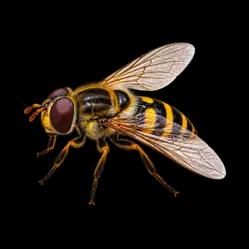
Hoverfly at a glance
Animal · Australia & Oceania · Anywhere with flowers · One pair of wings · Relatively common
Known for: Hovers motionless, One pair of wings, Large eyes covering most of the head, Short
Its Power
Stingless Warning
Wear a warning you never had to earn.
Clever imitation and quiet work can support entire ecosystems.
“Look dangerous, do good.”
Capture a Hoverfly, and it's yours when you finish one step it gives you.
Biological basis
Hoverflies carry no sting at all, but their black-and-yellow banding copies wasps and bees closely enough that predators leave them alone, which frees them to feed in the open as major pollinators and to lay larvae that strip aphids from plants.
Put it into practice
A shopkeeper hangs a guard dog sign, owns no dog, and serves customers in peace with the door open.
What does the hoverfly symbolize?
The hoverfly symbolizes stingless warning: wear a warning you never had to earn. It represents strategic bluffing, contribution and humility. Its AnimalDex motto: "Look dangerous, do good."
The hoverfly as a spirit animal
If the hoverfly is your spirit animal, the AnimalDex reading is Stingless Warning: clever imitation and quiet work can support entire ecosystems. It suggests a strength in strategic bluffing and contribution, and a reminder to use it on purpose.
What can the hoverfly help you with in life?
The hoverfly is a guide for strategic bluffing, contribution and humility. Its lesson applies wherever strategic bluffing matters: clever imitation and quiet work can support entire ecosystems.
- Strategic Bluffing
- Contribution
- Humility
In practice: A shopkeeper hangs a guard dog sign, owns no dog, and serves customers in peace with the door open.
What can we learn from the Hoverfly?What does it mean to dream about or encounter a wild hoverfly?
A wild hoverfly, whether in a dream or in front of you, tends to show up when strategic bluffing or contribution is on your mind. In AnimalDex, the hoverfly's principle is Stingless Warning: wear a warning you never had to earn. Read the moment through its core lesson: Clever imitation and quiet work can support entire ecosystems.
It depends on how the hoverfly behaved. Calm or close by, it reads as contribution within reach; aggressive or fleeing, it points to strategic bluffing you are resisting.
Spotting a hoverfly in the wild
A real encounter is the plainest version of the sign: notice what the hoverfly was doing. Wear a warning you never had to earn. That is the strategic bluffing worth borrowing today.
A hoverfly that keeps appearing
A hoverfly that keeps turning up points to contribution you keep circling back to. The repetition is the message.
Dreaming of being chased by a hoverfly
If the hoverfly pursues you, look at where contribution is being asked of you and you are stepping away instead of meeting it.
Dreaming that a hoverfly attacks you
An aggressive hoverfly can mirror a conflict where strategic bluffing has become a weapon rather than a strength.
A calm or friendly hoverfly
A relaxed hoverfly near you, in a dream or in person, reads as readiness: Stingless Warning is available to you now, as its motto puts it, "Look dangerous, do good.".
A dead or injured hoverfly
A dead or injured hoverfly, dreamed or found, can mark strategic bluffing you have let lapse, or a phase built on Stingless Warning coming to an end.
These readings are reflective prompts drawn from how the hoverfly really lives, not predictions. If you meet one in the wild, watch from a distance and leave it undisturbed.
Capture your own Hoverfly
Photograph or film one in the wild, at a zoo or at home with the app. It becomes yours: it remembers you, gives you steps, and can debate your problems with your other animals.
Animal field guide
Hoverfly
Sign in to hear this read by a natural AI voice instead of your browser's.
Holding a fixed point in mid-air, then darting sideways or backwards between flowers, is what gives hoverflies their name. Adults are important pollinators, and the larvae of many species eat aphids.
Native range
Natural range, not this capture location
Anywhere with flowers: gardens, meadows, hedgerows, woodland rides and clearings, wetlands, farmland and mountain pastures. Larvae live on aphid-infested plants, in rotting wood, stagnant water, dung or the nests of ants, bees and wasps, depending on species.
Search near meAnimalDex stats
Dominance
9
Speed
28
Size
4
Intelligence
10
Rarity
7%
Total
58
Size scale
Understand the animal
Understand the Hoverfly
Factual biology first: what this animal is like, where it lives, how it survives, and why those traits exist.
01
Introduction to Hoverfly
Holding a fixed point in mid-air, then darting sideways or backwards between flowers, is what gives hoverflies their name. About 6,000 species of these true flies are known. Adults are important pollinators, and the larvae of many species eat aphids.
How to identify a Hoverfly
- Hovers motionless, then darts sideways
- One pair of wings, not two
- Large eyes covering most of the head
- Short, stubby antennae
- Black and yellow bands in many species
Why Hoverfly are interesting
- A false vein, a thickening that runs along the wing without joining other veins, is found in almost all hoverflies and in few other flies.
- Radar studies estimated that up to four billion hoverflies migrate in and out of southern Britain each year.
- A single aphid-eating larva can consume several hundred aphids before it pupates.
- Drone fly larvae, called rat-tailed maggots, breathe through a telescopic tube while living in stagnant, oxygen-poor water.
- Species of the genus Volucella lay their eggs in the nests of bumblebees and social wasps, where the larvae scavenge debris or eat the brood.
02
Adaptations and biological abilities
03
Why does Hoverfly behave this way?
- Hovers motionless, then darts sideways
- One pair of wings, not two
- Large eyes covering most of the head
- Short, stubby antennae
- Black and yellow bands in many species
Active by day, mainly in sunshine and warm, calm air. At night and in cold or wet weather adults rest on vegetation, often under leaves or on flower heads.
04
Why Anywhere with flowers?
Habitat: Anywhere with flowers: gardens, meadows, hedgerows, woodland rides and clearings, wetlands, farmland and mountain pastures. Larvae live on aphid-infested plants, in rotting wood, stagnant water, dung or the nests of ants, bees and wasps, depending on species.
Native range: Australia & Oceania, Central Asia, East Asia, Europe, North Africa & Middle East, North America, South America, South Asia, Southeast Asia, Sub-Saharan Africa
Native range
Natural range, not this specific capture location.
Anywhere with flowers: gardens, meadows, hedgerows, woodland rides and clearings, wetlands, farmland and mountain pastures. Larvae live on aphid-infested plants, in rotting wood, stagnant water, dung or the nests of ants, bees and wasps, depending on species.
05
Why this diet?
Adults drink nectar and eat pollen from open, shallow flowers; females need pollen protein to mature their eggs. Larvae differ by species: many hunt aphids, others filter bacteria from stagnant water, feed in decaying wood or bore into plant bulbs.
06
Activity, rest, and lifespan
Active by day, mainly in sunshine and warm, calm air. At night and in cold or wet weather adults rest on vegetation, often under leaves or on flower heads.
Adults typically live from a few days to a few weeks. Females of some species, such as the marmalade hoverfly, overwinter as adults and survive for several months.
07
Hoverfly reproduction
Females of aphid-eating species lay single white eggs beside aphid colonies, often several hundred in a lifetime. The legless larva feeds for one to three weeks and then pupates, and several generations a year are common. Other species lay in wet, decaying matter.
In most species the male's eyes meet on top of the head, while the female's are separated by a gap. Females usually have a more pointed abdomen; colour patterns are otherwise similar.
08
Predators, threats, and defense
Crab spiders waiting on flowers, birds, dragonflies, robber flies and social wasps catch adults, and parasitic wasps attack the larvae. Wasp-like or bee-like colours make many birds hesitate, and adults escape by fast, agile flight.
09
Conservation and rarity
Rarity: Relatively common · 7/100. AnimalDex canonical rarity score: 7/100, maintained by the live indexed species profile.
- Observe from a respectful distance and avoid changing the animal's behavior.
- Do not block feeding, shelter, nesting, or travel routes.
- Use a live camera capture without handling or staging wildlife.
Talk to it
Talk to the Hoverfly
It answers as itself: ask about how it lives, or bring it something of yours and hear what it would do, from its own Power.
Anonymous: 3/day. Signed-in: 10/day. Pro: 100/day.
Side by side
The Hoverfly, side by side
Nothing written side by side for the Hoverfly yet. Pick any animal to compare it with. Compare with any animal →
Where to find them
Where to find Hoverfly
To find Hoverfly in the wild, focus on the exact habitat patches that match its body design and daily behavior, not just the broad country where it exists. You usually do better by working one good piece of habitat inside australia & Oceania, Central Asia, East Asia, Europe, North Africa & Middle East, North America, South America, South Asia, Southeast Asia, Sub-Saharan Africa than by covering too much ground.
- Quiet marsh edges, reedbeds, river bends, or shallow wetland margins
- Forest edge, canopy gaps, fruiting trees, or shaded trails where cover and food meet
- Rocky slopes, ridge lines, cliff ledges, or open mountain meadows with a wide view
Where explorers saw it
- Riverside, Washington County, United StatesAug · 1 sighting
Scientific name
Syrphidae
Category
Animal
Habitat
Anywhere with flowers: gardens, meadows, hedgerows, woodland rides and clearings, wetlands, farmland and mountain pastures. Larvae live on aphid-infested plants, in rotting wood, stagnant water, dung or the nests of ants, bees and wasps, depending on species.
Rarity
Relatively common · 7/100
Native range
Australia & Oceania, Central Asia, East Asia, Europe, North Africa & Middle East, North America, South America, South Asia, Southeast Asia, Sub-Saharan Africa
Take the encyclopedia outside
AnimalDex helps you scan real animals, identify species, collect cards, and learn from nature wherever you are.