
Animal field guide
Masked Lovebird
Agapornis personata
A small, stocky parrot with a sooty black head, a broad ring of bare white skin around each eye and a bright red bill. A yellow collar and breast separate the dark mask from the green body. It lives naturally only in the dry interior of Tanzania, where noisy flocks feed on seeds and drink every day.
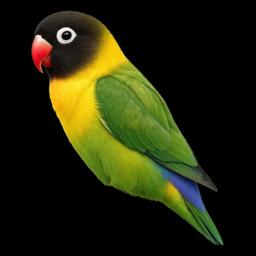
Masked Lovebird at a glance
Animal · Sub-Saharan Africa · Dry acacia and baobab savanna and · Relatively common
Known for: Sooty black to dark brown head forming a mask, Broad ring of bare white skin around each eye, Bright red bill, Yellow collar and upper breast
Its Power
Nest Weaving
Build connections with care and creativity.
The Masked Lovebird constructs its nest using a variety of materials, showcasing creativity and adaptability in building a secure home.
“Weave Your World.”
Capture a Masked Lovebird, and it's yours when you finish one step it gives you.
Biological basis
Masked lovebirds cut strips of bark and grass stems, carry them in the bill one load at a time and pack them into a tree hole or crevice, building a domed nest chamber reached through a short tunnel.
Put it into practice
Emma carefully organizes her workspace, using colorful folders and unique storage solutions to create an inspiring and efficient environment.
What does the masked lovebird symbolize?
The masked lovebird symbolizes nest weaving: build connections with care and creativity. It represents craftsmanship, creativity and partnership. Its AnimalDex motto: "Weave Your World."
The masked lovebird as a spirit animal
If the masked lovebird is your spirit animal, the AnimalDex reading is Nest Weaving: the Masked Lovebird constructs its nest using a variety of materials, showcasing creativity and adaptability in building a secure home. It suggests a strength in craftsmanship and creativity, and a reminder to use it on purpose.
What can the masked lovebird help you with in life?
The masked lovebird is a guide for craftsmanship, creativity and partnership. Its lesson applies wherever craftsmanship matters: the Masked Lovebird constructs its nest using a variety of materials, showcasing creativity and adaptability in building a secure home.
- Craftsmanship
- Creativity
- Partnership
In practice: Emma carefully organizes her workspace, using colorful folders and unique storage solutions to create an inspiring and efficient environment.
What can we learn from the Masked Lovebird?What does it mean to dream about or encounter a wild masked lovebird?
Meeting a wild masked lovebird, asleep or awake, is often a nudge toward craftsmanship, the quality the masked lovebird is built around. In AnimalDex, the masked lovebird's principle is Nest Weaving: build connections with care and creativity. Read the moment through its core lesson: The Masked Lovebird constructs its nest using a variety of materials, showcasing creativity and adaptability in building a secure home.
Neither good nor bad on its own. How the masked lovebird acts matters: at ease, it reflects craftsmanship; hostile, it flags craftsmanship out of balance.
Spotting a masked lovebird in the wild
If a masked lovebird crosses your path, take it as a cue to look at where craftsmanship fits your day. Its AnimalDex motto: "Weave Your World."
A masked lovebird that keeps appearing
Repeated sightings of a masked lovebird usually mean the Nest Weaving lesson is still open: the Masked Lovebird constructs its nest using a variety of materials, showcasing creativity and adaptability in building a secure home.
Dreaming of being chased by a masked lovebird
If the masked lovebird pursues you, look at where creativity is being asked of you and you are stepping away instead of meeting it.
Dreaming that a masked lovebird attacks you
An aggressive masked lovebird can mirror a conflict where craftsmanship has become a weapon rather than a strength.
A calm or friendly masked lovebird
Meeting a peaceful masked lovebird is usually encouraging: creativity and partnership are within reach.
A dead or injured masked lovebird
An injured masked lovebird often reflects craftsmanship under strain; rest and repair come before pushing again.
These readings are reflective prompts drawn from how the masked lovebird really lives, not predictions. If you meet one in the wild, watch from a distance and leave it undisturbed.
Capture your own Masked Lovebird
Photograph or film one in the wild, at a zoo or at home with the app. It becomes yours: it remembers you, gives you steps, and can debate your problems with your other animals.
Animal field guide
Masked Lovebird
Sign in to hear this read by a natural AI voice instead of your browser's.
A small, stocky parrot with a sooty black head, a broad ring of bare white skin around each eye and a bright red bill. It lives naturally only in the dry interior of Tanzania, where noisy flocks feed on seeds and drink every day.
Native range
Natural range, not this capture location
Dry acacia and baobab savanna and open woodland with scattered trees in north-eastern and central Tanzania, mostly at about 1,100 to 1,800 metres, always within reach of permanent water.
Search near meAnimalDex stats
Size scale
Understand the animal
Understand the Masked Lovebird
Factual biology first: what this animal is like, where it lives, how it survives, and why those traits exist.
01
Introduction to Masked Lovebird
A small, stocky parrot with a sooty black head, a broad ring of bare white skin around each eye and a bright red bill. A yellow collar and breast separate the dark mask from the green body. It lives naturally only in the dry interior of Tanzania, where noisy flocks feed on seeds and drink every day.
How to identify a Masked Lovebird
- Sooty black to dark brown head forming a mask
- Broad ring of bare white skin around each eye
- Bright red bill
- Yellow collar and upper breast
- Green body with a short, rounded tail
Why Masked Lovebird are interesting
- It belongs to the group of lovebirds with a bare white eye-ring, together with Fischer's, Lilian's and black-cheeked lovebirds.
- Escaped cage birds have founded feral colonies in Kenya, including around Nairobi and Lake Naivasha, where some interbreed with Fischer's lovebirds.
- Pairs stay together for long periods and preen each other, behaviour that gave lovebirds their common name.
- It is listed as Least Concern, although large numbers were once trapped in Tanzania for the cage-bird trade.
02
Adaptations and biological abilities
03
Why does Masked Lovebird behave this way?
- Sooty black to dark brown head forming a mask
- Broad ring of bare white skin around each eye
- Bright red bill
- Yellow collar and upper breast
- Green body with a short, rounded tail
Active by day, feeding and drinking most in the morning and late afternoon. At night birds roost in pairs or small groups inside nest chambers or tree holes.
04
Why Dry acacia and baobab savanna and open woodland with scattered trees in north-eastern and central Tanzania?
Habitat: Dry acacia and baobab savanna and open woodland with scattered trees in north-eastern and central Tanzania, mostly at about 1,100 to 1,800 metres, always within reach of permanent water.
Native range: Sub-Saharan Africa
Native range
Natural range, not this specific capture location.
Dry acacia and baobab savanna and open woodland with scattered trees in north-eastern and central Tanzania, mostly at about 1,100 to 1,800 metres, always within reach of permanent water.
05
Why this diet?
Mainly grass seeds and other small seeds, taken from seedheads or picked up from the ground, with some berries, buds and fruit. Flocks raid ripening millet and sorghum in places.
06
Activity, rest, and lifespan
Active by day, feeding and drinking most in the morning and late afternoon. At night birds roost in pairs or small groups inside nest chambers or tree holes.
Wild lifespan is poorly known; captive birds commonly live 10 to 15 years and occasionally longer.
07
Masked Lovebird reproduction
Usually four or five white eggs, sometimes more, are incubated by the female for about three weeks. Both parents feed the chicks, which leave the nest at about six weeks old.
Males and females look alike, and the sexes cannot be told apart reliably in the field.
08
Predators, threats, and defense
09
Conservation and rarity
Rarity: Relatively common · 15/100. AnimalDex canonical rarity score: 15/100, maintained by the live indexed species profile.
- Observe from a respectful distance and avoid changing the animal's behavior.
- Do not block feeding, shelter, nesting, or travel routes.
- Use a live camera capture without handling or staging wildlife.
Talk to it
Talk to the Masked Lovebird
It answers as itself: ask about how it lives, or bring it something of yours and hear what it would do, from its own Power.
Anonymous: 6/day. Signed-in: 10/day. Pro: 100/day.
Side by side
The Masked Lovebird, side by side
Nothing written side by side for the Masked Lovebird yet. Pick any animal to compare it with. Compare with any animal →
Where to find them
Where to find Masked Lovebird
To find Masked Lovebird in the wild, focus on the exact habitat patches that match its body design and daily behavior, not just the broad country where it exists. You usually do better by working one good piece of habitat inside sub-Saharan Africa than by covering too much ground.
- Forest edge, canopy gaps, fruiting trees, or shaded trails where cover and food meet
- Protected habitat blocks within sub-Saharan Africa
In the Ark
1 Masked Lovebird is aboard right now.
None have come aboard or left since November 17.
The Ark is a live, shared animal world. Animals come aboard when people capture them, and live there by rules based on their field guides.
Scientific name
Agapornis personata
Category
Animal
Habitat
Dry acacia and baobab savanna and open woodland with scattered trees in north-eastern and central Tanzania, mostly at about 1,100 to 1,800 metres, always within reach of permanent water.
Rarity
Relatively common · 15/100
Native range
Sub-Saharan Africa
Take the encyclopedia outside
AnimalDex helps you scan real animals, identify species, collect cards, and learn from nature wherever you are.