
Animal field guide
Multicolored Asian Lady Beetle
Harmonia axyridis
The Multicolored Asian lady beetle teaches Polka-Dot Defense through color, warning, and chemical backup. Its red, orange, yellow, and spotted forms make it easy to notice, while its foul yellow defensive fluid makes predators remember that this tiny beetle is not an easy snack. Its lesson is that being visible works best when the signal has real protection behind it.
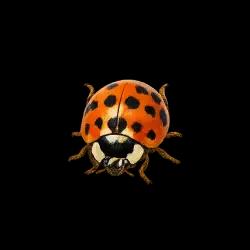
Multicolored Asian Lady Beetle at a glance
Invertebrate · Central Asia · In its native range · Relatively common
Known for: Large for a ladybird, Highly variable: orange to red with none to about, Whitish plate behind the head with a black M- or, Small ridge across the rear of the wing cases
Its Power
Polka-Dot Defense
Use your unique traits to protect and thrive.
The Multicolored Asian lady beetle uses its ability to emit a foul-tasting fluid as a defense, allowing it to thrive in various environments and outcompete others.
“Defend with Distinction.”
Capture a Multicolored Asian Lady Beetle, and it's yours when you finish one step it gives you.
Biological basis
This beetle can release a yellow fluid from its legs that deters predators with its unpleasant taste, providing a strong defense mechanism.
Put it into practice
Make your boundaries clear early, and back them with real consequences so others know not to push carelessly.
What does the multicolored Asian lady beetle symbolize?
The multicolored Asian lady beetle symbolizes polka-dot defense: use your unique traits to protect and thrive. It represents self-defense, boundaries and early warning. Its AnimalDex motto: "Defend with Distinction."
The multicolored Asian lady beetle as a spirit animal
If the multicolored Asian lady beetle is your spirit animal, the AnimalDex reading is Polka-Dot Defense: the Multicolored Asian lady beetle uses its ability to emit a foul-tasting fluid as a defense, allowing it to thrive in various environments and outcompete others. It suggests a strength in self-defense and boundaries, and a reminder to use it on purpose.
What can the multicolored Asian lady beetle help you with in life?
The multicolored Asian lady beetle is a guide for self-defense, boundaries and early warning. Its lesson applies wherever self-defense matters: the Multicolored Asian lady beetle uses its ability to emit a foul-tasting fluid as a defense, allowing it to thrive in various environments and outcompete others.
- Self-Defense
- Boundaries
- Early Warning
In practice: Make your boundaries clear early, and back them with real consequences so others know not to push carelessly.
What can we learn from the Multicolored Asian Lady Beetle?What does it mean to dream about or encounter a wild multicolored Asian lady beetle?
Meeting a wild multicolored Asian lady beetle, asleep or awake, is often a nudge toward self-defense, the quality the multicolored Asian lady beetle is built around. In AnimalDex, the multicolored Asian lady beetle's principle is Polka-Dot Defense: use your unique traits to protect and thrive. Read the moment through its core lesson: The Multicolored Asian lady beetle uses its ability to emit a foul-tasting fluid as a defense, allowing it to thrive in various environments and outcompete others.
Mostly a prompt rather than a warning. A calm multicolored Asian lady beetle suggests self-defense you already have; a threatening one suggests self-defense is being tested or pushed too far.
Spotting a multicolored Asian lady beetle in the wild
If a multicolored Asian lady beetle crosses your path, take it as a cue to look at where self-defense fits your day. Its AnimalDex motto: "Defend with Distinction."
A multicolored Asian lady beetle that keeps appearing
Seeing the multicolored Asian lady beetle again and again, in dreams or outside, suggests self-defense is a theme you have not settled yet.
Dreaming of being chased by a multicolored Asian lady beetle
A chase often means a demand for self-defense is catching up with you. The multicolored Asian lady beetle's lesson, "The Multicolored Asian lady beetle uses its ability to emit a foul-tasting fluid as a defense, allowing it to thrive in various environments and outcompete others", is the part you may be running from.
Dreaming that a multicolored Asian lady beetle attacks you
An aggressive multicolored Asian lady beetle can mirror a conflict where self-defense has become a weapon rather than a strength.
A calm or friendly multicolored Asian lady beetle
A relaxed multicolored Asian lady beetle near you, in a dream or in person, reads as readiness: Polka-Dot Defense is available to you now, as its motto puts it, "Defend with Distinction.".
A dead or injured multicolored Asian lady beetle
Seeing the multicolored Asian lady beetle hurt may point to boundaries that has been neglected. Ask what it would take to restore it.
These readings are reflective prompts drawn from how the multicolored Asian lady beetle really lives, not predictions. If you meet one in the wild, watch from a distance and leave it undisturbed.
Capture your own Multicolored Asian Lady Beetle
Photograph or film one in the wild, at a zoo or at home with the app. It becomes yours: it remembers you, gives you steps, and can debate your problems with your other animals.
Animal field guide
Multicolored Asian Lady Beetle
Sign in to hear this read by a natural AI voice instead of your browser's.
The Multicolored Asian lady beetle teaches Polka-Dot Defense through color, warning, and chemical backup. Its lesson is that being visible works best when the signal has real protection behind it.
Native range
Natural range, not this capture location
In its native range, from southern Siberia and central Asia to China, Korea and Japan, it lives on trees, shrubs and crops wherever aphids are plentiful: woodland edges, orchards, fields, parks and gardens.
Search near meAnimalDex stats
Size scale
Understand the animal
Understand the Multicolored Asian Lady Beetle
Factual biology first: what this animal is like, where it lives, how it survives, and why those traits exist.
01
Introduction to Multicolored Asian Lady Beetle
The Multicolored Asian lady beetle teaches Polka-Dot Defense through color, warning, and chemical backup. Its red, orange, yellow, and spotted forms make it easy to notice, while its foul yellow defensive fluid makes predators remember that this tiny beetle is not an easy snack. Its lesson is that being visible works best when the signal has real protection behind it.
How to identify a Multicolored Asian Lady Beetle
- Large for a ladybird, about 5 to 8 millimetres long
- Highly variable: orange to red with none to about 20 black spots, or black with two or four red spots
- Whitish plate behind the head with a black M- or W-shaped mark
- Small ridge across the rear of the wing cases
- Spiny black larva with orange patches along the sides
Why Multicolored Asian Lady Beetle are interesting
- Released in North America and Europe to control aphids, it has since spread across much of the world as an invasive species.
- In autumn adults gather in large numbers on pale, sunlit walls, then overwinter in cracks, roof spaces and houses.
- Beetles crushed with harvested grapes can taint wine with a bitter, peanut-like flavour from their defensive chemicals.
- Adults can live for a year or more, surviving the winter in a dormant state before breeding in spring.
02
Adaptations and biological abilities
03
Why does Multicolored Asian Lady Beetle behave this way?
- Large for a ladybird, about 5 to 8 millimetres long
- Highly variable: orange to red with none to about 20 black spots, or black with two or four red spots
- Whitish plate behind the head with a black M- or W-shaped mark
- Small ridge across the rear of the wing cases
- Spiny black larva with orange patches along the sides
Active by day in warm weather. In autumn adults gather in large groups on pale, sunlit surfaces, then overwinter in crevices, rock outcrops and buildings, staying dormant until spring.
04
Why In its native range?
Habitat: In its native range, from southern Siberia and central Asia to China, Korea and Japan, it lives on trees, shrubs and crops wherever aphids are plentiful: woodland edges, orchards, fields, parks and gardens.
Native range: Central Asia, East Asia
Native range
Natural range, not this specific capture location.
In its native range, from southern Siberia and central Asia to China, Korea and Japan, it lives on trees, shrubs and crops wherever aphids are plentiful: woodland edges, orchards, fields, parks and gardens.
05
Why this diet?
Adults and larvae hunt aphids and scale insects on trees, crops and weeds, and also eat the eggs and larvae of other ladybirds. In autumn adults feed on ripe and damaged fruit, pollen and nectar.
06
Activity, rest, and lifespan
Active by day in warm weather. In autumn adults gather in large groups on pale, sunlit surfaces, then overwinter in crevices, rock outcrops and buildings, staying dormant until spring.
Adults commonly live several months to a year, and overwintered adults can survive into a second season. Development from egg to adult takes about three to four weeks in warm conditions.
07
Multicolored Asian Lady Beetle reproduction
Females lay clusters of about 20 to 30 yellow eggs on leaves near aphid colonies and can produce over a thousand eggs in a lifetime. Larvae pass through four stages before pupating on a leaf; several generations can follow each year.
The sexes look alike in colour and spotting. Males are slightly smaller on average, and differ in the shape of the last underside segment, visible only with a lens.
08
Predators, threats, and defense
Few birds eat it, because it releases bitter, foul-smelling yellow fluid from its leg joints. Spiders and some insects take it, and the parasitic wasp Dinocampus coccinellae lays eggs inside adults.
09
Conservation and rarity
Rarity: Relatively common · 6/100. AnimalDex canonical rarity score: 6/100, maintained by the live indexed species profile.
- Observe from a respectful distance and avoid changing the animal's behavior.
- Do not block feeding, shelter, nesting, or travel routes.
- Use a live camera capture without handling or staging wildlife.
Talk to it
Talk to the Multicolored Asian Lady Beetle
It answers as itself: ask about how it lives, or bring it something of yours and hear what it would do, from its own Power.
Anonymous: 6/day. Signed-in: 10/day. Pro: 100/day.
Side by side
The Multicolored Asian Lady Beetle, side by side
Nothing written side by side for the Multicolored Asian Lady Beetle yet. Pick any animal to compare it with. Compare with any animal →
Where to find them
Where to find Multicolored Asian Lady Beetle
To find Multicolored Asian Lady Beetle in the wild, focus on the exact habitat patches that match its body design and daily behavior, not just the broad country where it exists. You usually do better by working one good piece of habitat inside central Asia, East Asia than by covering too much ground.
- Forest edge, canopy gaps, fruiting trees, or shaded trails where cover and food meet
- Protected habitat blocks within central Asia, East Asia
In the Ark
2 Multicolored Asian Lady Beetles are aboard right now.
Since November 17: 2 died of old age.
The Ark is a live, shared animal world. Animals come aboard when people capture them, and live there by rules based on their field guides.
Scientific name
Harmonia axyridis
Category
Invertebrate
Habitat
In its native range, from southern Siberia and central Asia to China, Korea and Japan, it lives on trees, shrubs and crops wherever aphids are plentiful: woodland edges, orchards, fields, parks and gardens.
Rarity
Relatively common · 6/100
Native range
Central Asia, East Asia
Take the encyclopedia outside
AnimalDex helps you scan real animals, identify species, collect cards, and learn from nature wherever you are.