
Animal field guide
Northern Pike
Esox lucius
Northern Pike is an ambush line made of muscle, waiting among weed and cover until patience becomes acceleration.
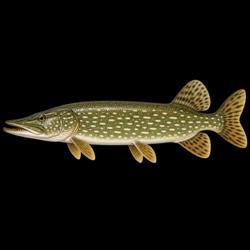
Northern Pike at a glance
Animal · Europe · Clear · Relatively common
Known for: Long, Dorsal and anal fins set far back near the tail, Green body with rows of pale bean-shaped spots, Usually five sensory pores under each side of the
Its Power
Ambush Line
Hold still until the right opening moves within reach.
Power grows when patience and sudden movement share the same body.
“Straighten the bend, strike.”
Capture a Northern Pike, and it's yours when you finish one step it gives you.
Biological basis
Northern Pike are long freshwater predators that wait among weeds, then launch fast ambush strikes at fish, frogs, and other prey.
Put it into practice
Wait without wasting energy, then move fast when the opportunity enters your strike zone.
What does the northern pike symbolize?
The northern pike symbolizes ambush line: hold still until the right opening moves within reach. It represents readiness, stillness and speed. Its AnimalDex motto: "Straighten the bend, strike."
The northern pike as a spirit animal
If the northern pike is your spirit animal, the AnimalDex reading is Ambush Line: power grows when patience and sudden movement share the same body. It suggests a strength in readiness and stillness, and a reminder to use it on purpose.
What can the northern pike help you with in life?
The northern pike is a guide for readiness, stillness and speed. Its lesson applies wherever readiness matters: power grows when patience and sudden movement share the same body.
- Readiness
- Stillness
- Speed
In practice: Wait without wasting energy, then move fast when the opportunity enters your strike zone.
What can we learn from the Northern Pike?What does it mean to dream about or encounter a wild northern pike?
A wild northern pike, whether in a dream or in front of you, tends to show up when readiness or stillness is on your mind. In AnimalDex, the northern pike's principle is Ambush Line: hold still until the right opening moves within reach. Read the moment through its core lesson: Power grows when patience and sudden movement share the same body.
Neither good nor bad on its own. How the northern pike acts matters: at ease, it reflects readiness; hostile, it flags readiness out of balance.
Spotting a northern pike in the wild
If a northern pike crosses your path, take it as a cue to look at where readiness fits your day. Its AnimalDex motto: "Straighten the bend, strike."
A northern pike that keeps appearing
Seeing the northern pike again and again, in dreams or outside, suggests readiness is a theme you have not settled yet.
Dreaming of being chased by a northern pike
A chase often means a demand for readiness is catching up with you. The northern pike's lesson, "Power grows when patience and sudden movement share the same body", is the part you may be running from.
Dreaming that a northern pike attacks you
An aggressive northern pike can mirror a conflict where readiness has become a weapon rather than a strength.
A calm or friendly northern pike
A relaxed northern pike near you, in a dream or in person, reads as readiness: Ambush Line is available to you now, as its motto puts it, "Straighten the bend, strike.".
A dead or injured northern pike
Seeing the northern pike hurt may point to stillness that has been neglected. Ask what it would take to restore it.
These readings are reflective prompts drawn from how the northern pike really lives, not predictions. If you meet one in the wild, watch from a distance and leave it undisturbed.
Capture your own Northern Pike
Photograph or film one in the wild, at a zoo or at home with the app. It becomes yours: it remembers you, gives you steps, and can debate your problems with your other animals.
Animal field guide
Northern Pike
Sign in to hear this read by a natural AI voice instead of your browser's.
Northern Pike is an ambush line made of muscle, waiting among weed and cover until patience becomes acceleration.
Native range
Natural range, not this capture location
Clear, weedy lakes, slow rivers, backwaters, marshes and reservoirs across northern Europe, Asia and North America, as well as brackish coastal bays of the Baltic. Small pike stay in shallow margins, while large fish move deeper in summer.
Search near meAnimalDex stats
Size scale
Understand the animal
Understand the Northern Pike
Factual biology first: what this animal is like, where it lives, how it survives, and why those traits exist.
01
Introduction to Northern Pike
Northern Pike is an ambush line made of muscle, waiting among weed and cover until patience becomes acceleration.
How to identify a Northern Pike
- Long, flattened, duck-bill snout
- Dorsal and anal fins set far back near the tail
- Green body with rows of pale bean-shaped spots
- Usually five sensory pores under each side of the lower jaw
- Fully scaled cheek; gill cover scaled only on its upper half
Why Northern Pike are interesting
- Fry start eating other fish when only a few centimetres long, and cannibalism is a major cause of death among young pike.
- A hybrid with the muskellunge, called the tiger muskie, occurs naturally and is also stocked in North America.
- Its lateral line senses water movement, letting it strike prey even in murky water.
- Pike can swallow prey up to about half their own length.
- Introduced pike in parts of south-central Alaska have sharply reduced native salmon and trout.
02
Adaptations and biological abilities
03
Why does Northern Pike behave this way?
- Long, flattened, duck-bill snout
- Dorsal and anal fins set far back near the tail
- Green body with rows of pale bean-shaped spots
- Usually five sensory pores under each side of the lower jaw
- Fully scaled cheek; gill cover scaled only on its upper half
Hunts mainly in daylight and twilight, relying heavily on sight. At night it usually rests motionless near the bottom or among weed.
04
Why Clear?
Habitat: Clear, weedy lakes, slow rivers, backwaters, marshes and reservoirs across northern Europe, Asia and North America, as well as brackish coastal bays of the Baltic. Small pike stay in shallow margins, while large fish move deeper in summer.
Native range: Europe, North America, Central Asia
Native range
Natural range, not this specific capture location.
Clear, weedy lakes, slow rivers, backwaters, marshes and reservoirs across northern Europe, Asia and North America, as well as brackish coastal bays of the Baltic. Small pike stay in shallow margins, while large fish move deeper in summer.
05
Why this diet?
Mostly fish, including perch, roach, whitefish and smaller pike, plus frogs, crayfish, ducklings and small mammals swimming at the surface. Prey is usually seized crosswise in the teeth, then turned and swallowed head first.
06
Activity, rest, and lifespan
Hunts mainly in daylight and twilight, relying heavily on sight. At night it usually rests motionless near the bottom or among weed.
Often 7 to 15 years; females live longer than males, and fish over 20 years old have been aged in cold northern waters.
07
Northern Pike reproduction
Spawning follows ice-out in early spring on flooded meadows and weedy shallows. A female scatters tens of thousands to a few hundred thousand sticky eggs, depending on her size, attended by one or more smaller males, with no care. Eggs hatch in about two weeks, and larvae hang from plants by an adhesive gland.
The sexes share the same colours. Females grow faster and larger, and the biggest pike are almost always female.
08
Predators, threats, and defense
09
Conservation and rarity
Rarity: Relatively common · 20/100. AnimalDex canonical rarity score: 20/100, maintained by the live indexed species profile.
- Observe from a respectful distance and avoid changing the animal's behavior.
- Do not block feeding, shelter, nesting, or travel routes.
- Use a live camera capture without handling or staging wildlife.
Talk to it
Talk to the Northern Pike
It answers as itself: ask about how it lives, or bring it something of yours and hear what it would do, from its own Power.
Anonymous: 6/day. Signed-in: 10/day. Pro: 100/day.
Side by side
The Northern Pike, side by side
Nothing written side by side for the Northern Pike yet. Pick any animal to compare it with. Compare with any animal →
Where to find them
Where to find Northern Pike
To find Northern Pike in the wild, focus on the exact habitat patches that match its body design and daily behavior, not just the broad country where it exists. You usually do better by working one good piece of habitat inside europe, North America, Central Asia than by covering too much ground.
- Quiet marsh edges, reedbeds, river bends, or shallow wetland margins
- Headlands, reef edges, island colonies, tidal channels, or productive coastal water
- Protected habitat blocks within europe, North America, Central Asia
Where explorers saw it
- 3Nov · 1 sighting
In the Ark
1 Northern Pike is aboard right now.
Since November 17: 1 eaten.
The Ark is a live, shared animal world. Animals come aboard when people capture them, and live there by rules based on their field guides.
Scientific name
Esox lucius
Category
Animal
Habitat
Clear, weedy lakes, slow rivers, backwaters, marshes and reservoirs across northern Europe, Asia and North America, as well as brackish coastal bays of the Baltic. Small pike stay in shallow margins, while large fish move deeper in summer.
Rarity
Relatively common · 20/100
Native range
Europe, North America, Central Asia
Take the encyclopedia outside
AnimalDex helps you scan real animals, identify species, collect cards, and learn from nature wherever you are.