
Animal field guide
Northern Stargazer
Astroscopus guttatus
Northern Stargazers bury themselves in sandy bottoms and ambush from below. Their upward-facing eyes, sudden strike, venomous spines, and electric abilities make the seafloor itself part of the trap.
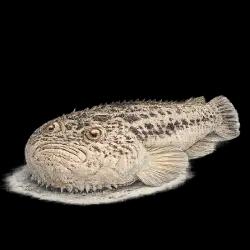
Northern Stargazer at a glance
Fish · North Atlantic · Sandy and muddy bottoms in coastal · Uncommon
Known for: Dark brown body scattered with small white spots, Massive, Mouth opening almost vertically on top of the head, Large fan-shaped pectoral fins
Its Power
Buried Spark
Hide under the sand until the opening comes close enough.
Hidden danger is strongest when patience removes wasted movement.
“Wait below.”
Capture a Northern Stargazer, and it's yours when you finish one step it gives you.
Biological basis
Stargazer fish bury themselves in sand with upward-facing eyes and mouth, ambushing prey from below; some species also have venomous spines or electric organs.
Put it into practice
You stop chasing every chance and prepare for the one that comes within reach.
What does the northern stargazer symbolize?
The northern stargazer symbolizes buried spark: hide under the sand until the opening comes close enough. It represents patient progress, stillness and efficiency. Its AnimalDex motto: "Wait below."
The northern stargazer as a spirit animal
If the northern stargazer is your spirit animal, the AnimalDex reading is Buried Spark: hidden danger is strongest when patience removes wasted movement. It suggests a strength in patient progress and stillness, and a reminder to use it on purpose.
What can the northern stargazer help you with in life?
The northern stargazer is a guide for patient progress, stillness and efficiency. Its lesson applies wherever patient progress matters: hidden danger is strongest when patience removes wasted movement.
- Patient Progress
- Stillness
- Efficiency
In practice: You stop chasing every chance and prepare for the one that comes within reach.
What can we learn from the Northern Stargazer?What does it mean to dream about or encounter a wild northern stargazer?
Meeting a wild northern stargazer, asleep or awake, is often a nudge toward patient progress, the quality the northern stargazer is built around. In AnimalDex, the northern stargazer's principle is Buried Spark: hide under the sand until the opening comes close enough. Read the moment through its core lesson: Hidden danger is strongest when patience removes wasted movement.
It depends on how the northern stargazer behaved. Calm or close by, it reads as stillness within reach; aggressive or fleeing, it points to patient progress you are resisting.
Spotting a northern stargazer in the wild
Coming across a northern stargazer in person asks for attention more than interpretation. Watch it for a minute; the northern stargazer's way of working is Buried Spark, and the lesson is: hidden danger is strongest when patience removes wasted movement.
A northern stargazer that keeps appearing
Repeated sightings of a northern stargazer usually mean the Buried Spark lesson is still open: hidden danger is strongest when patience removes wasted movement.
Dreaming of being chased by a northern stargazer
If the northern stargazer pursues you, look at where stillness is being asked of you and you are stepping away instead of meeting it.
Dreaming that a northern stargazer attacks you
An attack points to patient progress turned against you: someone using it on you, or your own patient progress overused until it costs you.
A calm or friendly northern stargazer
A calm northern stargazer suggests you have made peace with patient progress and can use it without force.
A dead or injured northern stargazer
An injured northern stargazer often reflects patient progress under strain; rest and repair come before pushing again.
These readings are reflective prompts drawn from how the northern stargazer really lives, not predictions. If you meet one in the wild, watch from a distance and leave it undisturbed.
Capture your own Northern Stargazer
Photograph or film one in the wild, at a zoo or at home with the app. It becomes yours: it remembers you, gives you steps, and can debate your problems with your other animals.
Animal field guide
Northern Stargazer
Sign in to hear this read by a natural AI voice instead of your browser's.
Northern Stargazers bury themselves in sandy bottoms and ambush from below. Their upward-facing eyes, sudden strike, venomous spines, and electric abilities make the seafloor itself part of the trap.
Native range
Natural range, not this capture location
Sandy and muddy bottoms in coastal waters of the western North Atlantic, roughly from New York to North Carolina, from the shallows and estuary mouths to depths of several tens of metres.
Search near meAnimalDex stats
Size scale
Understand the animal
Understand the Northern Stargazer
Factual biology first: what this animal is like, where it lives, how it survives, and why those traits exist.
01
Introduction to Northern Stargazer
Northern Stargazers bury themselves in sandy bottoms and ambush from below. Their upward-facing eyes, sudden strike, venomous spines, and electric abilities make the seafloor itself part of the trap.
How to identify a Northern Stargazer
- Dark brown body scattered with small white spots
- Massive, broad, flat-topped head
- Mouth opening almost vertically on top of the head
- Large fan-shaped pectoral fins
- Grows to about 55 centimetres
Why Northern Stargazer are interesting
- Its electric organ lies behind the eyes and is made of modified eye muscle tissue.
- Discharges of around 50 volts have been reported, enough to give a person a sharp shock.
- It digs in backwards by wriggling and shovelling sand with its pectoral fins, disappearing within seconds.
- Fringes on the lips are thought to help keep sand out of the mouth while it breathes buried.
02
Adaptations and biological abilities
03
Why does Northern Stargazer behave this way?
- Dark brown body scattered with small white spots
- Massive, broad, flat-topped head
- Mouth opening almost vertically on top of the head
- Large fan-shaped pectoral fins
- Grows to about 55 centimetres
It seems to feed at any hour when prey comes within reach, and no clear daily rhythm of activity and rest has been recorded.
04
Why Sandy and muddy bottoms in coastal waters of the western North Atlantic?
Habitat: Sandy and muddy bottoms in coastal waters of the western North Atlantic, roughly from New York to North Carolina, from the shallows and estuary mouths to depths of several tens of metres.
Native range: North Atlantic
Native range
Natural range, not this specific capture location.
Some regional overlays are unavailable in this web build.
Sandy and muddy bottoms in coastal waters of the western North Atlantic, roughly from New York to North Carolina, from the shallows and estuary mouths to depths of several tens of metres.
05
Why this diet?
06
Activity, rest, and lifespan
It seems to feed at any hour when prey comes within reach, and no clear daily rhythm of activity and rest has been recorded.
Lifespan is unknown; reliable ages for wild fish have not been reported.
07
Northern Stargazer reproduction
Spawning takes place in spring and summer. The eggs float, the larvae drift near the surface, and the young settle to the bottom at a small size and begin to bury themselves.
The sexes look alike, and any difference in size has not been well documented.
08
Predators, threats, and defense
09
Conservation and rarity
Rarity: Uncommon · 55/100. AnimalDex canonical rarity score: 55/100, maintained by the live indexed species profile.
- Observe from a respectful distance and avoid changing the animal's behavior.
- Do not block feeding, shelter, nesting, or travel routes.
- Use a live camera capture without handling or staging wildlife.
Talk to it
Talk to the Northern Stargazer
It answers as itself: ask about how it lives, or bring it something of yours and hear what it would do, from its own Power.
Anonymous: 6/day. Signed-in: 10/day. Pro: 100/day.
Side by side
The Northern Stargazer, side by side
Nothing written side by side for the Northern Stargazer yet. Pick any animal to compare it with. Compare with any animal →
Where to find them
Where to find Northern Stargazer
To find Northern Stargazer in the wild, focus on the exact habitat patches that match its body design and daily behavior, not just the broad country where it exists. You usually do better by working one good piece of habitat inside north Atlantic than by covering too much ground.
- Quiet marsh edges, reedbeds, river bends, or shallow wetland margins
- Headlands, reef edges, island colonies, tidal channels, or productive coastal water
- Protected habitat blocks within north Atlantic
In the Ark
No Northern Stargazer is aboard yet.
None have come aboard or left since November 17.
The Ark is a live, shared animal world. Animals come aboard when people capture them, and live there by rules based on their field guides.
Scientific name
Astroscopus guttatus
Category
Fish
Habitat
Sandy and muddy bottoms in coastal waters of the western North Atlantic, roughly from New York to North Carolina, from the shallows and estuary mouths to depths of several tens of metres.
Rarity
Uncommon · 55/100
Native range
North Atlantic
Take the encyclopedia outside
AnimalDex helps you scan real animals, identify species, collect cards, and learn from nature wherever you are.