Animal field guide
Nutmeg Mannikin
Lonchura punctulata
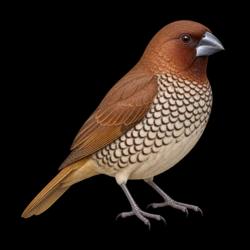
Dark scalloping on the white feathers of its breast and belly gives this small munia its other name, the Scaly-breasted Munia. Its thick, conical bill cracks the husk from each grass seed before the kernel is swallowed.
Nutmeg Mannikin at a glance
Animal · South Asia · Open grassy country · Relatively common
Known for: White belly and breast scaled with dark brown, Chocolate-brown face and throat, Short, Brown back and short tail
Its Power
Seed Gathering
Flock Seed Harvesting
Return to the places that reliably feed you, and gather well together while the harvest is good.
“Harvest while it's ripe.”
Capture a Nutmeg Mannikin, and it's yours when you finish one step it gives you.
Biological basis
Nutmeg Mannikins feed in tight flocks on grass seeds and grain, returning day after day to ripening patches rather than hoarding seeds in caches.
Put it into practice
You and two friends study together at the same library table every week, because that is where the work gets done.
What does the nutmeg mannikin symbolize?
The nutmeg mannikin symbolizes seed gathering: flock Seed Harvesting. It represents saving for later, preparation and healthy routine. Its AnimalDex motto: "Harvest while it's ripe."
The nutmeg mannikin as a spirit animal
If the nutmeg mannikin is your spirit animal, the AnimalDex reading is Seed Gathering: return to the places that reliably feed you, and gather well together while the harvest is good. It suggests a strength in saving for later and preparation, and a reminder to use it on purpose.
What can the nutmeg mannikin help you with in life?
The nutmeg mannikin is a guide for saving for later, preparation and healthy routine. Its lesson applies wherever saving for later matters: return to the places that reliably feed you, and gather well together while the harvest is good.
- Saving for Later
- Preparation
- Healthy Routine
In practice: You and two friends study together at the same library table every week, because that is where the work gets done.
What can we learn from the Nutmeg Mannikin?What does it mean to dream about or encounter a wild nutmeg mannikin?
A wild nutmeg mannikin, whether in a dream or in front of you, tends to show up when saving for later or preparation is on your mind. In AnimalDex, the nutmeg mannikin's principle is Seed Gathering: flock Seed Harvesting. Read the moment through its core lesson: Return to the places that reliably feed you, and gather well together while the harvest is good.
It depends on how the nutmeg mannikin behaved. Calm or close by, it reads as preparation within reach; aggressive or fleeing, it points to saving for later you are resisting.
Spotting a nutmeg mannikin in the wild
If a nutmeg mannikin crosses your path, take it as a cue to look at where saving for later fits your day. Its AnimalDex motto: "Harvest while it's ripe."
A nutmeg mannikin that keeps appearing
Repeated sightings of a nutmeg mannikin usually mean the Seed Gathering lesson is still open: return to the places that reliably feed you, and gather well together while the harvest is good.
Dreaming of being chased by a nutmeg mannikin
If the nutmeg mannikin pursues you, look at where preparation is being asked of you and you are stepping away instead of meeting it.
Dreaming that a nutmeg mannikin attacks you
An aggressive nutmeg mannikin can mirror a conflict where saving for later has become a weapon rather than a strength.
A calm or friendly nutmeg mannikin
Meeting a peaceful nutmeg mannikin is usually encouraging: preparation and healthy routine are within reach.
A dead or injured nutmeg mannikin
An injured nutmeg mannikin often reflects saving for later under strain; rest and repair come before pushing again.
These readings are reflective prompts drawn from how the nutmeg mannikin really lives, not predictions. If you meet one in the wild, watch from a distance and leave it undisturbed.
Capture your own Nutmeg Mannikin
Photograph or film one in the wild, at a zoo or at home with the app. It becomes yours: it remembers you, gives you steps, and can debate your problems with your other animals.
Animal field guide
Nutmeg Mannikin
Sign in to hear this read by a natural AI voice instead of your browser's.
Dark scalloping on the white feathers of its breast and belly gives this small munia its other name, the Scaly-breasted Munia. Its thick, conical bill cracks the husk from each grass seed before the kernel is swallowed.
Native range
Natural range, not this capture location
Open grassy country: rice paddies, farmland, scrub, grassy clearings, road verges and gardens, from lowlands into hills across South Asia, southern China and South-east Asia.
Search near meAnimalDex stats
Size scale
Understand the animal
Understand the Nutmeg Mannikin
Factual biology first: what this animal is like, where it lives, how it survives, and why those traits exist.
01
Introduction to Nutmeg Mannikin
Dark scalloping on the white feathers of its breast and belly gives this small munia its other name, the Scaly-breasted Munia. Its thick, conical bill cracks the husk from each grass seed before the kernel is swallowed.
How to identify a Nutmeg Mannikin
- White belly and breast scaled with dark brown
- Chocolate-brown face and throat
- Short, thick dark grey bill
- Brown back and short tail
- Small, compact body with short rounded wings
Why Nutmeg Mannikin are interesting
- Escaped and released cage birds have founded wild populations in places such as Hawaii, Australia, Puerto Rico and Florida.
- It often joins mixed flocks with other munia species where their ranges overlap.
- In much of South Asia it breeds during and after the monsoon, when grasses are setting seed.
- Its song is a very quiet series of high notes and whistles, barely audible beyond a few metres.
02
Adaptations and biological abilities
03
Why does Nutmeg Mannikin behave this way?
- White belly and breast scaled with dark brown
- Chocolate-brown face and throat
- Short, thick dark grey bill
- Brown back and short tail
- Small, compact body with short rounded wings
Active by day. Flocks roost together at night in dense bushes, reeds or bamboo, and birds sometimes sleep inside old or purpose-built nests.
04
Why Open grassy country?
Habitat: Open grassy country: rice paddies, farmland, scrub, grassy clearings, road verges and gardens, from lowlands into hills across South Asia, southern China and South-east Asia.
Native range: South Asia, Southeast Asia, East Asia
Native range
Natural range, not this specific capture location.
Open grassy country: rice paddies, farmland, scrub, grassy clearings, road verges and gardens, from lowlands into hills across South Asia, southern China and South-east Asia.
05
Why this diet?
Mainly grass seeds, including rice, taken directly from seed heads or picked from the ground. Small insects are eaten occasionally.
06
Activity, rest, and lifespan
Active by day. Flocks roost together at night in dense bushes, reeds or bamboo, and birds sometimes sleep inside old or purpose-built nests.
Wild lifespan is poorly documented; captive birds commonly live about 5 to 8 years.
07
Nutmeg Mannikin reproduction
Both sexes build a domed grass nest with a side entrance, in a tree, shrub or palm. Clutches are usually 4 to 6 white eggs, incubated by both parents for about two weeks.
Males and females look alike. Young birds are plain buff-brown below and lack the scaly pattern.
08
Predators, threats, and defense
09
Conservation and rarity
Rarity: Relatively common · 11/100. AnimalDex canonical rarity score: 11/100, maintained by the live indexed species profile.
- Observe from a respectful distance and avoid changing the animal's behavior.
- Do not block feeding, shelter, nesting, or travel routes.
- Use a live camera capture without handling or staging wildlife.
Talk to it
Talk to the Nutmeg Mannikin
It answers as itself: ask about how it lives, or bring it something of yours and hear what it would do, from its own Power.
Anonymous: 6/day. Signed-in: 10/day. Pro: 100/day.
Side by side
The Nutmeg Mannikin, side by side
Nothing written side by side for the Nutmeg Mannikin yet. Pick any animal to compare it with. Compare with any animal →
Where to find them
Where to find Nutmeg Mannikin
To find Nutmeg Mannikin in the wild, focus on the exact habitat patches that match its body design and daily behavior, not just the broad country where it exists. You usually do better by working one good piece of habitat inside south Asia, Southeast Asia, East Asia than by covering too much ground.
- Open grassy country: rice paddies, farmland, scrub
- Protected habitat blocks within south Asia, Southeast Asia, East Asia
Scientific name
Lonchura punctulata
Category
Animal
Habitat
Open grassy country: rice paddies, farmland, scrub, grassy clearings, road verges and gardens, from lowlands into hills across South Asia, southern China and South-east Asia.
Rarity
Relatively common · 11/100
Native range
South Asia, Southeast Asia, East Asia
Take the encyclopedia outside
AnimalDex helps you scan real animals, identify species, collect cards, and learn from nature wherever you are.