
Animal field guide
Paper Nautilus
Argonauta argo
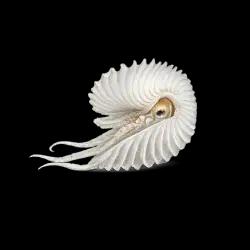
Not a nautilus at all but an open-ocean octopus. The female secretes a paper-thin, ribbed case from two broadened arms and cradles her eggs and herself inside it; unlike a true shell, it has no chambers and is not attached to her body.
Paper Nautilus at a glance
Animal · North Atlantic · Paper Nautilus belongs in warm open · Rare
Known for: White case flattened side to side with fine, Narrow keel fringed with two rows of small knobs, Knobs near the tight inner coil tipped dark brown, Largest cases reaching about 25 to 30 centimetres
Its Power
Paper Shell Mothering
Carry a delicate chamber across open water.
Care can be light, mobile, and built for a temporary future.
“Carry the cradle.”
Capture a Paper Nautilus, and it's yours when you finish one step it gives you.
Biological basis
Paper Nautiluses are pelagic octopuses; females make thin eggcases often called paper shells to hold eggs while drifting.
Put it into practice
You create a light structure that protects the project only as long as it needs protecting.
What does the paper nautilus symbolize?
The paper nautilus symbolizes paper shell mothering: carry a delicate chamber across open water. It represents nurturing, family care and gentleness. Its AnimalDex motto: "Carry the cradle."
The paper nautilus as a spirit animal
If the paper nautilus is your spirit animal, the AnimalDex reading is Paper Shell Mothering: care can be light, mobile, and built for a temporary future. It suggests a strength in nurturing and family care, and a reminder to use it on purpose.
What can the paper nautilus help you with in life?
The paper nautilus is a guide for nurturing, family care and gentleness. Its lesson applies wherever nurturing matters: care can be light, mobile, and built for a temporary future.
- Nurturing
- Family Care
- Gentleness
In practice: You create a light structure that protects the project only as long as it needs protecting.
What can we learn from the Paper Nautilus?What does it mean to dream about or encounter a wild paper nautilus?
Dreaming about a wild paper nautilus, or coming across one, usually points to nurturing and family care: the qualities the paper nautilus lives by. In AnimalDex, the paper nautilus's principle is Paper Shell Mothering: carry a delicate chamber across open water. Read the moment through its core lesson: Care can be light, mobile, and built for a temporary future.
It depends on how the paper nautilus behaved. Calm or close by, it reads as family care within reach; aggressive or fleeing, it points to nurturing you are resisting.
Spotting a paper nautilus in the wild
A real encounter is the plainest version of the sign: notice what the paper nautilus was doing. Carry a delicate chamber across open water. That is the nurturing worth borrowing today.
A paper nautilus that keeps appearing
Repeated sightings of a paper nautilus usually mean the Paper Shell Mothering lesson is still open: care can be light, mobile, and built for a temporary future.
Dreaming of being chased by a paper nautilus
Being chased suggests you are avoiding the Paper Shell Mothering the paper nautilus stands for: care can be light, mobile, and built for a temporary future. Ask what you keep postponing that needs nurturing.
Dreaming that a paper nautilus attacks you
When the paper nautilus attacks, the dream may be about pressure: family care or gentleness applied too hard, by you or by someone close to you.
A calm or friendly paper nautilus
A relaxed paper nautilus near you, in a dream or in person, reads as readiness: Paper Shell Mothering is available to you now, as its motto puts it, "Carry the cradle.".
A dead or injured paper nautilus
An injured paper nautilus often reflects nurturing under strain; rest and repair come before pushing again.
These readings are reflective prompts drawn from how the paper nautilus really lives, not predictions. If you meet one in the wild, watch from a distance and leave it undisturbed.
Capture your own Paper Nautilus
Photograph or film one in the wild, at a zoo or at home with the app. It becomes yours: it remembers you, gives you steps, and can debate your problems with your other animals.
Animal field guide
Paper Nautilus
Sign in to hear this read by a natural AI voice instead of your browser's.
Not a nautilus at all but an open-ocean octopus. The female secretes a paper-thin, ribbed case from two broadened arms and cradles her eggs and herself inside it; unlike a true shell, it has no chambers and is not attached to her body.
Native range
Natural range, not this capture location
Paper Nautilus belongs in warm open ocean, surface drift zones, pelagic currents, and floating prey fields.
Search near meAnimalDex stats
Size scale
Understand the animal
Understand the Paper Nautilus
Factual biology first: what this animal is like, where it lives, how it survives, and why those traits exist.
01
Introduction to Paper Nautilus
Not a nautilus at all but an open-ocean octopus. The female secretes a paper-thin, ribbed case from two broadened arms and cradles her eggs and herself inside it; unlike a true shell, it has no chambers and is not attached to her body.
How to identify a Paper Nautilus
- White case flattened side to side with fine radiating ribs
- Narrow keel fringed with two rows of small knobs
- Knobs near the tight inner coil tipped dark brown
- Largest cases reaching about 25 to 30 centimetres across
Why Paper Nautilus are interesting
- Males are dwarfs only a centimetre or two long and never make a case; females grow many times larger.
- The male's mating arm breaks off inside the female, and early naturalists mistook these detached arms for parasitic worms.
- Females trap a pocket of air at the top of the case, which lets them float at a chosen depth without effort.
- Paper nautiluses have been found clinging to jellyfish and salps, possibly using them as rafts, shelter or food.
02
Adaptations and biological abilities
03
Why does Paper Nautilus behave this way?
- White case flattened side to side with fine radiating ribs
- Narrow keel fringed with two rows of small knobs
- Knobs near the tight inner coil tipped dark brown
- Largest cases reaching about 25 to 30 centimetres across
Paper Nautilus rests in open water and the female eggcase rather than a permanent home. When and for how long it rests has not been documented.
04
Why Paper Nautilus belongs in warm open ocean?
Habitat: Paper Nautilus belongs in warm open ocean, surface drift zones, pelagic currents, and floating prey fields.
Native range: North Atlantic, South Atlantic, North Pacific, South Pacific, Indian Ocean
Native range
Natural range, not this specific capture location.
Some regional overlays are unavailable in this web build.
Paper Nautilus belongs in warm open ocean, surface drift zones, pelagic currents, and floating prey fields.
05
Why this diet?
Paper Nautilus feeds on small crustaceans, jelly animals, fish larvae, and drifting prey caught with arms.
06
Activity, rest, and lifespan
07
Paper Nautilus reproduction
Eggs are laid in several batches over time, so one case can hold eggs at different stages of development. The tiny hatchlings drift in the plankton.
Extreme. Females are many times larger than males, which reach only a couple of centimetres and never make a case.
08
Predators, threats, and defense
09
Conservation and rarity
Rarity: Rare · 70/100. AnimalDex canonical rarity score: 70/100, maintained by the live indexed species profile.
- Observe from a respectful distance and avoid changing the animal's behavior.
- Do not block feeding, shelter, nesting, or travel routes.
- Use a live camera capture without handling or staging wildlife.
Talk to it
Talk to the Paper Nautilus
It answers as itself: ask about how it lives, or bring it something of yours and hear what it would do, from its own Power.
Anonymous: 6/day. Signed-in: 10/day. Pro: 100/day.
Side by side
The Paper Nautilus, side by side
Nothing written side by side for the Paper Nautilus yet. Pick any animal to compare it with. Compare with any animal →
Where to find them
Where to find Paper Nautilus
To find Paper Nautilus in the wild, focus on the exact habitat patches that match its body design and daily behavior, not just the broad country where it exists. You usually do better by working one good piece of habitat inside north Atlantic, South Atlantic, North Pacific, South Pacific, Indian Ocean than by covering too much ground.
- Headlands, reef edges, island colonies, tidal channels, or productive coastal water
- Protected habitat blocks within north Atlantic, South Atlantic, North Pacific, South Pacific, Indian Ocean
In the Ark
No Paper Nautilus is aboard yet.
None have come aboard or left since November 17.
The Ark is a live, shared animal world. Animals come aboard when people capture them, and live there by rules based on their field guides.
Scientific name
Argonauta argo
Category
Animal
Habitat
Paper Nautilus belongs in warm open ocean, surface drift zones, pelagic currents, and floating prey fields.
Rarity
Rare · 70/100
Native range
North Atlantic, South Atlantic, North Pacific, South Pacific, Indian Ocean
Take the encyclopedia outside
AnimalDex helps you scan real animals, identify species, collect cards, and learn from nature wherever you are.