
Animal field guide
Southern Platyfish
Xiphophorus maculatus
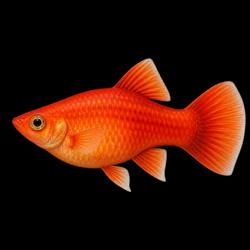
A small livebearer from warm lowland waters of southern Mexico and northern Central America, and one of the most widely kept aquarium fishes. Wild fish are olive-grey with scattered dark spots, but the species carries many natural pigment genes, which breeders have used to produce red, gold, blue, black and patterned forms.

Southern Platyfish at a glance
Animal · Domesticated worldwide · In the wild · Relatively common
Known for: Short, Rounded or squared tail fin with no long extension, Adults about 3 to 6 centimetres long, Often a dark tail-base marking
From AnimalDex stories
Southern Platyfish in motion
Scenes from Southern Platyfish story videos made in the AnimalDex app: the animal's Trial, and moments from its story.

Its Power
Small Harmony
Keep peace in the shared water.
A calm social rhythm can make a small environment work better.
“Share the water.”
Capture a Southern Platyfish, and it's yours when you finish one step it gives you.
Biological basis
Platies are small livebearing aquarium fish often kept in community tanks and known for hardy, social behavior.
Put it into practice
A strange mix of skills becomes a career when the pieces support each other.
What does the southern platyfish symbolize?
The southern platyfish symbolizes small harmony: keep peace in the shared water. It represents conflict prevention, community and composure. Its AnimalDex motto: "Share the water."
The southern platyfish as a spirit animal
If the southern platyfish is your spirit animal, the AnimalDex reading is Small Harmony: a calm social rhythm can make a small environment work better. It suggests a strength in conflict prevention and community, and a reminder to use it on purpose.
What can the southern platyfish help you with in life?
The southern platyfish is a guide for conflict prevention, community and composure. Its lesson applies wherever conflict prevention matters: a calm social rhythm can make a small environment work better.
- Conflict Prevention
- Community
- Composure
In practice: A strange mix of skills becomes a career when the pieces support each other.
What can we learn from the Southern Platyfish?What does it mean to dream about or encounter a wild southern platyfish?
Dreaming about a wild southern platyfish, or coming across one, usually points to conflict prevention and community: the qualities the southern platyfish lives by. In AnimalDex, the southern platyfish's principle is Small Harmony: keep peace in the shared water. Read the moment through its core lesson: A calm social rhythm can make a small environment work better.
Mostly a prompt rather than a warning. A calm southern platyfish suggests conflict prevention you already have; a threatening one suggests conflict prevention is being tested or pushed too far.
Spotting a southern platyfish in the wild
A real encounter is the plainest version of the sign: notice what the southern platyfish was doing. Keep peace in the shared water. That is the conflict prevention worth borrowing today.
A southern platyfish that keeps appearing
Repeated sightings of a southern platyfish usually mean the Small Harmony lesson is still open: a calm social rhythm can make a small environment work better.
Dreaming of being chased by a southern platyfish
If the southern platyfish pursues you, look at where community is being asked of you and you are stepping away instead of meeting it.
Dreaming that a southern platyfish attacks you
An aggressive southern platyfish can mirror a conflict where conflict prevention has become a weapon rather than a strength.
A calm or friendly southern platyfish
A calm southern platyfish suggests you have made peace with conflict prevention and can use it without force.
A dead or injured southern platyfish
A dead or injured southern platyfish, dreamed or found, can mark conflict prevention you have let lapse, or a phase built on Small Harmony coming to an end.
These readings are reflective prompts drawn from how the southern platyfish really lives, not predictions. If you meet one in the wild, watch from a distance and leave it undisturbed.
Capture your own Southern Platyfish
Photograph or film one in the wild, at a zoo or at home with the app. It becomes yours: it remembers you, gives you steps, and can debate your problems with your other animals.
Animal field guide
Southern Platyfish
Sign in to hear this read by a natural AI voice instead of your browser's.
A small livebearer from warm lowland waters of southern Mexico and northern Central America, and one of the most widely kept aquarium fishes. Wild fish are olive-grey with scattered dark spots, but the species carries many natural pigment genes, which breeders have used to produce red, gold, blue, black and patterned forms.
Native range
Natural range, not this capture location
In the wild, warm, still or slow-moving fresh water with dense vegetation and soft bottoms: ditches, swamps, canals, springs and quiet stream margins on the Atlantic slope from Veracruz in Mexico to northern Belize. It is also kept in heated aquariums worldwide.
Search near meAnimalDex stats
Size scale
Understand the animal
Understand the Southern Platyfish
Factual biology first: what this animal is like, where it lives, how it survives, and why those traits exist.
01
Introduction to Southern Platyfish
A small livebearer from warm lowland waters of southern Mexico and northern Central America, and one of the most widely kept aquarium fishes. Wild fish are olive-grey with scattered dark spots, but the species carries many natural pigment genes, which breeders have used to produce red, gold, blue, black and patterned forms.
How to identify a Southern Platyfish
- Short, deep, side-flattened body
- Rounded or squared tail fin with no long extension
- Adults about 3 to 6 centimetres long, females larger
- Often a dark tail-base marking, its shape varying between individuals
Why Southern Platyfish are interesting
- Hybrids between platies and swordtails can develop melanoma from pigment cells, and such crosses have been studied as a cancer model since the late 1920s.
- The species has three kinds of sex chromosome, W, X and Y, so sex is set by more than one chromosome combination across populations.
- Many aquarium platies carry genes from crosses with the variable platy and swordtails, so pet-shop fish are often not pure southern platyfish.
- A gene region called the P locus largely sets when males mature, so some males mature early at a small size and others late and large.
02
Adaptations and biological abilities
03
Why does Southern Platyfish behave this way?
- Short, deep, side-flattened body
- Rounded or squared tail fin with no long extension
- Adults about 3 to 6 centimetres long, females larger
- Often a dark tail-base marking, its shape varying between individuals
Active by day. At night it settles low in the water or among plants and moves very little, and its colours often look paler until light returns.
04
Why In the wild?
Habitat: In the wild, warm, still or slow-moving fresh water with dense vegetation and soft bottoms: ditches, swamps, canals, springs and quiet stream margins on the Atlantic slope from Veracruz in Mexico to northern Belize. It is also kept in heated aquariums worldwide.
Native range: Domesticated worldwide
Native range
Natural range, not this specific capture location.
Some regional overlays are unavailable in this web build.
In the wild, warm, still or slow-moving fresh water with dense vegetation and soft bottoms: ditches, swamps, canals, springs and quiet stream margins on the Atlantic slope from Veracruz in Mexico to northern Belize. It is also kept in heated aquariums worldwide.
05
Why this diet?
An omnivorous grazer that picks algae and soft plant material from surfaces and takes small insect larvae, worms and crustaceans. In the wild, plant matter and algae usually make up a large share of what it eats.
06
Activity, rest, and lifespan
Active by day. At night it settles low in the water or among plants and moves very little, and its colours often look paler until light returns.
About 2 to 3 years in aquariums, occasionally longer; lifespan in the wild has not been documented in detail.
07
Southern Platyfish reproduction
Fertilisation is internal. After roughly four weeks' gestation, depending on temperature, a female gives birth to about 20 to 80 free-swimming young, and stored sperm lets her produce further broods without mating again. There is no parental care.
Males are smaller and have a gonopodium, an anal fin reshaped into a narrow, rod-like mating organ. Females are larger and deeper-bodied, with a fan-shaped anal fin.
08
Predators, threats, and defense
Larger fish, herons, kingfishers and predatory aquatic insects take wild platies, and adults of many fishes, their own species included, eat newborn fry. Platies escape by darting into dense plants, where the fry also hide.
09
Conservation and rarity
Rarity: Relatively common · 9/100. AnimalDex canonical rarity score: 9/100, maintained by the live indexed species profile.
- Observe from a respectful distance and avoid changing the animal's behavior.
- Do not block feeding, shelter, nesting, or travel routes.
- Use a live camera capture without handling or staging wildlife.
Talk to it
Talk to the Southern Platyfish
It answers as itself: ask about how it lives, or bring it something of yours and hear what it would do, from its own Power.
Anonymous: 6/day. Signed-in: 10/day. Pro: 100/day.
Side by side
The Southern Platyfish, side by side
Nothing written side by side for the Southern Platyfish yet. Pick any animal to compare it with. Compare with any animal →
Where to find them
Where to find Southern Platyfish
To find Southern Platyfish in the wild, focus on the exact habitat patches that match its body design and daily behavior, not just the broad country where it exists. You usually do better by working one good piece of habitat inside domesticated worldwide than by covering too much ground.
- Quiet marsh edges, reedbeds, river bends, or shallow wetland margins
- Protected habitat blocks within domesticated worldwide
In the Ark
3 Southern Platyfish are aboard right now.
Since November 6: 3 came aboard.
The Ark is a live, shared animal world. Animals come aboard when people capture them, and live there by rules based on their field guides.
Scientific name
Xiphophorus maculatus
Category
Animal
Habitat
In the wild, warm, still or slow-moving fresh water with dense vegetation and soft bottoms: ditches, swamps, canals, springs and quiet stream margins on the Atlantic slope from Veracruz in Mexico to northern Belize. It is also kept in heated aquariums worldwide.
Rarity
Relatively common · 9/100
Native range
Domesticated worldwide
Take the encyclopedia outside
AnimalDex helps you scan real animals, identify species, collect cards, and learn from nature wherever you are.