
Animal field guide
Prevost's Squirrel
Callosciurus prevostii
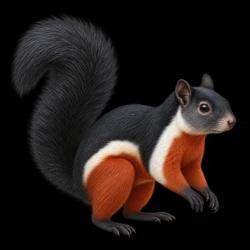
Three sharply bordered colours divide the coat of this Sundaland tree squirrel, a pattern bold enough to stand out even in deep canopy shade. The borders are crisp rather than blended, so an animal can be picked out from the ground at a considerable distance.

Prevost's Squirrel at a glance
Animal · Southeast Asia · Lowland and hill tropical forest · Relatively common
Known for: Glossy black back and tail, White or cream stripe along each flank, Chestnut-red belly and inner legs, Long
From AnimalDex stories
Prevost's Squirrel in motion
Scenes from Prevost's Squirrel story videos made in the AnimalDex app: the animal's Trial, and moments from its story.

Its Power
River-Split Colour Races
One squirrel, split by rivers into many coat patterns.
Groups cut off from each other for long enough drift into their own distinct styles, even when they started from the same stock.
“Separate banks, separate colours.”
Capture a Prevost's Squirrel, and it's yours when you finish one step it gives you.
Biological basis
Callosciurus prevostii is a canopy squirrel of the Malay Peninsula, Sumatra, Borneo and nearby islands. Its many described subspecies differ mainly in how black, white and chestnut are arranged on the coat, and large rivers and straits appear to separate the forms. What the bold coat does for the squirrel is not known.
Put it into practice
A linguist mapping village dialects along a valley finds that each change in accent falls at a river crossing, so she plans her interviews bank by bank.
What does the Prevost's squirrel symbolize?
The Prevost's squirrel symbolizes river-split colour races: one squirrel, split by rivers into many coat patterns. It represents self-expression, self-knowledge and belonging. Its AnimalDex motto: "Separate banks, separate colours."
The Prevost's squirrel as a spirit animal
If the Prevost's squirrel is your spirit animal, the AnimalDex reading is River-Split Colour Races: groups cut off from each other for long enough drift into their own distinct styles, even when they started from the same stock. It suggests a strength in self-expression and self-knowledge, and a reminder to use it on purpose.
What can the Prevost's squirrel help you with in life?
The Prevost's squirrel is a guide for self-expression, self-knowledge and belonging. Its lesson applies wherever self-expression matters: groups cut off from each other for long enough drift into their own distinct styles, even when they started from the same stock.
- Self-Expression
- Self-Knowledge
- Belonging
In practice: A linguist mapping village dialects along a valley finds that each change in accent falls at a river crossing, so she plans her interviews bank by bank.
What can we learn from the Prevost's Squirrel?What does it mean to dream about or encounter a wild Prevost's squirrel?
Dreaming about a wild Prevost's squirrel, or coming across one, usually points to self-expression and self-knowledge: the qualities the Prevost's squirrel lives by. In AnimalDex, the Prevost's squirrel's principle is River-Split Colour Races: one squirrel, split by rivers into many coat patterns. Read the moment through its core lesson: Groups cut off from each other for long enough drift into their own distinct styles, even when they started from the same stock.
It depends on how the Prevost's squirrel behaved. Calm or close by, it reads as self-knowledge within reach; aggressive or fleeing, it points to self-expression you are resisting.
Spotting a Prevost's squirrel in the wild
If a Prevost's squirrel crosses your path, take it as a cue to look at where self-expression fits your day. Its AnimalDex motto: "Separate banks, separate colours."
A Prevost's squirrel that keeps appearing
Repeated sightings of a Prevost's squirrel usually mean the River-Split Colour Races lesson is still open: groups cut off from each other for long enough drift into their own distinct styles, even when they started from the same stock.
Dreaming of being chased by a Prevost's squirrel
A chase often means a demand for self-expression is catching up with you. The Prevost's squirrel's lesson, "Groups cut off from each other for long enough drift into their own distinct styles, even when they started from the same stock", is the part you may be running from.
Dreaming that a Prevost's squirrel attacks you
When the Prevost's squirrel attacks, the dream may be about pressure: self-knowledge or belonging applied too hard, by you or by someone close to you.
A calm or friendly Prevost's squirrel
A calm Prevost's squirrel suggests you have made peace with self-expression and can use it without force.
A dead or injured Prevost's squirrel
An injured Prevost's squirrel often reflects self-expression under strain; rest and repair come before pushing again.
These readings are reflective prompts drawn from how the Prevost's squirrel really lives, not predictions. If you meet one in the wild, watch from a distance and leave it undisturbed.
Capture your own Prevost's Squirrel
Photograph or film one in the wild, at a zoo or at home with the app. It becomes yours: it remembers you, gives you steps, and can debate your problems with your other animals.
Animal field guide
Prevost's Squirrel
Sign in to hear this read by a natural AI voice instead of your browser's.
Three sharply bordered colours divide the coat of this Sundaland tree squirrel, a pattern bold enough to stand out even in deep canopy shade. The borders are crisp rather than blended, so an animal can be picked out from the ground at a considerable distance.
Native range
Natural range, not this capture location
Lowland and hill tropical forest, including secondary and logged forest, forest edges, plantations and large gardens with tall trees, in southern Thailand, the Malay Peninsula, Sumatra, Borneo and nearby islands.
Search near meAnimalDex stats
Size scale
Understand the animal
Understand the Prevost's Squirrel
Factual biology first: what this animal is like, where it lives, how it survives, and why those traits exist.
01
Introduction to Prevost's Squirrel
Three sharply bordered colours divide the coat of this Sundaland tree squirrel, a pattern bold enough to stand out even in deep canopy shade. The borders are crisp rather than blended, so an animal can be picked out from the ground at a considerable distance.
How to identify a Prevost's Squirrel
- Glossy black back and tail
- White or cream stripe along each flank
- Chestnut-red belly and inner legs
- Long, bushy black tail held arched
- Moves in quick dashes with frequent pauses on branches
Why Prevost's Squirrel are interesting
- Many subspecies have been named across its islands, some with grey or grizzled backs rather than black.
- It often shares forests with the smaller plantain squirrel, another member of the genus Callosciurus.
- It is widely kept in zoos, where its bold colours make it one of the best-known Asian squirrels.
- The species name is generally taken to honour the French naturalist and illustrator Florent Prévost.
02
Adaptations and biological abilities
03
Why does Prevost's Squirrel behave this way?
- Glossy black back and tail
- White or cream stripe along each flank
- Chestnut-red belly and inner legs
- Long, bushy black tail held arched
- Moves in quick dashes with frequent pauses on branches
Active by day, busiest in the morning and late afternoon. It spends the night in a leaf nest built high in the branches or inside a tree hollow.
04
Why Lowland and hill tropical forest?
Habitat: Lowland and hill tropical forest, including secondary and logged forest, forest edges, plantations and large gardens with tall trees, in southern Thailand, the Malay Peninsula, Sumatra, Borneo and nearby islands.
Native range: Southeast Asia
Native range
Natural range, not this specific capture location.
Lowland and hill tropical forest, including secondary and logged forest, forest edges, plantations and large gardens with tall trees, in southern Thailand, the Malay Peninsula, Sumatra, Borneo and nearby islands.
05
Why this diet?
Fruits and seeds form most of the diet, with flowers, nectar and insects; tree sap and bird eggs are also reported. It is known to raid fruit crops and plantation trees.
06
Activity, rest, and lifespan
Active by day, busiest in the morning and late afternoon. It spends the night in a leaf nest built high in the branches or inside a tree hollow.
Around 15 years has been reported for a captive animal. Wild squirrels probably live much shorter lives, but no study has measured it.
07
Prevost's Squirrel reproduction
Litters are small, usually one to three young, born in a nest after a gestation of about seven weeks. The young are raised by the mother and stay in the nest until they can climb well.
Males and females look alike in size and colour.
08
Predators, threats, and defense
09
Conservation and rarity
Rarity: Relatively common · 37/100. AnimalDex canonical rarity score: 37/100, maintained by the live indexed species profile.
- Observe from a respectful distance and avoid changing the animal's behavior.
- Do not block feeding, shelter, nesting, or travel routes.
- Use a live camera capture without handling or staging wildlife.
Talk to it
Talk to the Prevost's Squirrel
It answers as itself: ask about how it lives, or bring it something of yours and hear what it would do, from its own Power.
Anonymous: 6/day. Signed-in: 10/day. Pro: 100/day.
Side by side
The Prevost's Squirrel, side by side
Nothing written side by side for the Prevost's Squirrel yet. Pick any animal to compare it with. Compare with any animal →
Where to find them
Where to find Prevost's Squirrel
To find Prevost's Squirrel in the wild, focus on the exact habitat patches that match its body design and daily behavior, not just the broad country where it exists. You usually do better by working one good piece of habitat inside southeast Asia than by covering too much ground.
- Forest edge, canopy gaps, fruiting trees, or shaded trails where cover and food meet
- Headlands, reef edges, island colonies, tidal channels, or productive coastal water
- Sunlit logs, exposed branches, warm rocks, or regular perch sites used for scanning
In the Ark
2 Prevost's Squirrels are aboard right now.
None have come aboard or left since November 17.
The Ark is a live, shared animal world. Animals come aboard when people capture them, and live there by rules based on their field guides.
Scientific name
Callosciurus prevostii
Category
Animal
Habitat
Lowland and hill tropical forest, including secondary and logged forest, forest edges, plantations and large gardens with tall trees, in southern Thailand, the Malay Peninsula, Sumatra, Borneo and nearby islands.
Rarity
Relatively common · 37/100
Native range
Southeast Asia
Take the encyclopedia outside
AnimalDex helps you scan real animals, identify species, collect cards, and learn from nature wherever you are.