
Animal field guide
Racket-tailed Roller
Coracias spatulatus
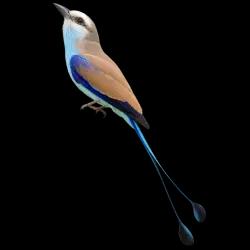
A blue-and-brown roller of the miombo woodlands of south-central Africa, named for its two long outer tail feathers ending in small rackets. It is quieter than most rollers and often perches inside the canopy rather than on open treetops.
Racket-tailed Roller at a glance
Animal · Sub-Saharan Africa · Racket-tailed Rollers are native to · Uncommon
Known for: Two long outer tail feathers with small, Cinnamon-brown back, Pale turquoise-blue underparts, Whitish forehead and eyebrow
Its Power
Aerial Acrobatics
Tumbling Display Flight
A bold show that is hard to fake proves what you can really do.
“Fly with flair.”
Capture a Racket-tailed Roller, and it's yours when you finish one step it gives you.
Biological basis
Racket-tailed rollers display by climbing, then diving with wings half-closed, rolling and tumbling low over the ground. Only a bird in good condition can pull off this risky display.
Put it into practice
A gymnast shows her skill by landing a hard routine cleanly, which proves more than any amount of talking could.
What does the racket-tailed roller symbolize?
The racket-tailed roller symbolizes aerial acrobatics: tumbling Display Flight. It represents creativity, calculated risk and agility. Its AnimalDex motto: "Fly with flair."
The racket-tailed roller as a spirit animal
If the racket-tailed roller is your spirit animal, the AnimalDex reading is Aerial Acrobatics: a bold show that is hard to fake proves what you can really do. It suggests a strength in creativity and calculated risk, and a reminder to use it on purpose.
What can the racket-tailed roller help you with in life?
The racket-tailed roller is a guide for creativity, calculated risk and agility. Its lesson applies wherever creativity matters: a bold show that is hard to fake proves what you can really do.
- Creativity
- Calculated Risk
- Agility
In practice: A gymnast shows her skill by landing a hard routine cleanly, which proves more than any amount of talking could.
What can we learn from the Racket-tailed Roller?What does it mean to dream about or encounter a wild racket-tailed roller?
Dreaming about a wild racket-tailed roller, or coming across one, usually points to creativity and calculated risk: the qualities the racket-tailed roller lives by. In AnimalDex, the racket-tailed roller's principle is Aerial Acrobatics: tumbling Display Flight. Read the moment through its core lesson: A bold show that is hard to fake proves what you can really do.
It depends on how the racket-tailed roller behaved. Calm or close by, it reads as calculated risk within reach; aggressive or fleeing, it points to creativity you are resisting.
Spotting a racket-tailed roller in the wild
A real encounter is the plainest version of the sign: notice what the racket-tailed roller was doing. Tumbling Display Flight. That is the creativity worth borrowing today.
A racket-tailed roller that keeps appearing
A racket-tailed roller that keeps turning up points to calculated risk you keep circling back to. The repetition is the message.
Dreaming of being chased by a racket-tailed roller
If the racket-tailed roller pursues you, look at where calculated risk is being asked of you and you are stepping away instead of meeting it.
Dreaming that a racket-tailed roller attacks you
An attack points to creativity turned against you: someone using it on you, or your own creativity overused until it costs you.
A calm or friendly racket-tailed roller
A calm racket-tailed roller suggests you have made peace with creativity and can use it without force.
A dead or injured racket-tailed roller
An injured racket-tailed roller often reflects creativity under strain; rest and repair come before pushing again.
These readings are reflective prompts drawn from how the racket-tailed roller really lives, not predictions. If you meet one in the wild, watch from a distance and leave it undisturbed.
Capture your own Racket-tailed Roller
Photograph or film one in the wild, at a zoo or at home with the app. It becomes yours: it remembers you, gives you steps, and can debate your problems with your other animals.
Animal field guide
Racket-tailed Roller
Sign in to hear this read by a natural AI voice instead of your browser's.
A blue-and-brown roller of the miombo woodlands of south-central Africa, named for its two long outer tail feathers ending in small rackets. It is quieter than most rollers and often perches inside the canopy rather than on open treetops.
Native range
Natural range, not this capture location
Racket-tailed Rollers are native to south-central Africa. They inhabit miombo and other broadleaf woodland, open wooded savanna, forest edges, and clearings with exposed perches for hunting insects.
Search near meAnimalDex stats
Size scale
Understand the animal
Understand the Racket-tailed Roller
Factual biology first: what this animal is like, where it lives, how it survives, and why those traits exist.
01
Introduction to Racket-tailed Roller
A blue-and-brown roller of the miombo woodlands of south-central Africa, named for its two long outer tail feathers ending in small rackets. It is quieter than most rollers and often perches inside the canopy rather than on open treetops.
How to identify a Racket-tailed Roller
- Two long outer tail feathers with small spatula-shaped tips
- Cinnamon-brown back
- Pale turquoise-blue underparts
- Whitish forehead and eyebrow
- Deep violet-blue flight feathers in flight
Why Racket-tailed Roller are interesting
- It nests in natural tree cavities or old woodpecker holes, usually well above the ground.
- Like other rollers, the male performs rolling, tumbling display flights accompanied by harsh calls.
- Two subspecies are recognised, one in the north-east of the range and one further south-west.
- Young birds lack the long racket-tipped tail feathers, which develop only as they reach adult plumage.
02
Adaptations and biological abilities
03
Why does Racket-tailed Roller behave this way?
- Two long outer tail feathers with small spatula-shaped tips
- Cinnamon-brown back
- Pale turquoise-blue underparts
- Whitish forehead and eyebrow
- Deep violet-blue flight feathers in flight
Active by day, hunting from perches in the morning and afternoon. Its night roosts have not been well documented. It is largely resident, with some local movements.
04
Why Racket-tailed Rollers are native to south-central Africa?
Habitat: Racket-tailed Rollers are native to south-central Africa. They inhabit miombo and other broadleaf woodland, open wooded savanna, forest edges, and clearings with exposed perches for hunting insects.
Native range: Sub-Saharan Africa
Native range
Natural range, not this specific capture location.
Racket-tailed Rollers are native to south-central Africa. They inhabit miombo and other broadleaf woodland, open wooded savanna, forest edges, and clearings with exposed perches for hunting insects.
05
Why this diet?
Mainly large insects such as grasshoppers, beetles and caterpillars, and occasionally small lizards. It watches from a perch, then drops to the ground to seize prey.
06
Activity, rest, and lifespan
Active by day, hunting from perches in the morning and afternoon. Its night roosts have not been well documented. It is largely resident, with some local movements.
Lifespan in the wild has not been recorded for this species.
07
Racket-tailed Roller reproduction
Nests in a hole in a tree, often an old woodpecker or barbet hole, early in the rains. Clutches of about two to four white eggs have been reported; other details of breeding are poorly known.
Males and females look alike in plumage; males may have slightly longer tail rackets.
08
Predators, threats, and defense
09
Conservation and rarity
Rarity: Uncommon · 55/100. AnimalDex canonical rarity score: 55/100, maintained by the live indexed species profile.
- Observe from a respectful distance and avoid changing the animal's behavior.
- Do not block feeding, shelter, nesting, or travel routes.
- Use a live camera capture without handling or staging wildlife.
Talk to it
Talk to the Racket-tailed Roller
It answers as itself: ask about how it lives, or bring it something of yours and hear what it would do, from its own Power.
Anonymous: 6/day. Signed-in: 10/day. Pro: 100/day.
Side by side
The Racket-tailed Roller, side by side
Nothing written side by side for the Racket-tailed Roller yet. Pick any animal to compare it with. Compare with any animal →
Where to find them
Where to find Racket-tailed Roller
To find Racket-tailed Roller in the wild, focus on the exact habitat patches that match its body design and daily behavior, not just the broad country where it exists. You usually do better by working one good piece of habitat inside sub-Saharan Africa than by covering too much ground.
- Forest edge, canopy gaps, fruiting trees, or shaded trails where cover and food meet
- Sunlit logs, exposed branches, warm rocks, or regular perch sites used for scanning
- Protected habitat blocks within sub-Saharan Africa
In the Ark
1 Racket-tailed Roller is aboard right now.
None have come aboard or left since November 17.
The Ark is a live, shared animal world. Animals come aboard when people capture them, and live there by rules based on their field guides.
Scientific name
Coracias spatulatus
Category
Animal
Habitat
Racket-tailed Rollers are native to south-central Africa. They inhabit miombo and other broadleaf woodland, open wooded savanna, forest edges, and clearings with exposed perches for hunting insects.
Rarity
Uncommon · 55/100
Native range
Sub-Saharan Africa
Take the encyclopedia outside
AnimalDex helps you scan real animals, identify species, collect cards, and learn from nature wherever you are.