
Animal field guide
Rainbowfish
Melanotaeniidae
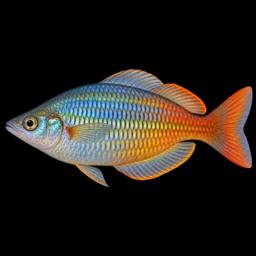
Rainbowfishes are colorful freshwater fishes from Australia and New Guinea, known for compressed bodies, two dorsal fins, and active schooling.
Rainbowfish at a glance
Animal · Australia & Oceania · Streams · Relatively common
Known for: Two separate dorsal fins, Laterally compressed body, Iridescent coloration, Active schooling movement
Its Power
Visible Coordination
Colour-Signalled Schooling
Make direction legible so a group can move without collision.
“Show your direction.”
Capture a Rainbowfish, and it's yours when you finish one step it gives you.
Biological basis
Rainbowfish combine lateral visual awareness, schooling responses, and changing display colors to coordinate movement and courtship in bright shallow water.
Put it into practice
A cyclist signals every turn clearly, so the riders behind can follow without bumping into each other.
What does the rainbowfish symbolize?
The rainbowfish symbolizes visible coordination: colour-Signalled Schooling. It represents coordination, clear communication and teamwork. Its AnimalDex motto: "Show your direction."
The rainbowfish as a spirit animal
If the rainbowfish is your spirit animal, the AnimalDex reading is Visible Coordination: make direction legible so a group can move without collision. It suggests a strength in coordination and clear communication, and a reminder to use it on purpose.
What can the rainbowfish help you with in life?
The rainbowfish is a guide for coordination, clear communication and teamwork. Its lesson applies wherever coordination matters: make direction legible so a group can move without collision.
- Coordination
- Clear Communication
- Teamwork
In practice: A cyclist signals every turn clearly, so the riders behind can follow without bumping into each other.
What can we learn from the Rainbowfish?What does it mean to dream about or encounter a wild rainbowfish?
Meeting a wild rainbowfish, asleep or awake, is often a nudge toward coordination, the quality the rainbowfish is built around. In AnimalDex, the rainbowfish's principle is Visible Coordination: colour-Signalled Schooling. Read the moment through its core lesson: Make direction legible so a group can move without collision.
Neither good nor bad on its own. How the rainbowfish acts matters: at ease, it reflects coordination; hostile, it flags coordination out of balance.
Spotting a rainbowfish in the wild
If a rainbowfish crosses your path, take it as a cue to look at where coordination fits your day. Its AnimalDex motto: "Show your direction."
A rainbowfish that keeps appearing
Repeated sightings of a rainbowfish usually mean the Visible Coordination lesson is still open: make direction legible so a group can move without collision.
Dreaming of being chased by a rainbowfish
If the rainbowfish pursues you, look at where clear communication is being asked of you and you are stepping away instead of meeting it.
Dreaming that a rainbowfish attacks you
An aggressive rainbowfish can mirror a conflict where coordination has become a weapon rather than a strength.
A calm or friendly rainbowfish
Meeting a peaceful rainbowfish is usually encouraging: clear communication and teamwork are within reach.
A dead or injured rainbowfish
An injured rainbowfish often reflects coordination under strain; rest and repair come before pushing again.
These readings are reflective prompts drawn from how the rainbowfish really lives, not predictions. If you meet one in the wild, watch from a distance and leave it undisturbed.
Capture your own Rainbowfish
Photograph or film one in the wild, at a zoo or at home with the app. It becomes yours: it remembers you, gives you steps, and can debate your problems with your other animals.
Animal field guide
Rainbowfish
Sign in to hear this read by a natural AI voice instead of your browser's.
Rainbowfishes are colorful freshwater fishes from Australia and New Guinea, known for compressed bodies, two dorsal fins, and active schooling.
Native range
Natural range, not this capture location
Streams, lakes, wetlands, and vegetated freshwater margins.
Search near meAnimalDex stats
Size scale
Understand the animal
Understand the Rainbowfish
Factual biology first: what this animal is like, where it lives, how it survives, and why those traits exist.
01
Introduction to Rainbowfish
Rainbowfishes are colorful freshwater fishes from Australia and New Guinea, known for compressed bodies, two dorsal fins, and active schooling.
How to identify a Rainbowfish
- Two separate dorsal fins
- Laterally compressed body
- Iridescent coloration
- Active schooling movement
Why Rainbowfish are interesting
- Male colors can intensify dramatically during courtship, when males display to females with fins spread.
- Many species occupy very small geographic ranges, sometimes a single lake or stream system in New Guinea.
- Eggs have adhesive threads that attach them to fine plants.
- The Lake Eacham rainbowfish vanished from its home crater lake in Queensland after other fish were introduced, surviving in nearby streams and aquaria.
02
Adaptations and biological abilities
03
Why does Rainbowfish behave this way?
- Two separate dorsal fins
- Laterally compressed body
- Iridescent coloration
- Active schooling movement
Diurnal, usually resting among vegetation or quieter water at night.
04
Why Streams?
Habitat: Streams, lakes, wetlands, and vegetated freshwater margins.
Native range: Australia & Oceania
Native range
Natural range, not this specific capture location.
Streams, lakes, wetlands, and vegetated freshwater margins.
05
Why this diet?
Algae, small crustaceans, insect larvae, and other small aquatic food.
06
Activity, rest, and lifespan
Diurnal, usually resting among vegetation or quieter water at night.
Often three to eight years depending on species and conditions.
07
Rainbowfish reproduction
Females scatter adhesive eggs among aquatic plants over repeated spawning events.
Males are commonly deeper-bodied and more intensely colored than females.
08
Predators, threats, and defense
Larger fishes, birds, aquatic reptiles, and introduced predators.
09
Conservation and rarity
Rarity: Relatively common · 35/100. AnimalDex canonical rarity score: 35/100, maintained by the live indexed species profile.
- Observe from a respectful distance and avoid changing the animal's behavior.
- Do not block feeding, shelter, nesting, or travel routes.
- Use a live camera capture without handling or staging wildlife.
Talk to it
Talk to the Rainbowfish
It answers as itself: ask about how it lives, or bring it something of yours and hear what it would do, from its own Power.
Anonymous: 6/day. Signed-in: 10/day. Pro: 100/day.
Side by side
The Rainbowfish, side by side
Nothing written side by side for the Rainbowfish yet. Pick any animal to compare it with. Compare with any animal →
Where to find them
Where to find Rainbowfish
To find Rainbowfish in the wild, focus on the exact habitat patches that match its body design and daily behavior, not just the broad country where it exists. You usually do better by working one good piece of habitat inside australia & Oceania than by covering too much ground.
- Quiet marsh edges, reedbeds, river bends, or shallow wetland margins
- Protected habitat blocks within australia & Oceania
In the Ark
5 Rainbowfish are aboard right now.
Since November 6: 3 came aboard, 2 born.
The Ark is a live, shared animal world. Animals come aboard when people capture them, and live there by rules based on their field guides.
Scientific name
Melanotaeniidae
Category
Animal
Habitat
Streams, lakes, wetlands, and vegetated freshwater margins.
Rarity
Relatively common · 35/100
Native range
Australia & Oceania
Take the encyclopedia outside
AnimalDex helps you scan real animals, identify species, collect cards, and learn from nature wherever you are.