Animal field guide
Red Admiral
Vanessa atalanta
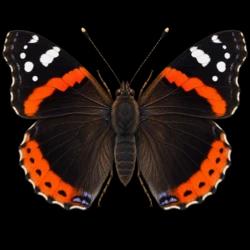
The Red Admiral is a velvet-black butterfly crossed by a scarlet band, found across Europe, North Africa and North America. It is a strong migrant that pushes north each spring, and its caterpillars grow up hidden one by one inside folded nettle leaves.
Red Admiral at a glance
Animal · Europe · Gardens · Relatively common
Known for: Velvet-black wings crossed by a red-orange band, White spots near the forewing tips, Red-orange border along the hindwing edge, Mottled brown and grey hindwing underside
Its Power
Nettle Tent
Fold the thing that feeds the work into a roof and eat from inside it.
What feeds a life can also be folded into the roof over it.
“Fold a roof.”
Capture a Red Admiral, and it's yours when you finish one step it gives you.
Biological basis
The caterpillar of Vanessa atalanta lives alone on a stinging nettle, drawing the edges of a leaf together with silk to make a closed tent. It feeds on the leaf from inside, out of sight of birds, and moves on to fold a fresh leaf when the old one is eaten through.
Put it into practice
A trainee baker who takes the small flat above the bakery turns the place that pays the wages into the place that keeps the rent low and the early starts easy.
What does the red admiral symbolize?
The red admiral symbolizes nettle tent: fold the thing that feeds the work into a roof and eat from inside it. It represents resourcefulness, safe shelter and renewal. Its AnimalDex motto: "Fold a roof."
The red admiral as a spirit animal
If the red admiral is your spirit animal, the AnimalDex reading is Nettle Tent: what feeds a life can also be folded into the roof over it. It suggests a strength in resourcefulness and safe shelter, and a reminder to use it on purpose.
What can the red admiral help you with in life?
The red admiral is a guide for resourcefulness, safe shelter and renewal. Its lesson applies wherever resourcefulness matters: what feeds a life can also be folded into the roof over it.
- Resourcefulness
- Safe Shelter
- Renewal
In practice: A trainee baker who takes the small flat above the bakery turns the place that pays the wages into the place that keeps the rent low and the early starts easy.
What can we learn from the Red Admiral?What does it mean to dream about or encounter a wild red admiral?
Meeting a wild red admiral, asleep or awake, is often a nudge toward resourcefulness, the quality the red admiral is built around. In AnimalDex, the red admiral's principle is Nettle Tent: fold the thing that feeds the work into a roof and eat from inside it. Read the moment through its core lesson: What feeds a life can also be folded into the roof over it.
Neither good nor bad on its own. How the red admiral acts matters: at ease, it reflects resourcefulness; hostile, it flags resourcefulness out of balance.
Spotting a red admiral in the wild
If a red admiral crosses your path, take it as a cue to look at where resourcefulness fits your day. Its AnimalDex motto: "Fold a roof."
A red admiral that keeps appearing
Repeated sightings of a red admiral usually mean the Nettle Tent lesson is still open: what feeds a life can also be folded into the roof over it.
Dreaming of being chased by a red admiral
If the red admiral pursues you, look at where safe shelter is being asked of you and you are stepping away instead of meeting it.
Dreaming that a red admiral attacks you
An aggressive red admiral can mirror a conflict where resourcefulness has become a weapon rather than a strength.
A calm or friendly red admiral
Meeting a peaceful red admiral is usually encouraging: safe shelter and renewal are within reach.
A dead or injured red admiral
An injured red admiral often reflects resourcefulness under strain; rest and repair come before pushing again.
These readings are reflective prompts drawn from how the red admiral really lives, not predictions. If you meet one in the wild, watch from a distance and leave it undisturbed.
Capture your own Red Admiral
Photograph or film one in the wild, at a zoo or at home with the app. It becomes yours: it remembers you, gives you steps, and can debate your problems with your other animals.
Animal field guide
Red Admiral
Sign in to hear this read by a natural AI voice instead of your browser's.
The Red Admiral is a velvet-black butterfly crossed by a scarlet band, found across Europe, North Africa and North America. It is a strong migrant that pushes north each spring, and its caterpillars grow up hidden one by one inside folded nettle leaves.
Native range
Natural range, not this capture location
Gardens, woodland edges, hedgerows, parks, orchards and damp meadows, wherever nettles grow for the caterpillars and flowers or fallen fruit feed the adults.
Search near meAnimalDex stats
Dominance
8
Speed
28
Size
5
Intelligence
15
Rarity
7%
Total
63
Size scale
Understand the animal
Understand the Red Admiral
Factual biology first: what this animal is like, where it lives, how it survives, and why those traits exist.
01
Introduction to Red Admiral
The Red Admiral is a velvet-black butterfly crossed by a scarlet band, found across Europe, North Africa and North America. It is a strong migrant that pushes north each spring, and its caterpillars grow up hidden one by one inside folded nettle leaves.
How to identify a Red Admiral
- Velvet-black wings crossed by a red-orange band
- White spots near the forewing tips
- Red-orange border along the hindwing edge
- Mottled brown and grey hindwing underside
Why Red Admiral are interesting
- Most northern populations die out in winter and are rebuilt each spring by migrants flying up from the south.
- In autumn a new generation flies south again, often travelling high up on following winds.
- Eggs are laid singly on nettle leaves, so each caterpillar starts life alone.
- Adults feed readily on fermenting fallen fruit and oozing tree sap as well as flower nectar.
- Males hold sunlit perches in the afternoon and fly up to chase rivals and other passing insects.
- The Painted Lady is its closest lookalike but is orange with black spotting throughout, and never shows a clean red band on a black wing.
02
Adaptations and biological abilities
03
Why does Red Admiral behave this way?
- Velvet-black wings crossed by a red-orange band
- White spots near the forewing tips
- Red-orange border along the hindwing edge
- Mottled brown and grey hindwing underside
Active by day and fond of basking with wings spread in the sun. It roosts overnight with wings closed on trunks, in foliage or in sheltered corners, and some adults pass the winter dormant in mild regions.
04
Why Gardens?
Habitat: Gardens, woodland edges, hedgerows, parks, orchards and damp meadows, wherever nettles grow for the caterpillars and flowers or fallen fruit feed the adults.
Native range: Europe, North Africa & Middle East, North America
Native range
Natural range, not this specific capture location.
Gardens, woodland edges, hedgerows, parks, orchards and damp meadows, wherever nettles grow for the caterpillars and flowers or fallen fruit feed the adults.
05
Why this diet?
Caterpillars eat stinging nettle and related plants such as pellitory and false nettle, feeding from inside the folded leaf that shelters them. Adults drink nectar from ivy, buddleia, thistles and asters, and gather at rotting fruit and sap runs.
06
Activity, rest, and lifespan
Active by day and fond of basking with wings spread in the sun. It roosts overnight with wings closed on trunks, in foliage or in sheltered corners, and some adults pass the winter dormant in mild regions.
A summer adult usually lives a few weeks, while those that migrate and overwinter can last several months. Egg to adult takes roughly one to two months in warm weather.
07
Red Admiral reproduction
A female lays her green, ribbed eggs one at a time on separate nettle leaves rather than in a batch. Each caterpillar therefore builds and lives in a tent of its own, with no siblings beside it.
Males and females look alike, with females slightly larger on average. Behaviour separates them better than pattern: males hold afternoon perches and chase intruders, while females spend their time searching nettle beds.
08
Predators, threats, and defense
Birds, spiders, dragonflies and wasps take adults, and parasitic wasps and flies attack the caterpillars. The leaf tent is the main defence of the young, and the bark-coloured underside hides a resting adult once the wings close.
09
Conservation and rarity
Rarity: Relatively common · 7/100. AnimalDex canonical rarity score: 7/100, maintained by the live indexed species profile.
- Observe from a respectful distance and avoid changing the animal's behavior.
- Do not block feeding, shelter, nesting, or travel routes.
- Use a live camera capture without handling or staging wildlife.
Talk to it
Talk to the Red Admiral
It answers as itself: ask about how it lives, or bring it something of yours and hear what it would do, from its own Power.
Anonymous: 3/day. Signed-in: 10/day. Pro: 100/day.
Side by side
The Red Admiral, side by side
Nothing written side by side for the Red Admiral yet. Pick any animal to compare it with. Compare with any animal →
Where to find them
Where to find Red Admiral
To find Red Admiral in the wild, focus on the exact habitat patches that match its body design and daily behavior, not just the broad country where it exists. You usually do better by working one good piece of habitat inside europe, North Africa & Middle East, North America than by covering too much ground.
- Forest edge, canopy gaps, fruiting trees, or shaded trails where cover and food meet
- Open grassland edges, lightly wooded plains, or raised ground where you can scan long distances
- Protected habitat blocks within europe, North Africa & Middle East, North America
Scientific name
Vanessa atalanta
Category
Animal
Habitat
Gardens, woodland edges, hedgerows, parks, orchards and damp meadows, wherever nettles grow for the caterpillars and flowers or fallen fruit feed the adults.
Rarity
Relatively common · 7/100
Native range
Europe, North Africa & Middle East, North America
Take the encyclopedia outside
AnimalDex helps you scan real animals, identify species, collect cards, and learn from nature wherever you are.
Related blog guides
Continue learning with practical articles connected to this species.
Why Photographers Should Track the Species They Photograph
A species list changes what you go out to shoot. How a tracked list exposes portfolio gaps, keeps IDs honest, and turns a camera roll into a body of work.
Read blog article