
Animal field guide
Red-breasted Parakeet
Psittacula alexandri
Flocks of this sociable parakeet, about 33 to 38 centimetres long with nearly half of that in the tail, stream into shared roost trees each evening. Some roosts are reported to hold hundreds of birds, which leave together soon after dawn for the feeding trees.
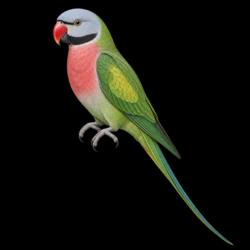
Red-breasted Parakeet at a glance
Animal · South Asia · Red-breasted Parakeets are native · Relatively common
Known for: Rosy-pink breast contrasting with green body, Grey head with a black moustache stripe, Narrow black line across the forehead to the eyes, Long
Its Power
Flock Voice
Heard Before Seen
Say where you are, and the rest of the flock finds you.
“Call, and be found.”
Capture a Red-breasted Parakeet, and it's yours when you finish one step it gives you.
Biological basis
Psittacula alexandri is a sociable parakeet of South and Southeast Asian woodland that feeds and travels in flocks and gathers at communal roosts. Birds give loud, nasal contact calls in flight and from the canopy, where green plumage makes them hard to pick out among leaves. The calling keeps flock members in touch with each other, which is why a group is usually heard well before it is seen.
Put it into practice
A new team member working remotely posts a short note each morning saying what they are on and where they are stuck. Colleagues who would never have guessed now know exactly where to find them and help.
What does the red-breasted parakeet symbolize?
The red-breasted parakeet symbolizes flock voice: heard Before Seen. It represents speaking up, belonging and learning from others. Its AnimalDex motto: "Call, and be found."
The red-breasted parakeet as a spirit animal
If the red-breasted parakeet is your spirit animal, the AnimalDex reading is Flock Voice: say where you are, and the rest of the flock finds you. It suggests a strength in speaking up and belonging, and a reminder to use it on purpose.
What can the red-breasted parakeet help you with in life?
The red-breasted parakeet is a guide for speaking up, belonging and learning from others. Its lesson applies wherever speaking up matters: say where you are, and the rest of the flock finds you.
- Speaking Up
- Belonging
- Learning from Others
In practice: A new team member working remotely posts a short note each morning saying what they are on and where they are stuck. Colleagues who would never have guessed now know exactly where to find them and help.
What can we learn from the Red-breasted Parakeet?What does it mean to dream about or encounter a wild red-breasted parakeet?
A wild red-breasted parakeet, whether in a dream or in front of you, tends to show up when speaking up or belonging is on your mind. In AnimalDex, the red-breasted parakeet's principle is Flock Voice: heard Before Seen. Read the moment through its core lesson: Say where you are, and the rest of the flock finds you.
Mostly a prompt rather than a warning. A calm red-breasted parakeet suggests speaking up you already have; a threatening one suggests speaking up is being tested or pushed too far.
Spotting a red-breasted parakeet in the wild
A real encounter is the plainest version of the sign: notice what the red-breasted parakeet was doing. Heard Before Seen. That is the speaking up worth borrowing today.
A red-breasted parakeet that keeps appearing
Seeing the red-breasted parakeet again and again, in dreams or outside, suggests speaking up is a theme you have not settled yet.
Dreaming of being chased by a red-breasted parakeet
Being chased suggests you are avoiding the Flock Voice the red-breasted parakeet stands for: say where you are, and the rest of the flock finds you. Ask what you keep postponing that needs speaking up.
Dreaming that a red-breasted parakeet attacks you
An aggressive red-breasted parakeet can mirror a conflict where speaking up has become a weapon rather than a strength.
A calm or friendly red-breasted parakeet
A calm red-breasted parakeet suggests you have made peace with speaking up and can use it without force.
A dead or injured red-breasted parakeet
Seeing the red-breasted parakeet hurt may point to belonging that has been neglected. Ask what it would take to restore it.
These readings are reflective prompts drawn from how the red-breasted parakeet really lives, not predictions. If you meet one in the wild, watch from a distance and leave it undisturbed.
Capture your own Red-breasted Parakeet
Photograph or film one in the wild, at a zoo or at home with the app. It becomes yours: it remembers you, gives you steps, and can debate your problems with your other animals.
Animal field guide
Red-breasted Parakeet
Sign in to hear this read by a natural AI voice instead of your browser's.
Flocks of this sociable parakeet, about 33 to 38 centimetres long with nearly half of that in the tail, stream into shared roost trees each evening. Some roosts are reported to hold hundreds of birds, which leave together soon after dawn for the feeding trees.
Native range
Natural range, not this capture location
Red-breasted Parakeets are native from the Himalayan foothills and northeastern India through Myanmar, Thailand, Laos, Cambodia and Vietnam into parts of southern China. They use forest edges, open woodland, cultivated areas, orchards and other landscapes with mature trees for feeding and nesting.
Search near meAnimalDex stats
Size scale
Understand the animal
Understand the Red-breasted Parakeet
Factual biology first: what this animal is like, where it lives, how it survives, and why those traits exist.
01
Introduction to Red-breasted Parakeet
Flocks of this sociable parakeet, about 33 to 38 centimetres long with nearly half of that in the tail, stream into shared roost trees each evening. Some roosts are reported to hold hundreds of birds, which leave together soon after dawn for the feeding trees.
How to identify a Red-breasted Parakeet
- Rosy-pink breast contrasting with green body
- Grey head with a black moustache stripe
- Narrow black line across the forehead to the eyes
- Long, tapering blue-green tail
Why Red-breasted Parakeet are interesting
- Adult males have a red upper mandible, while females have an all-black bill.
- It nests in tree holes, often enlarging old cavities made by woodpeckers or barbets.
- Trapping for the cage-bird trade and loss of large trees have led to its listing as Near Threatened.
- Several subspecies are recognised, differing slightly in size and in the shade of the breast.
02
Adaptations and biological abilities
03
Why does Red-breasted Parakeet behave this way?
- Rosy-pink breast contrasting with green body
- Grey head with a black moustache stripe
- Narrow black line across the forehead to the eyes
- Long, tapering blue-green tail
Active through the daylight hours. Nights are spent perched in the dense crowns of tall trees, and in hot weather birds are reported to sit quietly in shaded foliage around midday.
04
Why Red-breasted Parakeets are native from the Himalayan foothills and northeastern India through Myanmar?
Habitat: Red-breasted Parakeets are native from the Himalayan foothills and northeastern India through Myanmar, Thailand, Laos, Cambodia and Vietnam into parts of southern China. They use forest edges, open woodland, cultivated areas, orchards and other landscapes with mature trees for feeding and nesting.
Native range: South Asia, Southeast Asia
Native range
Natural range, not this specific capture location.
Red-breasted Parakeets are native from the Himalayan foothills and northeastern India through Myanmar, Thailand, Laos, Cambodia and Vietnam into parts of southern China. They use forest edges, open woodland, cultivated areas, orchards and other landscapes with mature trees for feeding and nesting.
05
Why this diet?
Fruits, seeds, nuts, flower buds, petals and nectar make up most of the diet, taken mainly in the canopy. Grain is also eaten where it grows near woodland.
06
Activity, rest, and lifespan
Active through the daylight hours. Nights are spent perched in the dense crowns of tall trees, and in hot weather birds are reported to sit quietly in shaded foliage around midday.
No reliable wild figures exist; kept birds reportedly reach 20 years or more.
07
Red-breasted Parakeet reproduction
A clutch of usually three or four eggs is laid in a tree hole, often an old woodpecker or natural cavity. Incubation by the female takes about four weeks, and the young fledge after roughly seven weeks.
The male has a red upper bill and a black lower bill, while the female's bill is entirely black.
08
Predators, threats, and defense
09
Conservation and rarity
Rarity: Relatively common · 20/100. AnimalDex canonical rarity score: 20/100, maintained by the live indexed species profile.
- Observe from a respectful distance and avoid changing the animal's behavior.
- Do not block feeding, shelter, nesting, or travel routes.
- Use a live camera capture without handling or staging wildlife.
Talk to it
Talk to the Red-breasted Parakeet
It answers as itself: ask about how it lives, or bring it something of yours and hear what it would do, from its own Power.
Anonymous: 6/day. Signed-in: 10/day. Pro: 100/day.
Side by side
The Red-breasted Parakeet, side by side
Nothing written side by side for the Red-breasted Parakeet yet. Pick any animal to compare it with. Compare with any animal →
Where to find them
Where to find Red-breasted Parakeet
To find Red-breasted Parakeet in the wild, focus on the exact habitat patches that match its body design and daily behavior, not just the broad country where it exists. You usually do better by working one good piece of habitat inside south Asia, Southeast Asia than by covering too much ground.
- Forest edge, canopy gaps, fruiting trees, or shaded trails where cover and food meet
- Protected habitat blocks within south Asia, Southeast Asia
In the Ark
2 Red-breasted Parakeets are aboard right now.
None have come aboard or left since November 17.
The Ark is a live, shared animal world. Animals come aboard when people capture them, and live there by rules based on their field guides.
Scientific name
Psittacula alexandri
Category
Animal
Habitat
Red-breasted Parakeets are native from the Himalayan foothills and northeastern India through Myanmar, Thailand, Laos, Cambodia and Vietnam into parts of southern China. They use forest edges, open woodland, cultivated areas, orchards and other landscapes with mature trees for feeding and nesting.
Rarity
Relatively common · 20/100
Native range
South Asia, Southeast Asia
Take the encyclopedia outside
AnimalDex helps you scan real animals, identify species, collect cards, and learn from nature wherever you are.