
Animal field guide
Red-eared Slider
Trachemys scripta elegans
A medium-sized freshwater turtle native to the Mississippi valley and Gulf of Mexico drainages, named for the red stripe behind each eye. Released pets have established populations on every continent except Antarctica, making it one of the most widespread turtles.
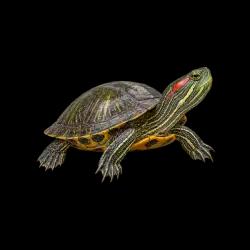
Red-eared Slider at a glance
Animal · North America · Warm · Relatively common
Known for: Broad red or orange stripe behind each eye, Olive-green shell with yellow lines, Yellow underside with a dark blotch on each plate, Yellow stripes on the head
Its Power
Patient Browsing Strategy
Long Sun Basking
Taking time to warm up properly makes everything you do afterwards work better.
“Warm up first.”
Capture a Red-eared Slider, and it's yours when you finish one step it gives you.
Biological basis
Red-eared sliders bask for long spells on logs and banks because their digestion, growth and health depend on body heat from the sun. When disturbed, they slide quickly into the water.
Put it into practice
A swimmer does a full warm-up before the race and swims faster than on the day she rushed straight in.
What does the red-eared slider symbolize?
The red-eared slider symbolizes patient browsing strategy: long Sun Basking. It represents patient progress, decisiveness and exploration. Its AnimalDex motto: "Warm up first."
The red-eared slider as a spirit animal
If the red-eared slider is your spirit animal, the AnimalDex reading is Patient Browsing Strategy: taking time to warm up properly makes everything you do afterwards work better. It suggests a strength in patient progress and decisiveness, and a reminder to use it on purpose.
What can the red-eared slider help you with in life?
The red-eared slider is a guide for patient progress, decisiveness and exploration. Its lesson applies wherever patient progress matters: taking time to warm up properly makes everything you do afterwards work better.
- Patient Progress
- Decisiveness
- Exploration
In practice: A swimmer does a full warm-up before the race and swims faster than on the day she rushed straight in.
What can we learn from the Red-eared Slider?What does it mean to dream about or encounter a wild red-eared slider?
Meeting a wild red-eared slider, asleep or awake, is often a nudge toward patient progress, the quality the red-eared slider is built around. In AnimalDex, the red-eared slider's principle is Patient Browsing Strategy: long Sun Basking. Read the moment through its core lesson: Taking time to warm up properly makes everything you do afterwards work better.
Neither good nor bad on its own. How the red-eared slider acts matters: at ease, it reflects patient progress; hostile, it flags patient progress out of balance.
Spotting a red-eared slider in the wild
A real encounter is the plainest version of the sign: notice what the red-eared slider was doing. Long Sun Basking. That is the patient progress worth borrowing today.
A red-eared slider that keeps appearing
A red-eared slider that keeps turning up points to decisiveness you keep circling back to. The repetition is the message.
Dreaming of being chased by a red-eared slider
Being chased suggests you are avoiding the Patient Browsing Strategy the red-eared slider stands for: taking time to warm up properly makes everything you do afterwards work better. Ask what you keep postponing that needs patient progress.
Dreaming that a red-eared slider attacks you
When the red-eared slider attacks, the dream may be about pressure: decisiveness or exploration applied too hard, by you or by someone close to you.
A calm or friendly red-eared slider
A calm red-eared slider suggests you have made peace with patient progress and can use it without force.
A dead or injured red-eared slider
An injured red-eared slider often reflects patient progress under strain; rest and repair come before pushing again.
These readings are reflective prompts drawn from how the red-eared slider really lives, not predictions. If you meet one in the wild, watch from a distance and leave it undisturbed.
Capture your own Red-eared Slider
Photograph or film one in the wild, at a zoo or at home with the app. It becomes yours: it remembers you, gives you steps, and can debate your problems with your other animals.
Animal field guide
Red-eared Slider
Sign in to hear this read by a natural AI voice instead of your browser's.
A medium-sized freshwater turtle native to the Mississippi valley and Gulf of Mexico drainages, named for the red stripe behind each eye. Released pets have established populations on every continent except Antarctica, making it one of the most widespread turtles.
Native range
Natural range, not this capture location
Warm, quiet fresh water with soft muddy bottoms and dense water plants: ponds, lakes, marshes, bayous, slow rivers and reservoirs in the central and southern United States and north-eastern Mexico. Logs, rocks and open banks for basking are essential.
Search near meAnimalDex stats
Size scale
Understand the animal
Understand the Red-eared Slider
Factual biology first: what this animal is like, where it lives, how it survives, and why those traits exist.
01
Introduction to Red-eared Slider
A medium-sized freshwater turtle native to the Mississippi valley and Gulf of Mexico drainages, named for the red stripe behind each eye. Released pets have established populations on every continent except Antarctica, making it one of the most widespread turtles.
How to identify a Red-eared Slider
- Broad red or orange stripe behind each eye
- Olive-green shell with yellow lines, darkening with age
- Yellow underside with a dark blotch on each plate
- Yellow stripes on the head, neck and legs
- Shell up to about 30 centimetres long
Why Red-eared Slider are interesting
- The name slider comes from its habit of sliding off a basking log into the water at the first sign of disturbance.
- Nest temperature decides the sex of the hatchlings: warm incubation produces mostly females, cooler incubation mostly males.
- Adult males grow very long front claws, which they flutter in front of a female's face during courtship.
- Older males often darken to almost black, a change that can hide the red ear stripe and the yellow shell lines.
02
Adaptations and biological abilities
03
Why does Red-eared Slider behave this way?
- Broad red or orange stripe behind each eye
- Olive-green shell with yellow lines, darkening with age
- Yellow underside with a dark blotch on each plate
- Yellow stripes on the head, neck and legs
- Shell up to about 30 centimetres long
Active by day, alternating basking and feeding. At night it sleeps underwater on the bottom or floating near the surface. In the north of its range it becomes largely inactive in winter, resting in mud on the bottom.
04
Why Warm?
Habitat: Warm, quiet fresh water with soft muddy bottoms and dense water plants: ponds, lakes, marshes, bayous, slow rivers and reservoirs in the central and southern United States and north-eastern Mexico. Logs, rocks and open banks for basking are essential.
Native range: North America
Native range
Natural range, not this specific capture location.
Warm, quiet fresh water with soft muddy bottoms and dense water plants: ponds, lakes, marshes, bayous, slow rivers and reservoirs in the central and southern United States and north-eastern Mexico. Logs, rocks and open banks for basking are essential.
05
Why this diet?
Omnivorous. Young turtles eat mainly insects, snails, tadpoles and small fish; adults take more water plants and algae, along with carrion. It usually swallows food underwater.
06
Activity, rest, and lifespan
Active by day, alternating basking and feeding. At night it sleeps underwater on the bottom or floating near the surface. In the north of its range it becomes largely inactive in winter, resting in mud on the bottom.
Commonly lives 20 to 30 years in the wild, and captive turtles often live longer.
07
Red-eared Slider reproduction
Females come onto land to dig a nest and lay usually about 6 to 12 eggs, sometimes several clutches a season. Eggs hatch after about two to three months, and nest temperature sets the sex, warmer nests giving more females. There is no parental care.
Males have very long front claws, used to flutter at a female's face in courtship, and longer, thicker tails. Females grow larger. Old males often darken to a dull, blackish colour.
08
Predators, threats, and defense
Raccoons, skunks and foxes dig up nests, and herons, large fish, snakes and bullfrogs take hatchlings. Adults face alligators and people. It slides off its basking spot into water at the slightest alarm and withdraws into the shell.
09
Conservation and rarity
Rarity: Relatively common · 9/100. AnimalDex canonical rarity score: 9/100, maintained by the live indexed species profile.
- Observe from a respectful distance and avoid changing the animal's behavior.
- Do not block feeding, shelter, nesting, or travel routes.
- Use a live camera capture without handling or staging wildlife.
Talk to it
Talk to the Red-eared Slider
It answers as itself: ask about how it lives, or bring it something of yours and hear what it would do, from its own Power.
Anonymous: 6/day. Signed-in: 10/day. Pro: 100/day.
Side by side
The Red-eared Slider, side by side
Nothing written side by side for the Red-eared Slider yet. Pick any animal to compare it with. Compare with any animal →
Where to find them
Where to find Red-eared Slider
To find Red-eared Slider in the wild, focus on the exact habitat patches that match its body design and daily behavior, not just the broad country where it exists. You usually do better by working one good piece of habitat inside north America than by covering too much ground.
- Quiet marsh edges, reedbeds, river bends, or shallow wetland margins
- Protected habitat blocks within north America
In the Ark
10 Red-eared Sliders are aboard right now.
Since November 17: 2 came aboard, 1 born.
The Ark is a live, shared animal world. Animals come aboard when people capture them, and live there by rules based on their field guides.
Scientific name
Trachemys scripta elegans
Category
Animal
Habitat
Warm, quiet fresh water with soft muddy bottoms and dense water plants: ponds, lakes, marshes, bayous, slow rivers and reservoirs in the central and southern United States and north-eastern Mexico. Logs, rocks and open banks for basking are essential.
Rarity
Relatively common · 9/100
Native range
North America
Take the encyclopedia outside
AnimalDex helps you scan real animals, identify species, collect cards, and learn from nature wherever you are.