Animal field guide
Red-necked Wallaby
Macropus rufogriseus
A medium-sized wallaby of eastern Australia and Tasmania, named for the reddish-brown fur across its nape and shoulders. The Tasmanian form, known as Bennett's wallaby, has a thicker, shaggier coat that suits its cold, wet highland habitat.
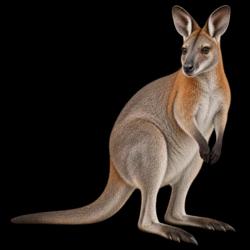
Red-necked Wallaby at a glance
Animal · Australia & Oceania · Eucalypt forest and woodland with a · Relatively common
Known for: Pale grey-white chest and belly, White stripe along the upper lip, Black paws, Grizzled grey body fur
Its Power
Pouch Reserve
Keep a small reserve for unexpected needs.
The red-necked wallaby uses its pouch to carry and protect its young, ensuring their safety and nourishment even in uncertain conditions.
“Reserve for the unexpected.”
Capture a Red-necked Wallaby, and it's yours when you finish one step it gives you.
Biological basis
Female red-necked wallabies have a pouch where they carry and nurture their joeys, providing them with protection and sustenance.
Put it into practice
Emma sets aside a portion of her monthly income into a savings account, ensuring she has a financial cushion for unforeseen expenses.
What does the red-necked wallaby symbolize?
The red-necked wallaby symbolizes pouch reserve: keep a small reserve for unexpected needs. It represents saving for later, nurturing and family care. Its AnimalDex motto: "Reserve for the unexpected."
The red-necked wallaby as a spirit animal
If the red-necked wallaby is your spirit animal, the AnimalDex reading is Pouch Reserve: the red-necked wallaby uses its pouch to carry and protect its young, ensuring their safety and nourishment even in uncertain conditions. It suggests a strength in saving for later and nurturing, and a reminder to use it on purpose.
What can the red-necked wallaby help you with in life?
The red-necked wallaby is a guide for saving for later, nurturing and family care. Its lesson applies wherever saving for later matters: the red-necked wallaby uses its pouch to carry and protect its young, ensuring their safety and nourishment even in uncertain conditions.
- Saving for Later
- Nurturing
- Family Care
In practice: Emma sets aside a portion of her monthly income into a savings account, ensuring she has a financial cushion for unforeseen expenses.
What can we learn from the Red-necked Wallaby?What does it mean to dream about or encounter a wild red-necked wallaby?
Dreaming about a wild red-necked wallaby, or coming across one, usually points to saving for later and nurturing: the qualities the red-necked wallaby lives by. In AnimalDex, the red-necked wallaby's principle is Pouch Reserve: keep a small reserve for unexpected needs. Read the moment through its core lesson: The red-necked wallaby uses its pouch to carry and protect its young, ensuring their safety and nourishment even in uncertain conditions.
It depends on how the red-necked wallaby behaved. Calm or close by, it reads as nurturing within reach; aggressive or fleeing, it points to saving for later you are resisting.
Spotting a red-necked wallaby in the wild
Coming across a red-necked wallaby in person asks for attention more than interpretation. Watch it for a minute; the red-necked wallaby's way of working is Pouch Reserve, and the lesson is: the red-necked wallaby uses its pouch to carry and protect its young, ensuring their safety and nourishment even in uncertain conditions.
A red-necked wallaby that keeps appearing
Seeing the red-necked wallaby again and again, in dreams or outside, suggests saving for later is a theme you have not settled yet.
Dreaming of being chased by a red-necked wallaby
Being chased suggests you are avoiding the Pouch Reserve the red-necked wallaby stands for: the red-necked wallaby uses its pouch to carry and protect its young, ensuring their safety and nourishment even in uncertain conditions. Ask what you keep postponing that needs saving for later.
Dreaming that a red-necked wallaby attacks you
When the red-necked wallaby attacks, the dream may be about pressure: nurturing or family care applied too hard, by you or by someone close to you.
A calm or friendly red-necked wallaby
Meeting a peaceful red-necked wallaby is usually encouraging: nurturing and family care are within reach.
A dead or injured red-necked wallaby
A dead or injured red-necked wallaby, dreamed or found, can mark saving for later you have let lapse, or a phase built on Pouch Reserve coming to an end.
These readings are reflective prompts drawn from how the red-necked wallaby really lives, not predictions. If you meet one in the wild, watch from a distance and leave it undisturbed.
Capture your own Red-necked Wallaby
Photograph or film one in the wild, at a zoo or at home with the app. It becomes yours: it remembers you, gives you steps, and can debate your problems with your other animals.
Animal field guide
Red-necked Wallaby
Sign in to hear this read by a natural AI voice instead of your browser's.
A medium-sized wallaby of eastern Australia and Tasmania, named for the reddish-brown fur across its nape and shoulders. The Tasmanian form, known as Bennett's wallaby, has a thicker, shaggier coat that suits its cold, wet highland habitat.
Native range
Natural range, not this capture location
Eucalypt forest and woodland with a dense shrub understorey, and coastal scrub, next to open grassy areas where it feeds. In Tasmania it ranges from coastal heath up into highland grassland and forest.
Search near meAnimalDex stats
Size scale
Understand the animal
Understand the Red-necked Wallaby
Factual biology first: what this animal is like, where it lives, how it survives, and why those traits exist.
01
Introduction to Red-necked Wallaby
A medium-sized wallaby of eastern Australia and Tasmania, named for the reddish-brown fur across its nape and shoulders. The Tasmanian form, known as Bennett's wallaby, has a thicker, shaggier coat that suits its cold, wet highland habitat.
How to identify a Red-necked Wallaby
- Pale grey-white chest and belly
- White stripe along the upper lip
- Black paws, feet tips and nose
- Grizzled grey body fur
Why Red-necked Wallaby are interesting
- Mainland females can breed at any time of year, whereas Tasmanian females give birth mostly in late summer.
- Animals released in New Zealand in the 1870s founded a wild population in South Canterbury, and escapes from collections have produced small, scattered populations in Britain.
- Adults are usually solitary but may gather loosely where grazing is good.
- Males spar by standing upright and grappling, pushing and kicking at each other.
02
Adaptations and biological abilities
03
Why does Red-necked Wallaby behave this way?
- Pale grey-white chest and belly
- White stripe along the upper lip
- Black paws, feet tips and nose
- Grizzled grey body fur
Mostly active at dusk, night and early morning, though often out in the late afternoon. It rests by day in dense scrub or forest cover.
04
Why Eucalypt forest and woodland with a dense shrub understorey?
Habitat: Eucalypt forest and woodland with a dense shrub understorey, and coastal scrub, next to open grassy areas where it feeds. In Tasmania it ranges from coastal heath up into highland grassland and forest.
Native range: Australia & Oceania, Tasmania
Native range
Natural range, not this specific capture location.
Some regional overlays are unavailable in this web build.
Eucalypt forest and woodland with a dense shrub understorey, and coastal scrub, next to open grassy areas where it feeds. In Tasmania it ranges from coastal heath up into highland grassland and forest.
05
Why this diet?
Grazes grasses and herbs, and browses on leaves of shrubs. It feeds in open pasture and clearings, usually close to cover.
06
Activity, rest, and lifespan
Mostly active at dusk, night and early morning, though often out in the late afternoon. It rests by day in dense scrub or forest cover.
Around 9 years in the wild; captive animals may reach about 15.
07
Red-necked Wallaby reproduction
After a pregnancy of about 30 days a single joey is born and spends roughly nine months in the pouch, then suckles at foot for several more months. Development of a second embryo can pause until the pouch is free.
Males are noticeably larger than females and more muscular in the forearms and chest.
08
Predators, threats, and defense
Dingoes and feral dogs take adults, while foxes and wedge-tailed eagles mainly take joeys and young animals. Tasmania has no dingoes, and there dogs, eagles and road traffic are the main threats. When alarmed it thumps the ground with its hind feet and bounds into cover.
09
Conservation and rarity
Rarity: Relatively common · 20/100. AnimalDex canonical rarity score: 20/100, maintained by the live indexed species profile.
- Observe from a respectful distance and avoid changing the animal's behavior.
- Do not block feeding, shelter, nesting, or travel routes.
- Use a live camera capture without handling or staging wildlife.
Talk to it
Talk to the Red-necked Wallaby
It answers as itself: ask about how it lives, or bring it something of yours and hear what it would do, from its own Power.
Anonymous: 6/day. Signed-in: 10/day. Pro: 100/day.
Side by side
The Red-necked Wallaby, side by side
Nothing written side by side for the Red-necked Wallaby yet. Pick any animal to compare it with. Compare with any animal →
Where to find them
Where to find Red-necked Wallaby
To find Red-necked Wallaby in the wild, focus on the exact habitat patches that match its body design and daily behavior, not just the broad country where it exists. You usually do better by working one good piece of habitat inside australia & Oceania, Tasmania than by covering too much ground.
- Forest edge, canopy gaps, fruiting trees, or shaded trails where cover and food meet
- Rocky slopes, ridge lines, cliff ledges, or open mountain meadows with a wide view
- Open grassland edges, lightly wooded plains, or raised ground where you can scan long distances
In the Ark
No Red-necked Wallaby is aboard yet.
The Ark is a live, shared animal world. Each animal comes aboard after a step that worked, and lives there by rules based on its field guide.
See the ArkScientific name
Macropus rufogriseus
Category
Animal
Habitat
Eucalypt forest and woodland with a dense shrub understorey, and coastal scrub, next to open grassy areas where it feeds. In Tasmania it ranges from coastal heath up into highland grassland and forest.
Rarity
Relatively common · 20/100
Native range
Australia & Oceania, Tasmania
Take the encyclopedia outside
AnimalDex helps you scan real animals, identify species, collect cards, and learn from nature wherever you are.