
Animal field guide
Red Swamp Crayfish
Procambarus clarkii
Dark red and usually no more than about 12 centimetres long, this freshwater crayfish comes from the swamps and ditches of the southern United States and north-east Mexico. It survives seasonal drying by digging a burrow down to the water table and waiting out the dry months in the damp chamber at the bottom.
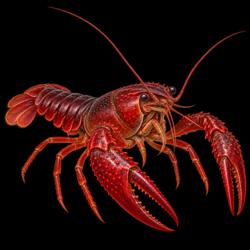
Red Swamp Crayfish at a glance
Animal · North America · Slow or still fresh water with soft · Relatively common
Known for: Dark red body, Claws covered in raised bright red bumps, Black wedge-shaped stripe along the top of the tail, Long
Its Power
Resourceful Tools Pattern
Utilize available tools to solve immediate challenges.
Red Swamp Crayfish use their pincers not only for defense but also to manipulate their environment and access food, showcasing adaptability and resourcefulness.
“Tools at Hand.”
Capture a Red Swamp Crayfish, and it's yours when you finish one step it gives you.
Biological basis
The Red Swamp Crayfish is known for its ability to use its pincers to dig burrows, capture prey, and interact with its surroundings.
Put it into practice
A camper with a broken tent pole splints it with a spoon and tape and sleeps dry.
What does the red swamp crayfish symbolize?
The red swamp crayfish symbolizes resourceful tools pattern: utilize available tools to solve immediate challenges. It represents using the right tool, resourcefulness and problem solving. Its AnimalDex motto: "Tools at Hand."
The red swamp crayfish as a spirit animal
If the red swamp crayfish is your spirit animal, the AnimalDex reading is Resourceful Tools Pattern: red Swamp Crayfish use their pincers not only for defense but also to manipulate their environment and access food, showcasing adaptability and resourcefulness. It suggests a strength in using the right tool and resourcefulness, and a reminder to use it on purpose.
What can the red swamp crayfish help you with in life?
The red swamp crayfish is a guide for using the right tool, resourcefulness and problem solving. Its lesson applies wherever using the right tool matters: red Swamp Crayfish use their pincers not only for defense but also to manipulate their environment and access food, showcasing adaptability and resourcefulness.
- Using the Right Tool
- Resourcefulness
- Problem Solving
In practice: A camper with a broken tent pole splints it with a spoon and tape and sleeps dry.
What can we learn from the Red Swamp Crayfish?What does it mean to dream about or encounter a wild red swamp crayfish?
A wild red swamp crayfish, whether in a dream or in front of you, tends to show up when using the right tool or resourcefulness is on your mind. In AnimalDex, the red swamp crayfish's principle is Resourceful Tools Pattern: utilize available tools to solve immediate challenges. Read the moment through its core lesson: Red Swamp Crayfish use their pincers not only for defense but also to manipulate their environment and access food, showcasing adaptability and resourcefulness.
Mostly a prompt rather than a warning. A calm red swamp crayfish suggests using the right tool you already have; a threatening one suggests using the right tool is being tested or pushed too far.
Spotting a red swamp crayfish in the wild
A real encounter is the plainest version of the sign: notice what the red swamp crayfish was doing. Utilize available tools to solve immediate challenges. That is the using the right tool worth borrowing today.
A red swamp crayfish that keeps appearing
A red swamp crayfish that keeps turning up points to resourcefulness you keep circling back to. The repetition is the message.
Dreaming of being chased by a red swamp crayfish
A chase often means a demand for using the right tool is catching up with you. The red swamp crayfish's lesson, "Red Swamp Crayfish use their pincers not only for defense but also to manipulate their environment and access food, showcasing adaptability and resourcefulness", is the part you may be running from.
Dreaming that a red swamp crayfish attacks you
An aggressive red swamp crayfish can mirror a conflict where using the right tool has become a weapon rather than a strength.
A calm or friendly red swamp crayfish
A relaxed red swamp crayfish near you, in a dream or in person, reads as readiness: Resourceful Tools Pattern is available to you now, as its motto puts it, "Tools at Hand.".
A dead or injured red swamp crayfish
Seeing the red swamp crayfish hurt may point to resourcefulness that has been neglected. Ask what it would take to restore it.
These readings are reflective prompts drawn from how the red swamp crayfish really lives, not predictions. If you meet one in the wild, watch from a distance and leave it undisturbed.
Capture your own Red Swamp Crayfish
Photograph or film one in the wild, at a zoo or at home with the app. It becomes yours: it remembers you, gives you steps, and can debate your problems with your other animals.
Animal field guide
Red Swamp Crayfish
Sign in to hear this read by a natural AI voice instead of your browser's.
Dark red and usually no more than about 12 centimetres long, this freshwater crayfish comes from the swamps and ditches of the southern United States and north-east Mexico. It survives seasonal drying by digging a burrow down to the water table and waiting out the dry months in the damp chamber at the bottom.
Native range
Natural range, not this capture location
Slow or still fresh water with soft mud bottoms: cypress swamps, marshes, roadside ditches, ponds, rice fields and sluggish streams on lowland coastal plains. It copes with warm, oxygen-poor and seasonally drying water better than most crayfish.
Search near meAnimalDex stats
Size scale
Understand the animal
Understand the Red Swamp Crayfish
Factual biology first: what this animal is like, where it lives, how it survives, and why those traits exist.
01
Introduction to Red Swamp Crayfish
Dark red and usually no more than about 12 centimetres long, this freshwater crayfish comes from the swamps and ditches of the southern United States and north-east Mexico. It survives seasonal drying by digging a burrow down to the water table and waiting out the dry months in the damp chamber at the bottom.
How to identify a Red Swamp Crayfish
- Dark red body, often almost black on older adults
- Claws covered in raised bright red bumps
- Black wedge-shaped stripe along the top of the tail
- Long, fairly narrow claws held forward
Why Red Swamp Crayfish are interesting
- It is the main crawfish of Louisiana, farmed on a large scale in flooded rice fields and ponds.
- Deliberate introductions for farming and the aquarium trade have made it one of the most widespread invasive freshwater animals in the world.
- Mature males alternate between a breeding form and a non-breeding form, switching when they moult.
- Where it has been introduced it can strip out water plants and eat amphibian eggs and tadpoles, changing whole pond communities.
- Blue and other unusual colour forms turn up in the wild and have been bred for aquariums.
02
Adaptations and biological abilities
03
Why does Red Swamp Crayfish behave this way?
- Dark red body, often almost black on older adults
- Claws covered in raised bright red bumps
- Black wedge-shaped stripe along the top of the tail
- Long, fairly narrow claws held forward
Mainly active at dusk and through the night, spending the day in its burrow or under debris. Laboratory studies of this species have described a sleep-like resting state with reduced responsiveness.
04
Why Slow or still fresh water with soft mud bottoms?
Habitat: Slow or still fresh water with soft mud bottoms: cypress swamps, marshes, roadside ditches, ponds, rice fields and sluggish streams on lowland coastal plains. It copes with warm, oxygen-poor and seasonally drying water better than most crayfish.
Native range: North America
Native range
Natural range, not this specific capture location.
Slow or still fresh water with soft mud bottoms: cypress swamps, marshes, roadside ditches, ponds, rice fields and sluggish streams on lowland coastal plains. It copes with warm, oxygen-poor and seasonally drying water better than most crayfish.
05
Why this diet?
An opportunistic omnivore that eats rotting plant matter, water plants, algae, snails, insect larvae, worms, tadpoles, small fish and carrion. It walks the bottom picking at food with its small front legs and seizes larger items with the claws.
06
Activity, rest, and lifespan
Mainly active at dusk and through the night, spending the day in its burrow or under debris. Laboratory studies of this species have described a sleep-like resting state with reduced responsiveness.
Usually 1 to 2 years in the wild; some individuals, especially in captivity, have been reported to live about 4 to 5 years.
07
Red Swamp Crayfish reproduction
After mating the female glues her fertilised eggs, usually a few hundred, to the swimmerets under her tail and carries them, often while sheltering in a burrow. The eggs hatch in about two to three weeks in warm water, and the young cling to her through their first moults.
Adult males have larger claws, small hooks at the base of some walking legs, and the first two pairs of swimmerets hardened into rigid mating structures. Females have a broader tail and soft, feathery swimmerets.
08
Predators, threats, and defense
09
Conservation and rarity
Rarity: Relatively common · 9/100. AnimalDex canonical rarity score: 9/100, maintained by the live indexed species profile.
- Observe from a respectful distance and avoid changing the animal's behavior.
- Do not block feeding, shelter, nesting, or travel routes.
- Use a live camera capture without handling or staging wildlife.
Talk to it
Talk to the Red Swamp Crayfish
It answers as itself: ask about how it lives, or bring it something of yours and hear what it would do, from its own Power.
Anonymous: 6/day. Signed-in: 10/day. Pro: 100/day.
Side by side
The Red Swamp Crayfish, side by side
Nothing written side by side for the Red Swamp Crayfish yet. Pick any animal to compare it with. Compare with any animal →
Where to find them
Where to find Red Swamp Crayfish
To find Red Swamp Crayfish in the wild, focus on the exact habitat patches that match its body design and daily behavior, not just the broad country where it exists. You usually do better by working one good piece of habitat inside north America than by covering too much ground.
- Quiet marsh edges, reedbeds, river bends, or shallow wetland margins
- Open grassland edges, lightly wooded plains, or raised ground where you can scan long distances
- Headlands, reef edges, island colonies, tidal channels, or productive coastal water
In the Ark
2 Red Swamp Crayfish are aboard right now.
Since November 5: 2 came aboard.
The Ark is a live, shared animal world. Animals come aboard when people capture them, and live there by rules based on their field guides.
Scientific name
Procambarus clarkii
Category
Animal
Habitat
Slow or still fresh water with soft mud bottoms: cypress swamps, marshes, roadside ditches, ponds, rice fields and sluggish streams on lowland coastal plains. It copes with warm, oxygen-poor and seasonally drying water better than most crayfish.
Rarity
Relatively common · 9/100
Native range
North America
Take the encyclopedia outside
AnimalDex helps you scan real animals, identify species, collect cards, and learn from nature wherever you are.