
Animal field guide
Rhinoceros
Rhinocerotidae
The Rhinoceros teaches Grounded Force through a massive herbivore body that makes panic break around its weight. Its thick skin, horn, low stance, grazing life, and defensive charge show that power is most convincing when rooted and direct. Its lesson is that strength does not need to rush when it is difficult to move.
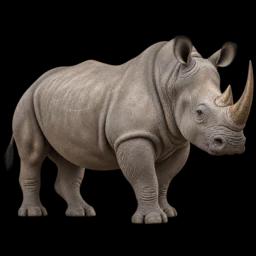
Rhinoceros at a glance
Mammal · Java · African species use savanna · Uncommon
Known for: One or two horns on the snout, Three toes on each foot, Thick skin, Small eyes and large
Its Power
Grounded Force
Stand heavy enough that panic breaks around you.
Power is most convincing when it is rooted, direct, and difficult to move.
“Stand like weight.”
Capture a Rhinoceros, and it's yours when you finish one step it gives you.
Biological basis
Rhinoceroses are large herbivores with thick skin, horns, and strong defensive charges when threatened.
Put it into practice
A calm no gets more respect than a loud argument.
What does the rhinoceros symbolize?
The rhinoceros symbolizes grounded force: stand heavy enough that panic breaks around you. It represents holding ground, presence and strength. Its AnimalDex motto: "Stand like weight."
The rhinoceros as a spirit animal
If the rhinoceros is your spirit animal, the AnimalDex reading is Grounded Force: power is most convincing when it is rooted, direct, and difficult to move. It suggests a strength in holding ground and presence, and a reminder to use it on purpose.
What can the rhinoceros help you with in life?
The rhinoceros is a guide for holding ground, presence and strength. Its lesson applies wherever holding ground matters: power is most convincing when it is rooted, direct, and difficult to move.
- Holding Ground
- Presence
- Strength
In practice: A calm no gets more respect than a loud argument.
What can we learn from the Rhinoceros?What does it mean to dream about or encounter a wild rhinoceros?
Dreaming about a wild rhinoceros, or coming across one, usually points to holding ground and presence: the qualities the rhinoceros lives by. In AnimalDex, the rhinoceros's principle is Grounded Force: stand heavy enough that panic breaks around you. Read the moment through its core lesson: Power is most convincing when it is rooted, direct, and difficult to move.
Neither good nor bad on its own. How the rhinoceros acts matters: at ease, it reflects holding ground; hostile, it flags holding ground out of balance.
Spotting a rhinoceros in the wild
If a rhinoceros crosses your path, take it as a cue to look at where holding ground fits your day. Its AnimalDex motto: "Stand like weight."
A rhinoceros that keeps appearing
Repeated sightings of a rhinoceros usually mean the Grounded Force lesson is still open: power is most convincing when it is rooted, direct, and difficult to move.
Dreaming of being chased by a rhinoceros
If the rhinoceros pursues you, look at where presence is being asked of you and you are stepping away instead of meeting it.
Dreaming that a rhinoceros attacks you
When the rhinoceros attacks, the dream may be about pressure: presence or strength applied too hard, by you or by someone close to you.
A calm or friendly rhinoceros
A relaxed rhinoceros near you, in a dream or in person, reads as readiness: Grounded Force is available to you now, as its motto puts it, "Stand like weight.".
A dead or injured rhinoceros
A dead or injured rhinoceros, dreamed or found, can mark holding ground you have let lapse, or a phase built on Grounded Force coming to an end.
These readings are reflective prompts drawn from how the rhinoceros really lives, not predictions. If you meet one in the wild, watch from a distance and leave it undisturbed.
Capture your own Rhinoceros
Photograph or film one in the wild, at a zoo or at home with the app. It becomes yours: it remembers you, gives you steps, and can debate your problems with your other animals.
Animal field guide
Rhinoceros
Sign in to hear this read by a natural AI voice instead of your browser's.
The Rhinoceros teaches Grounded Force through a massive herbivore body that makes panic break around its weight. Its lesson is that strength does not need to rush when it is difficult to move.
Native range
Natural range, not this capture location
African species use savanna, grassland and dry bush; Indian rhinos live in floodplain tall grass and swamp. The Javan and Sumatran rhinos live in dense lowland and hill rainforest. All need water and mud for wallowing.
Search near meAnimalDex stats
Size scale
Understand the animal
Understand the Rhinoceros
Factual biology first: what this animal is like, where it lives, how it survives, and why those traits exist.
01
Introduction to Rhinoceros
The Rhinoceros teaches Grounded Force through a massive herbivore body that makes panic break around its weight. Its thick skin, horn, low stance, grazing life, and defensive charge show that power is most convincing when rooted and direct. Its lesson is that strength does not need to rush when it is difficult to move.
How to identify a Rhinoceros
- One or two horns on the snout
- Three toes on each foot
- Thick skin, deeply folded in Indian and Javan rhinos, hairy in Sumatran
- Small eyes and large, mobile, tube-shaped ears
- Upper lip broad in grazers, pointed and grasping in browsers
Why Rhinoceros are interesting
- Rhino horn is made of keratin, the same protein as hair and nails, and has no bony core.
- There are five living species: two in Africa and three in Asia.
- The Javan rhinoceros survives only in Ujung Kulon National Park, with fewer than about 80 animals.
- Rhinos use communal dung heaps called middens, which carry scent information about the animals in the area.
02
Adaptations and biological abilities
03
Why does Rhinoceros behave this way?
- One or two horns on the snout
- Three toes on each foot
- Thick skin, deeply folded in Indian and Javan rhinos, hairy in Sumatran
- Small eyes and large, mobile, tube-shaped ears
- Upper lip broad in grazers, pointed and grasping in browsers
Most feed in the cooler morning, evening and night and rest through midday, lying down in shade or wallowing in mud. They doze standing or lying, often in the same resting places.
04
Why African species use savanna?
Habitat: African species use savanna, grassland and dry bush; Indian rhinos live in floodplain tall grass and swamp. The Javan and Sumatran rhinos live in dense lowland and hill rainforest. All need water and mud for wallowing.
Native range: Java, South Asia, Southeast Asia, Sub-Saharan Africa, Sumatra
Native range
Natural range, not this specific capture location.
Some regional overlays are unavailable in this web build.
African species use savanna, grassland and dry bush; Indian rhinos live in floodplain tall grass and swamp. The Javan and Sumatran rhinos live in dense lowland and hill rainforest. All need water and mud for wallowing.
05
Why this diet?
All are plant-eaters. White and Indian rhinos mainly graze short and tall grasses; black, Javan and Sumatran rhinos browse leaves, twigs, shoots and fruit, gripping them with a pointed upper lip. Adults eat large amounts daily.
06
Activity, rest, and lifespan
Most feed in the cooler morning, evening and night and rest through midday, lying down in shade or wallowing in mud. They doze standing or lying, often in the same resting places.
Roughly 30 to 45 years in the wild depending on species, though wild ages are hard to measure; some captive rhinos have lived past 45.
07
Rhinoceros reproduction
A single calf is born after a pregnancy of about 15 to 16 months. It can walk within hours, is suckled for a year or more and stays with its mother for two to four years, until the next calf arrives.
Males of most species are larger and heavier than females. Indian rhino males develop massive neck folds and larger incisor tusks; in African species females often have longer, thinner horns.
08
Predators, threats, and defense
Healthy adults have almost no natural predators, but lions and spotted hyenas in Africa and tigers in Asia kill calves. Mothers guard calves closely and charge threats. Poaching for horn is the greatest danger to every species.
09
Conservation and rarity
Rarity: Uncommon · 50/100. AnimalDex canonical rarity score: 50/100, maintained by the live indexed species profile.
- Observe from a respectful distance and avoid changing the animal's behavior.
- Do not block feeding, shelter, nesting, or travel routes.
- Use a live camera capture without handling or staging wildlife.
Talk to it
Talk to the Rhinoceros
It answers as itself: ask about how it lives, or bring it something of yours and hear what it would do, from its own Power.
Anonymous: 6/day. Signed-in: 10/day. Pro: 100/day.
Side by side
The Rhinoceros, side by side
Nothing written side by side for the Rhinoceros yet. Pick any animal to compare it with. Compare with any animal →
Where to find them
Where to find Rhinoceros
To find Rhinoceros in the wild, focus on the exact habitat patches that match its body design and daily behavior, not just the broad country where it exists. You usually do better by working one good piece of habitat inside java, South Asia, Southeast Asia, Sub-Saharan Africa, Sumatra than by covering too much ground.
- Quiet marsh edges, reedbeds, river bends, or shallow wetland margins
- Forest edge, canopy gaps, fruiting trees, or shaded trails where cover and food meet
- Open grassland edges, lightly wooded plains, or raised ground where you can scan long distances
In the Ark
4 Rhinoceroses are aboard right now.
Since November 5: 4 came aboard.
The Ark is a live, shared animal world. Animals come aboard when people capture them, and live there by rules based on their field guides.
Scientific name
Rhinocerotidae
Category
Mammal
Habitat
African species use savanna, grassland and dry bush; Indian rhinos live in floodplain tall grass and swamp. The Javan and Sumatran rhinos live in dense lowland and hill rainforest. All need water and mud for wallowing.
Rarity
Uncommon · 50/100
Native range
Java, South Asia, Southeast Asia, Sub-Saharan Africa, Sumatra
Take the encyclopedia outside
AnimalDex helps you scan real animals, identify species, collect cards, and learn from nature wherever you are.
Featured in tier lists
See where this species appears in AnimalDex tier-list pages built around structured comparison and methodology.
#6 · Character
Bravest Animals
Charges threats head-on rather than fleeing, with adults weighing well over a ton behind the horn.
Read tier list