
Animal field guide
Scarlet Tiger Moth
Callimorpha dominula
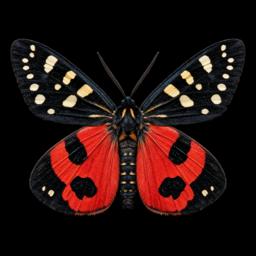
A day-flying tiger moth of damp, flowery places, glossy black-green above with cream and yellow spots, whose caterpillars are often found on comfrey. It is one of the most studied moths in evolutionary biology, thanks to decades of work on its colour forms in a fen at Cothill in Oxfordshire.
Scarlet Tiger Moth at a glance
Invertebrate · Europe · Damp · Relatively common
Known for: Wingspan about 45 to 55 millimetres, Glossy black-green forewings with cream and, Scarlet hindwings with bold black markings, Caterpillar black with yellow and white spots and
Its Power
Warning Flash
Signal your boundaries clearly to prevent conflict.
Use clear signals to communicate your limits and deter unwanted attention before it becomes a problem.
“Flash your warning.”
Capture a Scarlet Tiger Moth, and it's yours when you finish one step it gives you.
Biological basis
The Scarlet Tiger Moth flashes its vivid red underwings to warn predators of its toxicity, preventing attacks.
Put it into practice
In a meeting, she states her workload limits clearly, preventing extra tasks from being assigned to her.
What does the scarlet tiger moth symbolize?
The scarlet tiger moth symbolizes warning flash: signal your boundaries clearly to prevent conflict. It represents boundaries, early warning and confident display. Its AnimalDex motto: "Flash your warning."
The scarlet tiger moth as a spirit animal
If the scarlet tiger moth is your spirit animal, the AnimalDex reading is Warning Flash: use clear signals to communicate your limits and deter unwanted attention before it becomes a problem. It suggests a strength in boundaries and early warning, and a reminder to use it on purpose.
What can the scarlet tiger moth help you with in life?
The scarlet tiger moth is a guide for boundaries, early warning and confident display. Its lesson applies wherever boundaries matters: use clear signals to communicate your limits and deter unwanted attention before it becomes a problem.
- Boundaries
- Early Warning
- Confident Display
In practice: In a meeting, she states her workload limits clearly, preventing extra tasks from being assigned to her.
What can we learn from the Scarlet Tiger Moth?What does it mean to dream about or encounter a wild scarlet tiger moth?
A wild scarlet tiger moth, whether in a dream or in front of you, tends to show up when boundaries or early warning is on your mind. In AnimalDex, the scarlet tiger moth's principle is Warning Flash: signal your boundaries clearly to prevent conflict. Read the moment through its core lesson: Use clear signals to communicate your limits and deter unwanted attention before it becomes a problem.
Neither good nor bad on its own. How the scarlet tiger moth acts matters: at ease, it reflects boundaries; hostile, it flags boundaries out of balance.
Spotting a scarlet tiger moth in the wild
If a scarlet tiger moth crosses your path, take it as a cue to look at where boundaries fits your day. Its AnimalDex motto: "Flash your warning."
A scarlet tiger moth that keeps appearing
Seeing the scarlet tiger moth again and again, in dreams or outside, suggests boundaries is a theme you have not settled yet.
Dreaming of being chased by a scarlet tiger moth
Being chased suggests you are avoiding the Warning Flash the scarlet tiger moth stands for: use clear signals to communicate your limits and deter unwanted attention before it becomes a problem. Ask what you keep postponing that needs boundaries.
Dreaming that a scarlet tiger moth attacks you
When the scarlet tiger moth attacks, the dream may be about pressure: early warning or confident display applied too hard, by you or by someone close to you.
A calm or friendly scarlet tiger moth
A relaxed scarlet tiger moth near you, in a dream or in person, reads as readiness: Warning Flash is available to you now, as its motto puts it, "Flash your warning.".
A dead or injured scarlet tiger moth
Seeing the scarlet tiger moth hurt may point to early warning that has been neglected. Ask what it would take to restore it.
These readings are reflective prompts drawn from how the scarlet tiger moth really lives, not predictions. If you meet one in the wild, watch from a distance and leave it undisturbed.
Capture your own Scarlet Tiger Moth
Photograph or film one in the wild, at a zoo or at home with the app. It becomes yours: it remembers you, gives you steps, and can debate your problems with your other animals.
Animal field guide
Scarlet Tiger Moth
Sign in to hear this read by a natural AI voice instead of your browser's.
A day-flying tiger moth of damp, flowery places, glossy black-green above with cream and yellow spots, whose caterpillars are often found on comfrey. It is one of the most studied moths in evolutionary biology, thanks to decades of work on its colour forms in a fen at Cothill in Oxfordshire.
Native range
Natural range, not this capture location
Damp, sheltered places with lush vegetation: fens, marshes, riverbanks, damp woodland rides, and coastal cliffs and undercliffs, wherever comfrey and similar plants grow.
Search near meAnimalDex stats
Size scale
Understand the animal
Understand the Scarlet Tiger Moth
Factual biology first: what this animal is like, where it lives, how it survives, and why those traits exist.
01
Introduction to Scarlet Tiger Moth
A day-flying tiger moth of damp, flowery places, glossy black-green above with cream and yellow spots, whose caterpillars are often found on comfrey. It is one of the most studied moths in evolutionary biology, thanks to decades of work on its colour forms in a fen at Cothill in Oxfordshire.
How to identify a Scarlet Tiger Moth
- Wingspan about 45 to 55 millimetres
- Glossy black-green forewings with cream and yellowish spots
- Scarlet hindwings with bold black markings
- Caterpillar black with yellow and white spots and tufts of hair
Why Scarlet Tiger Moth are interesting
- The variant studied at Cothill, called medionigra, carries extra black on the hindwings and is controlled by a single gene.
- R. A. Fisher and E. B. Ford used yearly changes in the frequency of medionigra to argue that natural selection, not chance alone, was shaping the population.
- Its range runs from western Europe east into western Asia.
- In Britain it is most frequent in southern England and Wales and local or absent further north.
02
Adaptations and biological abilities
03
Why does Scarlet Tiger Moth behave this way?
- Wingspan about 45 to 55 millimetres
- Glossy black-green forewings with cream and yellowish spots
- Scarlet hindwings with bold black markings
- Caterpillar black with yellow and white spots and tufts of hair
Flies by day, mainly in warm sunshine, and also around dusk, when it sometimes comes to light. Rests on vegetation with the forewings drawn back over the hindwings.
04
Why Damp?
Habitat: Damp, sheltered places with lush vegetation: fens, marshes, riverbanks, damp woodland rides, and coastal cliffs and undercliffs, wherever comfrey and similar plants grow.
Native range: Europe
Native range
Natural range, not this specific capture location.
Damp, sheltered places with lush vegetation: fens, marshes, riverbanks, damp woodland rides, and coastal cliffs and undercliffs, wherever comfrey and similar plants grow.
05
Why this diet?
Caterpillars feed on comfrey, common nettle, bramble and a range of other plants, and are most often found on comfrey. Little is recorded about feeding by the adults.
06
Activity, rest, and lifespan
Flies by day, mainly in warm sunshine, and also around dusk, when it sometimes comes to light. Rests on vegetation with the forewings drawn back over the hindwings.
The life cycle takes one year, most of it as a caterpillar. Adult lifespan in the wild has not been documented in detail; the flight season lasts a few weeks.
07
Scarlet Tiger Moth reproduction
Eggs are laid on or near food plants in midsummer and hatch within a few weeks. Caterpillars feed into autumn, rest through the coldest weather, feed again in spring and pupate among plant litter in a loose cocoon.
The sexes look alike in colour and pattern and are hard to tell apart in the field.
08
Predators, threats, and defense
Birds, spiders, parasitic wasps and parasitic flies are its main enemies. Both moth and caterpillar are regarded as distasteful, and their bold colours are thought to warn birds away.
09
Conservation and rarity
Rarity: Relatively common · 12/100. AnimalDex canonical rarity score: 12/100, maintained by the live indexed species profile.
- Observe from a respectful distance and avoid changing the animal's behavior.
- Do not block feeding, shelter, nesting, or travel routes.
- Use a live camera capture without handling or staging wildlife.
Talk to it
Talk to the Scarlet Tiger Moth
It answers as itself: ask about how it lives, or bring it something of yours and hear what it would do, from its own Power.
Anonymous: 6/day. Signed-in: 10/day. Pro: 100/day.
Side by side
The Scarlet Tiger Moth, side by side
Nothing written side by side for the Scarlet Tiger Moth yet. Pick any animal to compare it with. Compare with any animal →
Where to find them
Where to find Scarlet Tiger Moth
To find Scarlet Tiger Moth in the wild, focus on the exact habitat patches that match its body design and daily behavior, not just the broad country where it exists. You usually do better by working one good piece of habitat inside europe than by covering too much ground.
- Quiet marsh edges, reedbeds, river bends, or shallow wetland margins
- Forest edge, canopy gaps, fruiting trees, or shaded trails where cover and food meet
- Rocky slopes, ridge lines, cliff ledges, or open mountain meadows with a wide view
In the Ark
No Scarlet Tiger Moth is aboard yet.
Since November 17: 1 died of old age.
The Ark is a live, shared animal world. Animals come aboard when people capture them, and live there by rules based on their field guides.
Scientific name
Callimorpha dominula
Category
Invertebrate
Habitat
Damp, sheltered places with lush vegetation: fens, marshes, riverbanks, damp woodland rides, and coastal cliffs and undercliffs, wherever comfrey and similar plants grow.
Rarity
Relatively common · 12/100
Native range
Europe
Take the encyclopedia outside
AnimalDex helps you scan real animals, identify species, collect cards, and learn from nature wherever you are.