
Animal field guide
Silver Dollar Fish
Metynnis argenteus
A close relative of the piranhas and pacus, in the same South American family, it uses sharp, closely set teeth to crop plants rather than flesh. Adults reach at most about 14 centimetres long.
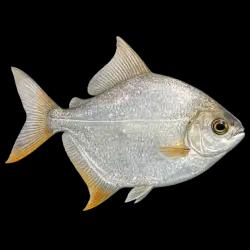
Silver Dollar Fish at a glance
Fish · Domesticated worldwide · In the wild it is recorded from the · Relatively common
Known for: Flat, Plain bright silver sides, Long, Saw-edged keel of small scutes along the belly
Its Power
Mirror-Disc Shoal
Foster a sense of unity by moving in sync with your team.
Silver Dollar Fish thrive in schools, where synchronized swimming helps them evade predators and find food efficiently.
“Move in harmony.”
Capture a Silver Dollar Fish, and it's yours when you finish one step it gives you.
Biological basis
Silver Dollar Fish naturally form schools, using coordinated movement as a defense mechanism and to improve foraging success.
Put it into practice
A rowing crew matches every stroke to one beat, and the boat runs faster than any of them could pull it.
What does the silver dollar fish symbolize?
The silver dollar fish symbolizes mirror-disc shoal: foster a sense of unity by moving in sync with your team. It represents coordination, teamwork and safety in numbers. Its AnimalDex motto: "Move in harmony."
The silver dollar fish as a spirit animal
If the silver dollar fish is your spirit animal, the AnimalDex reading is Mirror-Disc Shoal: silver Dollar Fish thrive in schools, where synchronized swimming helps them evade predators and find food efficiently. It suggests a strength in coordination and teamwork, and a reminder to use it on purpose.
What can the silver dollar fish help you with in life?
The silver dollar fish is a guide for coordination, teamwork and safety in numbers. Its lesson applies wherever coordination matters: silver Dollar Fish thrive in schools, where synchronized swimming helps them evade predators and find food efficiently.
- Coordination
- Teamwork
- Safety in Numbers
In practice: A rowing crew matches every stroke to one beat, and the boat runs faster than any of them could pull it.
What can we learn from the Silver Dollar Fish?What does it mean to dream about or encounter a wild silver dollar fish?
Meeting a wild silver dollar fish, asleep or awake, is often a nudge toward coordination, the quality the silver dollar fish is built around. In AnimalDex, the silver dollar fish's principle is Mirror-Disc Shoal: foster a sense of unity by moving in sync with your team. Read the moment through its core lesson: Silver Dollar Fish thrive in schools, where synchronized swimming helps them evade predators and find food efficiently.
Mostly a prompt rather than a warning. A calm silver dollar fish suggests coordination you already have; a threatening one suggests coordination is being tested or pushed too far.
Spotting a silver dollar fish in the wild
A real encounter is the plainest version of the sign: notice what the silver dollar fish was doing. Foster a sense of unity by moving in sync with your team. That is the coordination worth borrowing today.
A silver dollar fish that keeps appearing
A silver dollar fish that keeps turning up points to teamwork you keep circling back to. The repetition is the message.
Dreaming of being chased by a silver dollar fish
A chase often means a demand for coordination is catching up with you. The silver dollar fish's lesson, "Silver Dollar Fish thrive in schools, where synchronized swimming helps them evade predators and find food efficiently", is the part you may be running from.
Dreaming that a silver dollar fish attacks you
An aggressive silver dollar fish can mirror a conflict where coordination has become a weapon rather than a strength.
A calm or friendly silver dollar fish
A calm silver dollar fish suggests you have made peace with coordination and can use it without force.
A dead or injured silver dollar fish
An injured silver dollar fish often reflects coordination under strain; rest and repair come before pushing again.
These readings are reflective prompts drawn from how the silver dollar fish really lives, not predictions. If you meet one in the wild, watch from a distance and leave it undisturbed.
Capture your own Silver Dollar Fish
Photograph or film one in the wild, at a zoo or at home with the app. It becomes yours: it remembers you, gives you steps, and can debate your problems with your other animals.
Animal field guide
Silver Dollar Fish
Sign in to hear this read by a natural AI voice instead of your browser's.
A close relative of the piranhas and pacus, in the same South American family, it uses sharp, closely set teeth to crop plants rather than flesh. Adults reach at most about 14 centimetres long.
Native range
Natural range, not this capture location
In the wild it is recorded from the Tapajós River basin in Brazil, where it lives in warm, soft, slightly acidic water along well-vegetated margins and side channels.
Search near meAnimalDex stats
Size scale
Understand the animal
Understand the Silver Dollar Fish
Factual biology first: what this animal is like, where it lives, how it survives, and why those traits exist.
01
Introduction to Silver Dollar Fish
A close relative of the piranhas and pacus, in the same South American family, it uses sharp, closely set teeth to crop plants rather than flesh. Adults reach at most about 14 centimetres long.
How to identify a Silver Dollar Fish
- Flat, disc-shaped body almost as deep as it is long
- Plain bright silver sides, sometimes with faint grey spots
- Long, low fleshy fin between dorsal fin and tail
- Saw-edged keel of small scutes along the belly
- Small head with a short, blunt snout
Why Silver Dollar Fish are interesting
- The common name comes from its resemblance to the large silver dollar coin of the United States.
- Several species of Metynnis are sold under the same name, and they are hard to tell apart without close examination.
- The species was first described in 1923 by the German ichthyologist Ernst Ahl.
- Its scientific name argenteus is Latin for silvery, after the plain bright sides of the fish.
02
Adaptations and biological abilities
03
Why does Silver Dollar Fish behave this way?
- Flat, disc-shaped body almost as deep as it is long
- Plain bright silver sides, sometimes with faint grey spots
- Long, low fleshy fin between dorsal fin and tail
- Saw-edged keel of small scutes along the belly
- Small head with a short, blunt snout
Active by day, cruising the middle and upper water in a group. After dark the fish slow down and hang almost motionless near plants or the bottom until the light returns.
04
Why In the wild it is recorded from the Tapajós River basin in Brazil?
Habitat: In the wild it is recorded from the Tapajós River basin in Brazil, where it lives in warm, soft, slightly acidic water along well-vegetated margins and side channels.
Native range: Domesticated worldwide
Native range
Natural range, not this specific capture location.
Some regional overlays are unavailable in this web build.
In the wild it is recorded from the Tapajós River basin in Brazil, where it lives in warm, soft, slightly acidic water along well-vegetated margins and side channels.
05
Why this diet?
Leaves and stems of water plants form most of the diet, with algae, seeds and some small insects and worms taken as well. In aquaria it will strip soft-leaved plants down to the stalk.
06
Activity, rest, and lifespan
Active by day, cruising the middle and upper water in a group. After dark the fish slow down and hang almost motionless near plants or the bottom until the light returns.
Around 10 years in aquaria, and sometimes more; lifespan in the wild has not been documented.
07
Silver Dollar Fish reproduction
Eggs are scattered among plants, with around 2,000 reported from a single aquarium spawning. They sink, hatch in about three days, and the fry swim freely roughly a week after spawning. The parents give no care.
Males have a longer anal fin with a curved front edge, tinged with red or orange, most strongly at breeding time. In females the fin has a straight edge and little or no colour. The sexes are otherwise alike in size and shape.
08
Predators, threats, and defense
Predators of wild fish are not recorded in detail for this species, though larger predatory fish and fish-eating birds are the likely ones. A frightened fish dashes for plant cover, and in aquaria a sudden shadow or movement overhead is enough to set it off.
09
Conservation and rarity
Rarity: Relatively common · 22/100. AnimalDex canonical rarity score: 22/100, maintained by the live indexed species profile.
- Observe from a respectful distance and avoid changing the animal's behavior.
- Do not block feeding, shelter, nesting, or travel routes.
- Use a live camera capture without handling or staging wildlife.
Talk to it
Talk to the Silver Dollar Fish
It answers as itself: ask about how it lives, or bring it something of yours and hear what it would do, from its own Power.
Anonymous: 6/day. Signed-in: 10/day. Pro: 100/day.
Side by side
The Silver Dollar Fish, side by side
Nothing written side by side for the Silver Dollar Fish yet. Pick any animal to compare it with. Compare with any animal →
Where to find them
Where to find Silver Dollar Fish
To find Silver Dollar Fish in the wild, focus on the exact habitat patches that match its body design and daily behavior, not just the broad country where it exists. You usually do better by working one good piece of habitat inside domesticated worldwide than by covering too much ground.
- Quiet marsh edges, reedbeds, river bends, or shallow wetland margins
- Protected habitat blocks within domesticated worldwide
In the Ark
1 Silver Dollar Fish is aboard right now.
None have come aboard or left since November 17.
The Ark is a live, shared animal world. Animals come aboard when people capture them, and live there by rules based on their field guides.
Scientific name
Metynnis argenteus
Category
Fish
Habitat
In the wild it is recorded from the Tapajós River basin in Brazil, where it lives in warm, soft, slightly acidic water along well-vegetated margins and side channels.
Rarity
Relatively common · 22/100
Native range
Domesticated worldwide
Take the encyclopedia outside
AnimalDex helps you scan real animals, identify species, collect cards, and learn from nature wherever you are.