
Animal field guide
Smooth Ground Beetle
Carabus glabratus
Almost smooth wing-cases, without the ridges, rows of bumps or pits that many of its Carabus relatives show, set this large ground beetle apart. Adults measure roughly 22 to 34 millimetres, which puts it among the bigger beetles of the woodland floor.
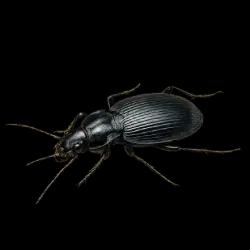
Smooth Ground Beetle at a glance
Invertebrate · Europe · Old deciduous and mixed woodland · Relatively common
Known for: Entirely black with a dull silky sheen, Long, Narrow head with long, Oval
Its Power
Unlit Patrol
Move with purpose and precision, avoiding unnecessary attention.
The Smooth Ground Beetle uses its dark, sleek body to blend into its environment, allowing it to hunt and navigate without drawing attention from predators.
“Walk the dark floor.”
Capture a Smooth Ground Beetle, and it's yours when you finish one step it gives you.
Biological basis
Smooth Ground Beetles are nocturnal and have a dark, shiny exoskeleton that helps them remain inconspicuous while foraging at night.
Put it into practice
A freelancer quietly finishes the contract while louder rivals are still announcing their plans.
What does the smooth ground beetle symbolize?
The smooth ground beetle symbolizes unlit patrol: move with purpose and precision, avoiding unnecessary attention. It represents quiet strategy, purpose and humility. Its AnimalDex motto: "Walk the dark floor."
The smooth ground beetle as a spirit animal
If the smooth ground beetle is your spirit animal, the AnimalDex reading is Unlit Patrol: the Smooth Ground Beetle uses its dark, sleek body to blend into its environment, allowing it to hunt and navigate without drawing attention from predators. It suggests a strength in quiet strategy and purpose, and a reminder to use it on purpose.
What can the smooth ground beetle help you with in life?
The smooth ground beetle is a guide for quiet strategy, purpose and humility. Its lesson applies wherever quiet strategy matters: the Smooth Ground Beetle uses its dark, sleek body to blend into its environment, allowing it to hunt and navigate without drawing attention from predators.
- Quiet Strategy
- Purpose
- Humility
In practice: A freelancer quietly finishes the contract while louder rivals are still announcing their plans.
What can we learn from the Smooth Ground Beetle?What does it mean to dream about or encounter a wild smooth ground beetle?
Meeting a wild smooth ground beetle, asleep or awake, is often a nudge toward quiet strategy, the quality the smooth ground beetle is built around. In AnimalDex, the smooth ground beetle's principle is Unlit Patrol: move with purpose and precision, avoiding unnecessary attention. Read the moment through its core lesson: The Smooth Ground Beetle uses its dark, sleek body to blend into its environment, allowing it to hunt and navigate without drawing attention from predators.
Mostly a prompt rather than a warning. A calm smooth ground beetle suggests quiet strategy you already have; a threatening one suggests quiet strategy is being tested or pushed too far.
Spotting a smooth ground beetle in the wild
If a smooth ground beetle crosses your path, take it as a cue to look at where quiet strategy fits your day. Its AnimalDex motto: "Walk the dark floor."
A smooth ground beetle that keeps appearing
Seeing the smooth ground beetle again and again, in dreams or outside, suggests quiet strategy is a theme you have not settled yet.
Dreaming of being chased by a smooth ground beetle
A chase often means a demand for quiet strategy is catching up with you. The smooth ground beetle's lesson, "The Smooth Ground Beetle uses its dark, sleek body to blend into its environment, allowing it to hunt and navigate without drawing attention from predators", is the part you may be running from.
Dreaming that a smooth ground beetle attacks you
An aggressive smooth ground beetle can mirror a conflict where quiet strategy has become a weapon rather than a strength.
A calm or friendly smooth ground beetle
A relaxed smooth ground beetle near you, in a dream or in person, reads as readiness: Unlit Patrol is available to you now, as its motto puts it, "Walk the dark floor.".
A dead or injured smooth ground beetle
Seeing the smooth ground beetle hurt may point to purpose that has been neglected. Ask what it would take to restore it.
These readings are reflective prompts drawn from how the smooth ground beetle really lives, not predictions. If you meet one in the wild, watch from a distance and leave it undisturbed.
Capture your own Smooth Ground Beetle
Photograph or film one in the wild, at a zoo or at home with the app. It becomes yours: it remembers you, gives you steps, and can debate your problems with your other animals.
Animal field guide
Smooth Ground Beetle
Sign in to hear this read by a natural AI voice instead of your browser's.
Almost smooth wing-cases, without the ridges, rows of bumps or pits that many of its Carabus relatives show, set this large ground beetle apart. Adults measure roughly 22 to 34 millimetres, which puts it among the bigger beetles of the woodland floor.
Native range
Natural range, not this capture location
Old deciduous and mixed woodland and conifer forest, and in some northern areas heather moor and bog; it favours cool, damp ground with deep leaf litter, moss and rotting wood, especially in hilly and upland country.
Search near meAnimalDex stats
Size scale
Understand the animal
Understand the Smooth Ground Beetle
Factual biology first: what this animal is like, where it lives, how it survives, and why those traits exist.
01
Introduction to Smooth Ground Beetle
Almost smooth wing-cases, without the ridges, rows of bumps or pits that many of its Carabus relatives show, set this large ground beetle apart. Adults measure roughly 22 to 34 millimetres, which puts it among the bigger beetles of the woodland floor.
How to identify a Smooth Ground Beetle
- Entirely black with a dull silky sheen
- Long, slender legs built for running
- Narrow head with long, curved jaws
- Oval, strongly domed body
Why Smooth Ground Beetle are interesting
- The species name glabratus is Latin for made smooth.
- In Britain it is local and found mostly in the uplands of the north and west.
- Because it cannot fly, populations cut off by farmland are thought to spread back into new woods only slowly.
- It is often found in long-established woodland and is treated in some regions as a sign of old, undisturbed forest.
02
Adaptations and biological abilities
03
Why does Smooth Ground Beetle behave this way?
- Entirely black with a dull silky sheen
- Long, slender legs built for running
- Narrow head with long, curved jaws
- Oval, strongly domed body
Mostly nocturnal, resting by day under logs, stones, moss or bark, though it also moves about by day in damp, overcast weather. Adults overwinter dormant in rotting wood or soil.
04
Why Old deciduous and mixed woodland and conifer forest?
Habitat: Old deciduous and mixed woodland and conifer forest, and in some northern areas heather moor and bog; it favours cool, damp ground with deep leaf litter, moss and rotting wood, especially in hilly and upland country.
Native range: Europe
Native range
Natural range, not this specific capture location.
Old deciduous and mixed woodland and conifer forest, and in some northern areas heather moor and bog; it favours cool, damp ground with deep leaf litter, moss and rotting wood, especially in hilly and upland country.
05
Why this diet?
A predator of soft-bodied animals: snails, slugs, earthworms and insect larvae. Like other Carabus, it digests prey partly outside its body, pouring out digestive juices and drinking the liquid.
06
Activity, rest, and lifespan
Mostly nocturnal, resting by day under logs, stones, moss or bark, though it also moves about by day in damp, overcast weather. Adults overwinter dormant in rotting wood or soil.
Adults of large Carabus beetles often live two to three years and breed in more than one season; exact figures for this species are poorly known.
07
Smooth Ground Beetle reproduction
Females lay eggs singly in the soil. The larvae are active hunters on the ground and pass through three stages before pupating in a chamber in the soil. There is no parental care.
Males have the first segments of the front feet widened and padded beneath, used to hold the female when mating; females lack these. Otherwise the sexes look alike.
08
Predators, threats, and defense
09
Conservation and rarity
Rarity: Relatively common · 27/100. AnimalDex canonical rarity score: 27/100, maintained by the live indexed species profile.
- Observe from a respectful distance and avoid changing the animal's behavior.
- Do not block feeding, shelter, nesting, or travel routes.
- Use a live camera capture without handling or staging wildlife.
Talk to it
Talk to the Smooth Ground Beetle
It answers as itself: ask about how it lives, or bring it something of yours and hear what it would do, from its own Power.
Anonymous: 6/day. Signed-in: 10/day. Pro: 100/day.
Side by side
The Smooth Ground Beetle, side by side
Nothing written side by side for the Smooth Ground Beetle yet. Pick any animal to compare it with. Compare with any animal →
Where to find them
Where to find Smooth Ground Beetle
To find Smooth Ground Beetle in the wild, focus on the exact habitat patches that match its body design and daily behavior, not just the broad country where it exists. You usually do better by working one good piece of habitat inside europe than by covering too much ground.
- Forest edge, canopy gaps, fruiting trees, or shaded trails where cover and food meet
- Protected habitat blocks within europe
Where explorers saw it
- Jausa, Hiiu maakond, EstoniaJul · 1 sighting
Guides to seeing Smooth Ground Beetle
In the Ark
1 Smooth Ground Beetle is aboard right now.
Since November 5: 1 came aboard.
The Ark is a live, shared animal world. Animals come aboard when people capture them, and live there by rules based on their field guides.
Scientific name
Carabus glabratus
Category
Invertebrate
Habitat
Old deciduous and mixed woodland and conifer forest, and in some northern areas heather moor and bog; it favours cool, damp ground with deep leaf litter, moss and rotting wood, especially in hilly and upland country.
Rarity
Relatively common · 27/100
Native range
Europe
Take the encyclopedia outside
AnimalDex helps you scan real animals, identify species, collect cards, and learn from nature wherever you are.