
Animal field guide
Splendid Garden Eel
Gorgasia preclara
The Splendid Garden Eel teaches anchored alertness. It does not chase the ocean; it positions itself where the current brings what it needs.
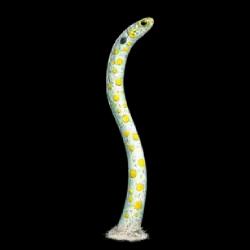
Splendid Garden Eel at a glance
Fish · Coral Triangle · Open sand and fine rubble slopes · Uncommon
Known for: Bright orange body ringed with narrow white bands, Pencil-thin body standing upright out of the sand, Large eyes on a short, Head bent into the current
Its Power
Rooted Awareness
Lives partly buried in sand, extending upward to feed while retreating quickly when threatened.
You can stay anchored while still reading the whole current around you.
“Stay rooted. Stay alert.”
Capture a Splendid Garden Eel, and it's yours when you finish one step it gives you.
Biological basis
Garden eels live in burrows and feed on drifting plankton, withdrawing into the sand when danger approaches.
Put it into practice
Keep a stable base while scanning for opportunities passing through your field.
What does the splendid garden eel symbolize?
The splendid garden eel symbolizes rooted awareness: lives partly buried in sand, extending upward to feed while retreating quickly when threatened. It represents alertness, holding ground and grounding. Its AnimalDex motto: "Stay rooted. Stay alert."
The splendid garden eel as a spirit animal
If the splendid garden eel is your spirit animal, the AnimalDex reading is Rooted Awareness: you can stay anchored while still reading the whole current around you. It suggests a strength in alertness and holding ground, and a reminder to use it on purpose.
What can the splendid garden eel help you with in life?
The splendid garden eel is a guide for alertness, holding ground and grounding. Its lesson applies wherever alertness matters: you can stay anchored while still reading the whole current around you.
- Alertness
- Holding Ground
- Grounding
In practice: Keep a stable base while scanning for opportunities passing through your field.
What can we learn from the Splendid Garden Eel?What does it mean to dream about or encounter a wild splendid garden eel?
Dreaming about a wild splendid garden eel, or coming across one, usually points to alertness and holding ground: the qualities the splendid garden eel lives by. In AnimalDex, the splendid garden eel's principle is Rooted Awareness: lives partly buried in sand, extending upward to feed while retreating quickly when threatened. Read the moment through its core lesson: You can stay anchored while still reading the whole current around you.
It depends on how the splendid garden eel behaved. Calm or close by, it reads as holding ground within reach; aggressive or fleeing, it points to alertness you are resisting.
Spotting a splendid garden eel in the wild
Coming across a splendid garden eel in person asks for attention more than interpretation. Watch it for a minute; the splendid garden eel's way of working is Rooted Awareness, and the lesson is: you can stay anchored while still reading the whole current around you.
A splendid garden eel that keeps appearing
Repeated sightings of a splendid garden eel usually mean the Rooted Awareness lesson is still open: you can stay anchored while still reading the whole current around you.
Dreaming of being chased by a splendid garden eel
If the splendid garden eel pursues you, look at where holding ground is being asked of you and you are stepping away instead of meeting it.
Dreaming that a splendid garden eel attacks you
When the splendid garden eel attacks, the dream may be about pressure: holding ground or grounding applied too hard, by you or by someone close to you.
A calm or friendly splendid garden eel
Meeting a peaceful splendid garden eel is usually encouraging: holding ground and grounding are within reach.
A dead or injured splendid garden eel
A dead or injured splendid garden eel, dreamed or found, can mark alertness you have let lapse, or a phase built on Rooted Awareness coming to an end.
These readings are reflective prompts drawn from how the splendid garden eel really lives, not predictions. If you meet one in the wild, watch from a distance and leave it undisturbed.
Capture your own Splendid Garden Eel
Photograph or film one in the wild, at a zoo or at home with the app. It becomes yours: it remembers you, gives you steps, and can debate your problems with your other animals.
Animal field guide
Splendid Garden Eel
Sign in to hear this read by a natural AI voice instead of your browser's.
The Splendid Garden Eel teaches anchored alertness. It does not chase the ocean; it positions itself where the current brings what it needs.
Native range
Natural range, not this capture location
Open sand and fine rubble slopes beside coral reefs in the Coral Triangle, where a steady current flows. Colonies are usually found fairly deep, often below about 25 metres.
Search near meAnimalDex stats
Size scale
Understand the animal
Understand the Splendid Garden Eel
Factual biology first: what this animal is like, where it lives, how it survives, and why those traits exist.
01
Introduction to Splendid Garden Eel
The Splendid Garden Eel teaches anchored alertness. It does not chase the ocean; it positions itself where the current brings what it needs.
How to identify a Splendid Garden Eel
- Bright orange body ringed with narrow white bands
- Pencil-thin body standing upright out of the sand
- Large eyes on a short, blunt snout
- Head bent into the current, body curved like a question mark
Why Splendid Garden Eel are interesting
- Colonies can hold dozens of individuals, each rising from its own burrow a short distance from its neighbours.
- Mixed colonies with spotted garden eels are often reported, the two kinds rising side by side on the same slope.
- The burrow walls are thought to be stiffened with mucus from the skin, which stops the sand tube collapsing.
- Garden eels are thought to dig their burrows tail first, driving a stiffened tail tip down into the sand.
02
Adaptations and biological abilities
03
Why does Splendid Garden Eel behave this way?
- Bright orange body ringed with narrow white bands
- Pencil-thin body standing upright out of the sand
- Large eyes on a short, blunt snout
- Head bent into the current, body curved like a question mark
Active by day, when it rises from the burrow to feed. At night it withdraws completely below the sand and rests inside the burrow.
04
Why Open sand and fine rubble slopes beside coral reefs in the Coral Triangle?
Habitat: Open sand and fine rubble slopes beside coral reefs in the Coral Triangle, where a steady current flows. Colonies are usually found fairly deep, often below about 25 metres.
Native range: Coral Triangle
Native range
Natural range, not this specific capture location.
Open sand and fine rubble slopes beside coral reefs in the Coral Triangle, where a steady current flows. Colonies are usually found fairly deep, often below about 25 metres.
05
Why this diet?
Zooplankton such as copepods and tiny crustacean and fish larvae, picked out of the water one item at a time.
06
Activity, rest, and lifespan
Active by day, when it rises from the burrow to feed. At night it withdraws completely below the sand and rests inside the burrow.
Its lifespan is unknown; no ages have been reported from the wild or from the colonies sometimes displayed in public aquariums.
07
Splendid Garden Eel reproduction
A transparent, leaf-shaped leptocephalus larva, the kind produced by all true eels, drifts in open water before changing shape and settling onto sand. Courtship and spawning have not been described in detail.
Males and females look alike, and the sexes cannot be told apart in the field.
08
Predators, threats, and defense
Predatory fish hunting over the sand are the main threat. When a predator or a diver comes near, it sinks backwards into its burrow within moments and stays hidden until the danger has passed.
09
Conservation and rarity
Rarity: Uncommon · 50/100. AnimalDex canonical rarity score: 50/100, maintained by the live indexed species profile.
- Observe from a respectful distance and avoid changing the animal's behavior.
- Do not block feeding, shelter, nesting, or travel routes.
- Use a live camera capture without handling or staging wildlife.
Talk to it
Talk to the Splendid Garden Eel
It answers as itself: ask about how it lives, or bring it something of yours and hear what it would do, from its own Power.
Anonymous: 6/day. Signed-in: 10/day. Pro: 100/day.
Side by side
The Splendid Garden Eel, side by side
Nothing written side by side for the Splendid Garden Eel yet. Pick any animal to compare it with. Compare with any animal →
Where to find them
Where to find Splendid Garden Eel
To find Splendid Garden Eel in the wild, focus on the exact habitat patches that match its body design and daily behavior, not just the broad country where it exists. You usually do better by working one good piece of habitat inside coral Triangle than by covering too much ground.
- Headlands, reef edges, island colonies, tidal channels, or productive coastal water
- Protected habitat blocks within coral Triangle
In the Ark
No Splendid Garden Eel is aboard yet.
None have come aboard or left since November 17.
The Ark is a live, shared animal world. Animals come aboard when people capture them, and live there by rules based on their field guides.
Scientific name
Gorgasia preclara
Category
Fish
Habitat
Open sand and fine rubble slopes beside coral reefs in the Coral Triangle, where a steady current flows. Colonies are usually found fairly deep, often below about 25 metres.
Rarity
Uncommon · 50/100
Native range
Coral Triangle
Take the encyclopedia outside
AnimalDex helps you scan real animals, identify species, collect cards, and learn from nature wherever you are.