
Animal field guide
Spotted Gar
Lepisosteus oculatus
A long, armoured fish of weedy, still water, it hunts by hanging almost motionless beside plants or sunken timber, its spotted flanks lost among the stems. When a small fish drifts within reach, the narrow jaws swing sideways and snap shut on it with rows of needle-like teeth.
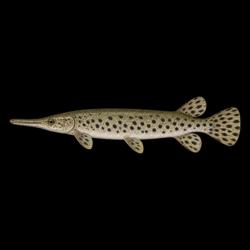
Spotted Gar at a glance
Fish · North America · Clear · Relatively common
Known for: Long, Round dark spots on the head, Fairly short, Dorsal fin set far back
Its Power
Stealth Approach
Master the art of quiet observation before acting.
Spotted Gars are patient predators, often lying motionless to ambush prey. This teaches the value of patience and observation before making a move.
“Wait and Watch.”
Capture a Spotted Gar, and it's yours when you finish one step it gives you.
Biological basis
The Spotted Gar uses its elongated body and camouflage to remain undetected in the water, allowing it to ambush prey effectively.
Put it into practice
A new hire spends the first month listening in meetings before suggesting a single change.
What does the spotted gar symbolize?
The spotted gar symbolizes stealth approach: master the art of quiet observation before acting. It represents stillness, patient progress and sharp observation. Its AnimalDex motto: "Wait and Watch."
The spotted gar as a spirit animal
If the spotted gar is your spirit animal, the AnimalDex reading is Stealth Approach: spotted Gars are patient predators, often lying motionless to ambush prey. This teaches the value of patience and observation before making a move. It suggests a strength in stillness and patient progress, and a reminder to use it on purpose.
What can the spotted gar help you with in life?
The spotted gar is a guide for stillness, patient progress and sharp observation. Its lesson applies wherever stillness matters: spotted Gars are patient predators, often lying motionless to ambush prey. This teaches the value of patience and observation before making a move.
- Stillness
- Patient Progress
- Sharp Observation
In practice: A new hire spends the first month listening in meetings before suggesting a single change.
What can we learn from the Spotted Gar?What does it mean to dream about or encounter a wild spotted gar?
Meeting a wild spotted gar, asleep or awake, is often a nudge toward stillness, the quality the spotted gar is built around. In AnimalDex, the spotted gar's principle is Stealth Approach: master the art of quiet observation before acting. Read the moment through its core lesson: Spotted Gars are patient predators, often lying motionless to ambush prey. This teaches the value of patience and observation before making a move.
Neither good nor bad on its own. How the spotted gar acts matters: at ease, it reflects stillness; hostile, it flags stillness out of balance.
Spotting a spotted gar in the wild
If a spotted gar crosses your path, take it as a cue to look at where stillness fits your day. Its AnimalDex motto: "Wait and Watch."
A spotted gar that keeps appearing
A spotted gar that keeps turning up points to patient progress you keep circling back to. The repetition is the message.
Dreaming of being chased by a spotted gar
If the spotted gar pursues you, look at where patient progress is being asked of you and you are stepping away instead of meeting it.
Dreaming that a spotted gar attacks you
An aggressive spotted gar can mirror a conflict where stillness has become a weapon rather than a strength.
A calm or friendly spotted gar
Meeting a peaceful spotted gar is usually encouraging: patient progress and sharp observation are within reach.
A dead or injured spotted gar
An injured spotted gar often reflects stillness under strain; rest and repair come before pushing again.
These readings are reflective prompts drawn from how the spotted gar really lives, not predictions. If you meet one in the wild, watch from a distance and leave it undisturbed.
Capture your own Spotted Gar
Photograph or film one in the wild, at a zoo or at home with the app. It becomes yours: it remembers you, gives you steps, and can debate your problems with your other animals.
Animal field guide
Spotted Gar
Sign in to hear this read by a natural AI voice instead of your browser's.
A long, armoured fish of weedy, still water, it hunts by hanging almost motionless beside plants or sunken timber, its spotted flanks lost among the stems. When a small fish drifts within reach, the narrow jaws swing sideways and snap shut on it with rows of needle-like teeth.
Native range
Natural range, not this capture location
Clear, quiet, heavily vegetated water: backwaters, oxbow lakes, swamps, bayous, sloughs and slow river margins across the Mississippi basin, the Gulf coastal drainages and parts of the Great Lakes. It tolerates slightly brackish coastal water.
Search near meAnimalDex stats
Size scale
Understand the animal
Understand the Spotted Gar
Factual biology first: what this animal is like, where it lives, how it survives, and why those traits exist.
01
Introduction to Spotted Gar
A long, armoured fish of weedy, still water, it hunts by hanging almost motionless beside plants or sunken timber, its spotted flanks lost among the stems. When a small fish drifts within reach, the narrow jaws swing sideways and snap shut on it with rows of needle-like teeth.
How to identify a Spotted Gar
- Long, cylindrical body covered in shiny diamond-shaped scales
- Round dark spots on the head, body and all fins
- Fairly short, broad snout for a gar
- Dorsal fin set far back, directly above the anal fin
Why Spotted Gar are interesting
- Its eggs are toxic, and eating gar roe can make people and other mammals ill.
- Its genome was sequenced in 2016 and serves as a reference for comparing ray-finned fishes with land vertebrates.
- Gars belong to an old lineage whose fossils reach back more than 100 million years.
- Its hard, interlocking scales are coated with ganoine, an enamel-like mineral layer.
02
Adaptations and biological abilities
03
Why does Spotted Gar behave this way?
- Long, cylindrical body covered in shiny diamond-shaped scales
- Round dark spots on the head, body and all fins
- Fairly short, broad snout for a gar
- Dorsal fin set far back, directly above the anal fin
Feeding peaks at dusk and through the night. By day it often rests near the surface among vegetation or logs, drifting almost still.
04
Why Clear?
Habitat: Clear, quiet, heavily vegetated water: backwaters, oxbow lakes, swamps, bayous, sloughs and slow river margins across the Mississippi basin, the Gulf coastal drainages and parts of the Great Lakes. It tolerates slightly brackish coastal water.
Native range: North America
Native range
Natural range, not this specific capture location.
Clear, quiet, heavily vegetated water: backwaters, oxbow lakes, swamps, bayous, sloughs and slow river margins across the Mississippi basin, the Gulf coastal drainages and parts of the Great Lakes. It tolerates slightly brackish coastal water.
05
Why this diet?
Mostly small fish such as shad, minnows and young sunfish, with crayfish and shrimp. A caught fish is worked round in the jaws and swallowed head first.
06
Activity, rest, and lifespan
Feeding peaks at dusk and through the night. By day it often rests near the surface among vegetation or logs, drifting almost still.
Females outlive males: ages in the high teens have been recorded for females, while males rarely seem to pass about 10 years.
07
Spotted Gar reproduction
Spawning runs from spring into early summer in shallow, weedy water, where a female scatters often thousands of sticky eggs over plants, attended by several males. There is no parental care; the larvae cling to vegetation with an adhesive pad on the snout until they can swim.
The sexes look alike in colour and pattern. Females grow larger and heavier than males of the same age.
08
Predators, threats, and defense
Young gars are eaten by larger fish, herons and other wading birds; adults face alligators and people. When disturbed it retreats into dense weed cover.
09
Conservation and rarity
Rarity: Relatively common · 37/100. AnimalDex canonical rarity score: 37/100, maintained by the live indexed species profile.
- Observe from a respectful distance and avoid changing the animal's behavior.
- Do not block feeding, shelter, nesting, or travel routes.
- Use a live camera capture without handling or staging wildlife.
Talk to it
Talk to the Spotted Gar
It answers as itself: ask about how it lives, or bring it something of yours and hear what it would do, from its own Power.
Anonymous: 6/day. Signed-in: 10/day. Pro: 100/day.
Side by side
The Spotted Gar, side by side
Nothing written side by side for the Spotted Gar yet. Pick any animal to compare it with. Compare with any animal →
Where to find them
Where to find Spotted Gar
To find Spotted Gar in the wild, focus on the exact habitat patches that match its body design and daily behavior, not just the broad country where it exists. You usually do better by working one good piece of habitat inside north America than by covering too much ground.
- Quiet marsh edges, reedbeds, river bends, or shallow wetland margins
- Headlands, reef edges, island colonies, tidal channels, or productive coastal water
- Sunlit logs, exposed branches, warm rocks, or regular perch sites used for scanning
In the Ark
No Spotted Gar is aboard yet.
None have come aboard or left since November 17.
The Ark is a live, shared animal world. Animals come aboard when people capture them, and live there by rules based on their field guides.
Scientific name
Lepisosteus oculatus
Category
Fish
Habitat
Clear, quiet, heavily vegetated water: backwaters, oxbow lakes, swamps, bayous, sloughs and slow river margins across the Mississippi basin, the Gulf coastal drainages and parts of the Great Lakes. It tolerates slightly brackish coastal water.
Rarity
Relatively common · 37/100
Native range
North America
Take the encyclopedia outside
AnimalDex helps you scan real animals, identify species, collect cards, and learn from nature wherever you are.