
Animal field guide
Stars and Stripes Pufferfish
Arothron hispidus
A heavy-bodied pufferfish reaching about 50 cm, among the larger members of its family. Young fish are often found in brackish estuaries and mangrove creeks, moving out onto reef flats and lagoons as they grow.
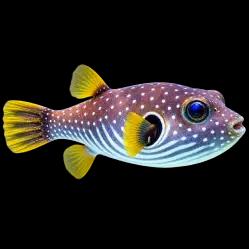
Stars and Stripes Pufferfish at a glance
Animal · Indian Ocean · Shallow reef flats · Relatively common
Known for: Small white spots scattered over a grey-brown back, Dark and pale stripes running along the belly, Black ring edged pale around each pectoral fin base, Stout
Its Power
Strategic Defense Strategy
Use your unique traits to deter threats effectively.
The Stars and Stripes Pufferfish inflates its body to appear larger and more intimidating, deterring predators and ensuring its safety.
“Swell too big to swallow.”
Capture a Stars and Stripes Pufferfish, and it's yours when you finish one step it gives you.
Biological basis
When threatened, the Stars and Stripes Pufferfish can inflate its body by swallowing water or air, making it difficult for predators to swallow.
Put it into practice
A short goalkeeper spreads her arms and rushes out, and the striker hurries the shot wide.
What does the stars and stripes pufferfish symbolize?
The stars and stripes pufferfish symbolizes strategic defense strategy: use your unique traits to deter threats effectively. It represents strategic bluffing, conflict prevention and self-defense. Its AnimalDex motto: "Swell too big to swallow."
The stars and stripes pufferfish as a spirit animal
If the stars and stripes pufferfish is your spirit animal, the AnimalDex reading is Strategic Defense Strategy: the Stars and Stripes Pufferfish inflates its body to appear larger and more intimidating, deterring predators and ensuring its safety. It suggests a strength in strategic bluffing and conflict prevention, and a reminder to use it on purpose.
What can the stars and stripes pufferfish help you with in life?
The stars and stripes pufferfish is a guide for strategic bluffing, conflict prevention and self-defense. Its lesson applies wherever strategic bluffing matters: the Stars and Stripes Pufferfish inflates its body to appear larger and more intimidating, deterring predators and ensuring its safety.
- Strategic Bluffing
- Conflict Prevention
- Self-Defense
In practice: A short goalkeeper spreads her arms and rushes out, and the striker hurries the shot wide.
What can we learn from the Stars and Stripes Pufferfish?What does it mean to dream about or encounter a wild stars and stripes pufferfish?
Meeting a wild stars and stripes pufferfish, asleep or awake, is often a nudge toward strategic bluffing, the quality the stars and stripes pufferfish is built around. In AnimalDex, the stars and stripes pufferfish's principle is Strategic Defense Strategy: use your unique traits to deter threats effectively. Read the moment through its core lesson: The Stars and Stripes Pufferfish inflates its body to appear larger and more intimidating, deterring predators and ensuring its safety.
Neither good nor bad on its own. How the stars and stripes pufferfish acts matters: at ease, it reflects strategic bluffing; hostile, it flags strategic bluffing out of balance.
Spotting a stars and stripes pufferfish in the wild
Coming across a stars and stripes pufferfish in person asks for attention more than interpretation. Watch it for a minute; the stars and stripes pufferfish's way of working is Strategic Defense Strategy, and the lesson is: the Stars and Stripes Pufferfish inflates its body to appear larger and more intimidating, deterring predators and ensuring its safety.
A stars and stripes pufferfish that keeps appearing
A stars and stripes pufferfish that keeps turning up points to conflict prevention you keep circling back to. The repetition is the message.
Dreaming of being chased by a stars and stripes pufferfish
If the stars and stripes pufferfish pursues you, look at where conflict prevention is being asked of you and you are stepping away instead of meeting it.
Dreaming that a stars and stripes pufferfish attacks you
When the stars and stripes pufferfish attacks, the dream may be about pressure: conflict prevention or self-defense applied too hard, by you or by someone close to you.
A calm or friendly stars and stripes pufferfish
A calm stars and stripes pufferfish suggests you have made peace with strategic bluffing and can use it without force.
A dead or injured stars and stripes pufferfish
Seeing the stars and stripes pufferfish hurt may point to conflict prevention that has been neglected. Ask what it would take to restore it.
These readings are reflective prompts drawn from how the stars and stripes pufferfish really lives, not predictions. If you meet one in the wild, watch from a distance and leave it undisturbed.
Capture your own Stars and Stripes Pufferfish
Photograph or film one in the wild, at a zoo or at home with the app. It becomes yours: it remembers you, gives you steps, and can debate your problems with your other animals.
Animal field guide
Stars and Stripes Pufferfish
Sign in to hear this read by a natural AI voice instead of your browser's.
A heavy-bodied pufferfish reaching about 50 cm, among the larger members of its family. Young fish are often found in brackish estuaries and mangrove creeks, moving out onto reef flats and lagoons as they grow.
Native range
Natural range, not this capture location
Shallow reef flats, lagoons, seagrass meadows and sandy or rubble patches near coral, usually from the shallows down to about 20 or 30 metres.
Search near meAnimalDex stats
Size scale
Understand the animal
Understand the Stars and Stripes Pufferfish
Factual biology first: what this animal is like, where it lives, how it survives, and why those traits exist.
01
Introduction to Stars and Stripes Pufferfish
A heavy-bodied pufferfish reaching about 50 cm, among the larger members of its family. Young fish are often found in brackish estuaries and mangrove creeks, moving out onto reef flats and lagoons as they grow.
How to identify a Stars and Stripes Pufferfish
- Small white spots scattered over a grey-brown back
- Dark and pale stripes running along the belly
- Black ring edged pale around each pectoral fin base
- Stout, rounded body with small prickles in the skin
- No pelvic fins and a blunt, beak-like mouth
Why Stars and Stripes Pufferfish are interesting
- Its beak is made of four tooth plates that keep growing throughout life and are worn down by crushing shells.
- It swims mainly by sculling its dorsal, anal and pectoral fins, using the tail only for short bursts of speed.
- The name hispidus means bristly, after the tiny prickles in its skin.
- It is reported to bite off the tips of branching corals as well as feeding on animals on the bottom.
02
Adaptations and biological abilities
03
Why does Stars and Stripes Pufferfish behave this way?
- Small white spots scattered over a grey-brown back
- Dark and pale stripes running along the belly
- Black ring edged pale around each pectoral fin base
- Stout, rounded body with small prickles in the skin
- No pelvic fins and a blunt, beak-like mouth
Mostly active in daylight, foraging slowly over the bottom. At night it rests on sand or wedged into a hole in the reef.
04
Why Shallow reef flats?
Habitat: Shallow reef flats, lagoons, seagrass meadows and sandy or rubble patches near coral, usually from the shallows down to about 20 or 30 metres.
Native range: Indian Ocean, Coral Triangle
Native range
Natural range, not this specific capture location.
Shallow reef flats, lagoons, seagrass meadows and sandy or rubble patches near coral, usually from the shallows down to about 20 or 30 metres.
05
Why this diet?
06
Activity, rest, and lifespan
Mostly active in daylight, foraging slowly over the bottom. At night it rests on sand or wedged into a hole in the reef.
No wild ages have been published. Aquarium keepers commonly report about 10 years in captivity, though this is not well documented.
07
Stars and Stripes Pufferfish reproduction
Breeding in the wild is little described. Like many pufferfishes it is thought to spawn eggs onto the bottom, and no care of eggs or young by either parent is known.
Males and females look alike, and there is no known external way to tell them apart.
08
Predators, threats, and defense
09
Conservation and rarity
Rarity: Relatively common · 39/100. AnimalDex canonical rarity score: 39/100, maintained by the live indexed species profile.
- Observe from a respectful distance and avoid changing the animal's behavior.
- Do not block feeding, shelter, nesting, or travel routes.
- Use a live camera capture without handling or staging wildlife.
Talk to it
Talk to the Stars and Stripes Pufferfish
It answers as itself: ask about how it lives, or bring it something of yours and hear what it would do, from its own Power.
Anonymous: 6/day. Signed-in: 10/day. Pro: 100/day.
Side by side
The Stars and Stripes Pufferfish, side by side
Nothing written side by side for the Stars and Stripes Pufferfish yet. Pick any animal to compare it with. Compare with any animal →
Where to find them
Where to find Stars and Stripes Pufferfish
To find Stars and Stripes Pufferfish in the wild, focus on the exact habitat patches that match its body design and daily behavior, not just the broad country where it exists. You usually do better by working one good piece of habitat inside indian Ocean, Coral Triangle than by covering too much ground.
- Quiet marsh edges, reedbeds, river bends, or shallow wetland margins
- Open grassland edges, lightly wooded plains, or raised ground where you can scan long distances
- Headlands, reef edges, island colonies, tidal channels, or productive coastal water
In the Ark
1 Stars and Stripes Pufferfish is aboard right now.
Since November 5: 1 came aboard.
The Ark is a live, shared animal world. Animals come aboard when people capture them, and live there by rules based on their field guides.
Scientific name
Arothron hispidus
Category
Animal
Habitat
Shallow reef flats, lagoons, seagrass meadows and sandy or rubble patches near coral, usually from the shallows down to about 20 or 30 metres.
Rarity
Relatively common · 39/100
Native range
Indian Ocean, Coral Triangle
Take the encyclopedia outside
AnimalDex helps you scan real animals, identify species, collect cards, and learn from nature wherever you are.