Animal field guide
Welcome Swallow
Hirundo neoxena
The Welcome Swallow is the common swallow of Australia and New Zealand, glossy blue-black above with a rust-coloured face and a deeply forked tail. It feeds entirely on the wing, sweeping low over water and paddocks, and nests close to people on almost any sheltered ledge.
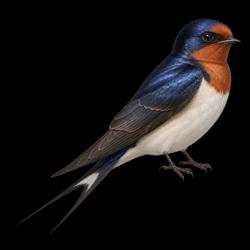
Welcome Swallow at a glance
Animal · Australia & Oceania · Open country of almost every kind · Relatively common
Known for: Glossy blue-black back and crown, Rusty orange forehead, Deeply forked tail with long outer streamers, Pale grey underparts with no dark breast band
Its Power
Borrowed Eaves
Build the small part and let a standing structure carry the rest.
A home does not need its own foundations when something sound is already standing to build against.
“Build under cover.”
Capture a Welcome Swallow, and it's yours when you finish one step it gives you.
Biological basis
Hirundo neoxena builds an open cup of mud pellets mixed with grass, lined with feathers and fur, and fixes it to a vertical surface under an overhang. Cliffs, caves and hollow trees once supplied those sites; bridges, verandas, culverts, sheds and moored boats now supply far more of them, and the species has spread with the buildings.
Put it into practice
A new tutor who rents a desk in the town library's community room gets a roof, heating and passing students without having to fund premises of her own.
What does the welcome swallow symbolize?
The welcome swallow symbolizes borrowed eaves: build the small part and let a standing structure carry the rest. It represents leverage, efficiency and safe shelter. Its AnimalDex motto: "Build under cover."
The welcome swallow as a spirit animal
If the welcome swallow is your spirit animal, the AnimalDex reading is Borrowed Eaves: a home does not need its own foundations when something sound is already standing to build against. It suggests a strength in leverage and efficiency, and a reminder to use it on purpose.
What can the welcome swallow help you with in life?
The welcome swallow is a guide for leverage, efficiency and safe shelter. Its lesson applies wherever leverage matters: a home does not need its own foundations when something sound is already standing to build against.
- Leverage
- Efficiency
- Safe Shelter
In practice: A new tutor who rents a desk in the town library's community room gets a roof, heating and passing students without having to fund premises of her own.
What can we learn from the Welcome Swallow?What does it mean to dream about or encounter a wild welcome swallow?
Dreaming about a wild welcome swallow, or coming across one, usually points to leverage and efficiency: the qualities the welcome swallow lives by. In AnimalDex, the welcome swallow's principle is Borrowed Eaves: build the small part and let a standing structure carry the rest. Read the moment through its core lesson: A home does not need its own foundations when something sound is already standing to build against.
Mostly a prompt rather than a warning. A calm welcome swallow suggests leverage you already have; a threatening one suggests leverage is being tested or pushed too far.
Spotting a welcome swallow in the wild
Coming across a welcome swallow in person asks for attention more than interpretation. Watch it for a minute; the welcome swallow's way of working is Borrowed Eaves, and the lesson is: a home does not need its own foundations when something sound is already standing to build against.
A welcome swallow that keeps appearing
A welcome swallow that keeps turning up points to efficiency you keep circling back to. The repetition is the message.
Dreaming of being chased by a welcome swallow
Being chased suggests you are avoiding the Borrowed Eaves the welcome swallow stands for: a home does not need its own foundations when something sound is already standing to build against. Ask what you keep postponing that needs leverage.
Dreaming that a welcome swallow attacks you
When the welcome swallow attacks, the dream may be about pressure: efficiency or safe shelter applied too hard, by you or by someone close to you.
A calm or friendly welcome swallow
A calm welcome swallow suggests you have made peace with leverage and can use it without force.
A dead or injured welcome swallow
Seeing the welcome swallow hurt may point to efficiency that has been neglected. Ask what it would take to restore it.
These readings are reflective prompts drawn from how the welcome swallow really lives, not predictions. If you meet one in the wild, watch from a distance and leave it undisturbed.
Capture your own Welcome Swallow
Photograph or film one in the wild, at a zoo or at home with the app. It becomes yours: it remembers you, gives you steps, and can debate your problems with your other animals.
Animal field guide
Welcome Swallow
Sign in to hear this read by a natural AI voice instead of your browser's.
The Welcome Swallow is the common swallow of Australia and New Zealand, glossy blue-black above with a rust-coloured face and a deeply forked tail. It feeds entirely on the wing, sweeping low over water and paddocks, and nests close to people on almost any sheltered ledge.
Native range
Natural range, not this capture location
Open country of almost every kind in Australia and New Zealand, including farmland, wetlands, coasts, towns and lightly wooded land, avoiding only dense forest and the driest deserts. It stays close to water for insects and mud, and close to structures that offer a sheltered ledge.
Search near meAnimalDex stats
Dominance
20
Speed
62
Size
6
Intelligence
36
Rarity
9%
Total
133
Size scale
Understand the animal
Understand the Welcome Swallow
Factual biology first: what this animal is like, where it lives, how it survives, and why those traits exist.
01
Introduction to Welcome Swallow
The Welcome Swallow is the common swallow of Australia and New Zealand, glossy blue-black above with a rust-coloured face and a deeply forked tail. It feeds entirely on the wing, sweeping low over water and paddocks, and nests close to people on almost any sheltered ledge.
How to identify a Welcome Swallow
- Glossy blue-black back and crown
- Rusty orange forehead, throat and upper breast
- Deeply forked tail with long outer streamers
- Pale grey underparts with no dark breast band
Why Welcome Swallow are interesting
- It reached New Zealand on its own, first breeding there in the 1950s, and is now common across the country.
- The name comes from southern Australia, where its return was welcomed as a sign of spring.
- It drinks and bathes in flight, skimming low to scoop water from the surface.
- Pairs often repair and reuse the same nest in following years, adding fresh mud to the rim.
- A row of white spots shows across the tail when it is fanned in a turn.
- The Barn Swallow, a summer visitor to northern Australia, has a dark blue-black band across the breast and whiter underparts, which the Welcome Swallow lacks.
02
Adaptations and biological abilities
03
Why does Welcome Swallow behave this way?
- Glossy blue-black back and crown
- Rusty orange forehead, throat and upper breast
- Deeply forked tail with long outer streamers
- Pale grey underparts with no dark breast band
Active by day from first light. Outside the breeding season birds gather to roost together, sometimes in large flocks, in reedbeds, on wires and on sheltered ledges.
04
Why Open country of almost every kind in Australia and New Zealand?
Habitat: Open country of almost every kind in Australia and New Zealand, including farmland, wetlands, coasts, towns and lightly wooded land, avoiding only dense forest and the driest deserts. It stays close to water for insects and mud, and close to structures that offer a sheltered ledge.
Native range: Australia & Oceania
Native range
Natural range, not this specific capture location.
Open country of almost every kind in Australia and New Zealand, including farmland, wetlands, coasts, towns and lightly wooded land, avoiding only dense forest and the driest deserts. It stays close to water for insects and mud, and close to structures that offer a sheltered ledge.
05
Why this diet?
Flying insects such as flies, midges, beetles, moths and flying ants, all caught in the air in fast, swerving flight. It often hunts low over water, mown grass and grazing stock where insects are stirred up.
06
Activity, rest, and lifespan
Active by day from first light. Outside the breeding season birds gather to roost together, sometimes in large flocks, in reedbeds, on wires and on sheltered ledges.
Most live only a few years, and around six years is a good age for a wild bird.
07
Welcome Swallow reproduction
The female lays three to five speckled eggs and incubates them alone for a little over two weeks, and both parents feed the chicks. Both sexes build the nest, and a pair often raises two broods in a season from the same cup.
The sexes look alike, though the female's outer tail streamers are slightly shorter. Juveniles are duller, with a paler face and short tail streamers.
08
Predators, threats, and defense
09
Conservation and rarity
Rarity: Relatively common · 9/100. AnimalDex canonical rarity score: 9/100, maintained by the live indexed species profile.
- Observe from a respectful distance and avoid changing the animal's behavior.
- Do not block feeding, shelter, nesting, or travel routes.
- Use a live camera capture without handling or staging wildlife.
Talk to it
Talk to the Welcome Swallow
It answers as itself: ask about how it lives, or bring it something of yours and hear what it would do, from its own Power.
Anonymous: 3/day. Signed-in: 10/day. Pro: 100/day.
Side by side
The Welcome Swallow, side by side
Nothing written side by side for the Welcome Swallow yet. Pick any animal to compare it with. Compare with any animal →
Where to find them
Where to find Welcome Swallow
To find Welcome Swallow in the wild, focus on the exact habitat patches that match its body design and daily behavior, not just the broad country where it exists. You usually do better by working one good piece of habitat inside australia & Oceania than by covering too much ground.
- Quiet marsh edges, reedbeds, river bends, or shallow wetland margins
- Forest edge, canopy gaps, fruiting trees, or shaded trails where cover and food meet
- Open grassland edges, lightly wooded plains, or raised ground where you can scan long distances
Where explorers saw it
- Rockhampton Regional, QLD, AustraliaSep · 1 sighting
Scientific name
Hirundo neoxena
Category
Animal
Habitat
Open country of almost every kind in Australia and New Zealand, including farmland, wetlands, coasts, towns and lightly wooded land, avoiding only dense forest and the driest deserts. It stays close to water for insects and mud, and close to structures that offer a sheltered ledge.
Rarity
Relatively common · 9/100
Native range
Australia & Oceania
Take the encyclopedia outside
AnimalDex helps you scan real animals, identify species, collect cards, and learn from nature wherever you are.