Animal field guide
Yellow-crowned Night Heron
Nyctanassa violacea
Stocky and grey, this heron of American coasts and swamps has a bill shorter and thicker than those of most herons, built for seizing and breaking hard-shelled prey. Small crabs go down whole; larger ones are shaken until the legs and claws come off, then swallowed body first.
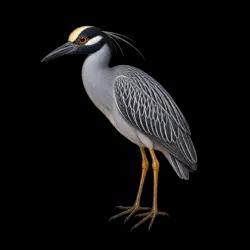
Yellow-crowned Night Heron at a glance
Bird · North America · Salt marshes · Relatively common
Known for: Black head with a broad white cheek patch, Creamy yellow crown with long pale plumes, Slate-grey body, Thick
Its Power
After-Dark Crabbing
Tide-Timed Crab Hunting
Work when the window opens, whether that comes at midnight or at midday.
“Follow the tide.”
Capture a Yellow-crowned Night Heron, and it's yours when you finish one step it gives you.
Biological basis
Yellow-crowned Night Herons eat mostly crabs and crayfish, cracked with a short heavy bill, and coastal birds feed whenever the tide exposes the flats, by night or by day.
Put it into practice
A busy student does homework whenever a free gap appears, morning or evening, instead of waiting for one fixed hour.
What does the yellow-crowned night heron symbolize?
The yellow-crowned night heron symbolizes after-dark crabbing: tide-Timed Crab Hunting. It represents deep work, seizing opportunity and focus. Its AnimalDex motto: "Follow the tide."
The yellow-crowned night heron as a spirit animal
If the yellow-crowned night heron is your spirit animal, the AnimalDex reading is After-Dark Crabbing: work when the window opens, whether that comes at midnight or at midday. It suggests a strength in deep work and seizing opportunity, and a reminder to use it on purpose.
What can the yellow-crowned night heron help you with in life?
The yellow-crowned night heron is a guide for deep work, seizing opportunity and focus. Its lesson applies wherever deep work matters: work when the window opens, whether that comes at midnight or at midday.
- Deep Work
- Seizing Opportunity
- Focus
In practice: A busy student does homework whenever a free gap appears, morning or evening, instead of waiting for one fixed hour.
What can we learn from the Yellow-crowned Night Heron?What does it mean to dream about or encounter a wild yellow-crowned night heron?
A wild yellow-crowned night heron, whether in a dream or in front of you, tends to show up when deep work or seizing opportunity is on your mind. In AnimalDex, the yellow-crowned night heron's principle is After-Dark Crabbing: tide-Timed Crab Hunting. Read the moment through its core lesson: Work when the window opens, whether that comes at midnight or at midday.
Mostly a prompt rather than a warning. A calm yellow-crowned night heron suggests deep work you already have; a threatening one suggests deep work is being tested or pushed too far.
Spotting a yellow-crowned night heron in the wild
A real encounter is the plainest version of the sign: notice what the yellow-crowned night heron was doing. Tide-Timed Crab Hunting. That is the deep work worth borrowing today.
A yellow-crowned night heron that keeps appearing
Repeated sightings of a yellow-crowned night heron usually mean the After-Dark Crabbing lesson is still open: work when the window opens, whether that comes at midnight or at midday.
Dreaming of being chased by a yellow-crowned night heron
If the yellow-crowned night heron pursues you, look at where seizing opportunity is being asked of you and you are stepping away instead of meeting it.
Dreaming that a yellow-crowned night heron attacks you
When the yellow-crowned night heron attacks, the dream may be about pressure: seizing opportunity or focus applied too hard, by you or by someone close to you.
A calm or friendly yellow-crowned night heron
Meeting a peaceful yellow-crowned night heron is usually encouraging: seizing opportunity and focus are within reach.
A dead or injured yellow-crowned night heron
Seeing the yellow-crowned night heron hurt may point to seizing opportunity that has been neglected. Ask what it would take to restore it.
These readings are reflective prompts drawn from how the yellow-crowned night heron really lives, not predictions. If you meet one in the wild, watch from a distance and leave it undisturbed.
Capture your own Yellow-crowned Night Heron
Photograph or film one in the wild, at a zoo or at home with the app. It becomes yours: it remembers you, gives you steps, and can debate your problems with your other animals.
Animal field guide
Yellow-crowned Night Heron
Sign in to hear this read by a natural AI voice instead of your browser's.
Stocky and grey, this heron of American coasts and swamps has a bill shorter and thicker than those of most herons, built for seizing and breaking hard-shelled prey. Small crabs go down whole; larger ones are shaken until the legs and claws come off, then swallowed body first.
Native range
Natural range, not this capture location
Salt marshes, mangroves, tidal creeks and mudflats on the coast; inland, wooded swamps, bayous and tree-lined rivers. It breeds from the eastern and central United States through Mexico, Central America and the Caribbean to coastal Peru and Brazil, and nests in tall trees, including those of suburban streets.
Search near meAnimalDex stats
Dominance
40
Speed
49
Size
25
Intelligence
36
Rarity
27%
Total
177
Size scale
Understand the animal
Understand the Yellow-crowned Night Heron
Factual biology first: what this animal is like, where it lives, how it survives, and why those traits exist.
01
Introduction to Yellow-crowned Night Heron
Stocky and grey, this heron of American coasts and swamps has a bill shorter and thicker than those of most herons, built for seizing and breaking hard-shelled prey. Small crabs go down whole; larger ones are shaken until the legs and claws come off, then swallowed body first.
How to identify a Yellow-crowned Night Heron
- Black head with a broad white cheek patch
- Creamy yellow crown with long pale plumes
- Slate-grey body; back feathers dark with pale edges
- Thick, all-dark bill and large orange-red eyes
- Yellow legs trail well beyond the tail in flight
Why Yellow-crowned Night Heron are interesting
- Despite the name, it often feeds by day as well as by night, timing its foraging to the tide more than to darkness.
- It was introduced to Bermuda in the 1970s to help control land crabs, and now breeds there.
- Young birds are brown with pale spots and streaks, and take about two years to reach full adult plumage.
- It is the only living member of the genus Nyctanassa.
02
Adaptations and biological abilities
03
Why does Yellow-crowned Night Heron behave this way?
- Black head with a broad white cheek patch
- Creamy yellow crown with long pale plumes
- Slate-grey body; back feathers dark with pale edges
- Thick, all-dark bill and large orange-red eyes
- Yellow legs trail well beyond the tail in flight
Most feeding happens from dusk through the night, but on the coast it follows the tide and will hunt in daylight when low water exposes crabs. It roosts by day in trees or dense shrubs, often over water.
04
Why Salt marshes?
Habitat: Salt marshes, mangroves, tidal creeks and mudflats on the coast; inland, wooded swamps, bayous and tree-lined rivers. It breeds from the eastern and central United States through Mexico, Central America and the Caribbean to coastal Peru and Brazil, and nests in tall trees, including those of suburban streets.
Native range: North America, South America
Native range
Natural range, not this specific capture location.
Salt marshes, mangroves, tidal creeks and mudflats on the coast; inland, wooded swamps, bayous and tree-lined rivers. It breeds from the eastern and central United States through Mexico, Central America and the Caribbean to coastal Peru and Brazil, and nests in tall trees, including those of suburban streets.
05
Why this diet?
06
Activity, rest, and lifespan
Most feeding happens from dusk through the night, but on the coast it follows the tide and will hunt in daylight when low water exposes crabs. It roosts by day in trees or dense shrubs, often over water.
Poorly documented. The oldest ringed wild bird reported was at least 6 years old, and the true span is probably longer.
07
Yellow-crowned Night Heron reproduction
The clutch is 2 to 6 pale blue-green eggs, usually 3 to 5, laid on a stick platform built by both parents. Both incubate for about 24 to 25 days and both feed the chicks, which leave the nest at five to six weeks.
The sexes look alike, with males averaging slightly larger. Juveniles are brown with fine white spots and streaks and take about three years to gain adult plumage.
08
Predators, threats, and defense
09
Conservation and rarity
Rarity: Relatively common · 27/100. AnimalDex canonical rarity score: 27/100, maintained by the live indexed species profile.
- Observe from a respectful distance and avoid changing the animal's behavior.
- Do not block feeding, shelter, nesting, or travel routes.
- Use a live camera capture without handling or staging wildlife.
Talk to it
Talk to the Yellow-crowned Night Heron
It answers as itself: ask about how it lives, or bring it something of yours and hear what it would do, from its own Power.
Anonymous: 3/day. Signed-in: 10/day. Pro: 100/day.
Side by side
The Yellow-crowned Night Heron, side by side
Nothing written side by side for the Yellow-crowned Night Heron yet. Pick any animal to compare it with. Compare with any animal →
Where to find them
Where to find Yellow-crowned Night Heron
To find Yellow-crowned Night Heron in the wild, focus on the exact habitat patches that match its body design and daily behavior, not just the broad country where it exists. You usually do better by working one good piece of habitat inside north America, South America than by covering too much ground.
- Quiet marsh edges, reedbeds, river bends, or shallow wetland margins
- Headlands, reef edges, island colonies, tidal channels, or productive coastal water
- Burrow systems, sandy banks, fallen logs, or ground with clear den entrances
Scientific name
Nyctanassa violacea
Category
Bird
Habitat
Salt marshes, mangroves, tidal creeks and mudflats on the coast; inland, wooded swamps, bayous and tree-lined rivers. It breeds from the eastern and central United States through Mexico, Central America and the Caribbean to coastal Peru and Brazil, and nests in tall trees, including those of suburban streets.
Rarity
Relatively common · 27/100
Native range
North America, South America
Take the encyclopedia outside
AnimalDex helps you scan real animals, identify species, collect cards, and learn from nature wherever you are.