
Animal field guide
Yellowfin Surgeonfish
Acanthurus xanthopterus
One of the largest surgeonfishes, reaching roughly 60 to 70 cm, this purplish-grey reef fish ranges more widely in depth than most of its relatives. It feeds in sheltered lagoons only a metre or two deep and has been recorded on outer reef slopes well below 50 metres.
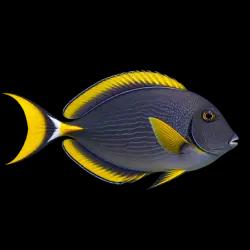
Yellowfin Surgeonfish at a glance
Animal · Indian Ocean · Sand and rubble bottoms beside · Relatively common
Known for: Outer part of each pectoral fin bright yellow, Yellow patch in front of the eye, Purplish-grey to dark brown body without stripes, Deeply crescent-shaped tail fin
Its Power
Sand-Film Grazing
Graze wherever the sand film lies, from shallow lagoon to deep slope.
The Yellowfin Surgeonfish thrives in various marine habitats by adjusting its feeding and social behaviors, showing the power of adaptability in changing conditions.
“Graze the open sand.”
Capture a Yellowfin Surgeonfish, and it's yours when you finish one step it gives you.
Biological basis
Yellowfin Surgeonfish are known for their ability to adapt to different marine environments, from coral reefs to sandy lagoons, by altering their diet and social interactions.
Put it into practice
A family posted abroad learns the local dishes and new ways of making friends within a few months.
What does the yellowfin surgeonfish symbolize?
The yellowfin surgeonfish symbolizes sand-film grazing: graze wherever the sand film lies, from shallow lagoon to deep slope. It represents teamwork, coordination and going with the flow. Its AnimalDex motto: "Graze the open sand."
The yellowfin surgeonfish as a spirit animal
If the yellowfin surgeonfish is your spirit animal, the AnimalDex reading is Sand-Film Grazing: the Yellowfin Surgeonfish thrives in various marine habitats by adjusting its feeding and social behaviors, showing the power of adaptability in changing conditions. It suggests a strength in teamwork and coordination, and a reminder to use it on purpose.
What can the yellowfin surgeonfish help you with in life?
The yellowfin surgeonfish is a guide for teamwork, coordination and going with the flow. Its lesson applies wherever teamwork matters: the Yellowfin Surgeonfish thrives in various marine habitats by adjusting its feeding and social behaviors, showing the power of adaptability in changing conditions.
- Teamwork
- Coordination
- Going with the Flow
In practice: A family posted abroad learns the local dishes and new ways of making friends within a few months.
What can we learn from the Yellowfin Surgeonfish?What does it mean to dream about or encounter a wild yellowfin surgeonfish?
A wild yellowfin surgeonfish, whether in a dream or in front of you, tends to show up when teamwork or coordination is on your mind. In AnimalDex, the yellowfin surgeonfish's principle is Sand-Film Grazing: graze wherever the sand film lies, from shallow lagoon to deep slope. Read the moment through its core lesson: The Yellowfin Surgeonfish thrives in various marine habitats by adjusting its feeding and social behaviors, showing the power of adaptability in changing conditions.
Mostly a prompt rather than a warning. A calm yellowfin surgeonfish suggests teamwork you already have; a threatening one suggests teamwork is being tested or pushed too far.
Spotting a yellowfin surgeonfish in the wild
Coming across a yellowfin surgeonfish in person asks for attention more than interpretation. Watch it for a minute; the yellowfin surgeonfish's way of working is Sand-Film Grazing, and the lesson is: the Yellowfin Surgeonfish thrives in various marine habitats by adjusting its feeding and social behaviors, showing the power of adaptability in changing conditions.
A yellowfin surgeonfish that keeps appearing
Seeing the yellowfin surgeonfish again and again, in dreams or outside, suggests teamwork is a theme you have not settled yet.
Dreaming of being chased by a yellowfin surgeonfish
Being chased suggests you are avoiding the Sand-Film Grazing the yellowfin surgeonfish stands for: the Yellowfin Surgeonfish thrives in various marine habitats by adjusting its feeding and social behaviors, showing the power of adaptability in changing conditions. Ask what you keep postponing that needs teamwork.
Dreaming that a yellowfin surgeonfish attacks you
An aggressive yellowfin surgeonfish can mirror a conflict where teamwork has become a weapon rather than a strength.
A calm or friendly yellowfin surgeonfish
Meeting a peaceful yellowfin surgeonfish is usually encouraging: coordination and going with the flow are within reach.
A dead or injured yellowfin surgeonfish
Seeing the yellowfin surgeonfish hurt may point to coordination that has been neglected. Ask what it would take to restore it.
These readings are reflective prompts drawn from how the yellowfin surgeonfish really lives, not predictions. If you meet one in the wild, watch from a distance and leave it undisturbed.
Capture your own Yellowfin Surgeonfish
Photograph or film one in the wild, at a zoo or at home with the app. It becomes yours: it remembers you, gives you steps, and can debate your problems with your other animals.
Animal field guide
Yellowfin Surgeonfish
Sign in to hear this read by a natural AI voice instead of your browser's.
One of the largest surgeonfishes, reaching roughly 60 to 70 cm, this purplish-grey reef fish ranges more widely in depth than most of its relatives. It feeds in sheltered lagoons only a metre or two deep and has been recorded on outer reef slopes well below 50 metres.
Native range
Natural range, not this capture location
Sand and rubble bottoms beside coral reefs, in bays, harbours, channels and lagoons. Young fish stay in shallow, sheltered and often turbid inshore water.
Search near meAnimalDex stats
Size scale
Understand the animal
Understand the Yellowfin Surgeonfish
Factual biology first: what this animal is like, where it lives, how it survives, and why those traits exist.
01
Introduction to Yellowfin Surgeonfish
One of the largest surgeonfishes, reaching roughly 60 to 70 cm, this purplish-grey reef fish ranges more widely in depth than most of its relatives. It feeds in sheltered lagoons only a metre or two deep and has been recorded on outer reef slopes well below 50 metres.
How to identify a Yellowfin Surgeonfish
- Outer part of each pectoral fin bright yellow
- Yellow patch in front of the eye
- Purplish-grey to dark brown body without stripes
- Deeply crescent-shaped tail fin
- Pale band often visible across the tail base
Why Yellowfin Surgeonfish are interesting
- It is often reported feeding in mixed groups with other surgeonfishes over open ground rather than alone.
- It is reported to have a thick-walled, gizzard-like stomach that grinds the sediment swallowed with its food.
- Individuals are reported to shift quickly between darker and noticeably lighter shades, especially when feeding or disturbed.
- It is taken for food by spear and net fishers in many parts of its range.
02
Adaptations and biological abilities
03
Why does Yellowfin Surgeonfish behave this way?
- Outer part of each pectoral fin bright yellow
- Yellow patch in front of the eye
- Purplish-grey to dark brown body without stripes
- Deeply crescent-shaped tail fin
- Pale band often visible across the tail base
Active by day, feeding over sand and rubble. At night it retreats into the reef and rests in crevices or beneath overhangs.
04
Why Sand and rubble bottoms beside coral reefs?
Habitat: Sand and rubble bottoms beside coral reefs, in bays, harbours, channels and lagoons. Young fish stay in shallow, sheltered and often turbid inshore water.
Native range: Indian Ocean, North Pacific, Coral Triangle
Native range
Natural range, not this specific capture location.
Some regional overlays are unavailable in this web build.
Sand and rubble bottoms beside coral reefs, in bays, harbours, channels and lagoons. Young fish stay in shallow, sheltered and often turbid inshore water.
05
Why this diet?
Mostly diatoms, detritus and filamentous algae taken from sand and hard surfaces, with hydroids and scraps of fish flesh also recorded in its gut. Unlike many surgeonfishes, it does not rely mainly on crops of seaweed on rock.
06
Activity, rest, and lifespan
Active by day, feeding over sand and rubble. At night it retreats into the reef and rests in crevices or beneath overhangs.
A long-lived reef fish: otolith ageing of fish from Hawaii has reported individuals up to about 29 years old. Lifespan elsewhere in its range is less well studied.
07
Yellowfin Surgeonfish reproduction
Adults gather to spawn in open water, releasing eggs and sperm that drift away with no parental care. The flat, transparent larvae spend weeks in the plankton before settling on shallow reefs as young fish.
Males and females look alike, and the sexes cannot be told apart in the field.
08
Predators, threats, and defense
09
Conservation and rarity
Rarity: Relatively common · 37/100. AnimalDex canonical rarity score: 37/100, maintained by the live indexed species profile.
- Observe from a respectful distance and avoid changing the animal's behavior.
- Do not block feeding, shelter, nesting, or travel routes.
- Use a live camera capture without handling or staging wildlife.
Talk to it
Talk to the Yellowfin Surgeonfish
It answers as itself: ask about how it lives, or bring it something of yours and hear what it would do, from its own Power.
Anonymous: 6/day. Signed-in: 10/day. Pro: 100/day.
Side by side
The Yellowfin Surgeonfish, side by side
Nothing written side by side for the Yellowfin Surgeonfish yet. Pick any animal to compare it with. Compare with any animal →
Where to find them
Where to find Yellowfin Surgeonfish
To find Yellowfin Surgeonfish in the wild, focus on the exact habitat patches that match its body design and daily behavior, not just the broad country where it exists. You usually do better by working one good piece of habitat inside indian Ocean, North Pacific, Coral Triangle than by covering too much ground.
- Quiet marsh edges, reedbeds, river bends, or shallow wetland margins
- Headlands, reef edges, island colonies, tidal channels, or productive coastal water
- Protected habitat blocks within indian Ocean, North Pacific, Coral Triangle
In the Ark
1 Yellowfin Surgeonfish is aboard right now.
None have come aboard or left since November 17.
The Ark is a live, shared animal world. Animals come aboard when people capture them, and live there by rules based on their field guides.
Scientific name
Acanthurus xanthopterus
Category
Animal
Habitat
Sand and rubble bottoms beside coral reefs, in bays, harbours, channels and lagoons. Young fish stay in shallow, sheltered and often turbid inshore water.
Rarity
Relatively common · 37/100
Native range
Indian Ocean, North Pacific, Coral Triangle
Take the encyclopedia outside
AnimalDex helps you scan real animals, identify species, collect cards, and learn from nature wherever you are.