animal incidents icebergiceberg explainedhumpback whale
The Animal Incidents Iceberg, Told by the Animals Themselves
The whale that gulped a kayaker, NOC the beluga who copied human voices, the nihilist penguin and Escobar's hippos: four famous animal incidents, and each animal's side of the story.
The short version · 0:38
THE ANIMAL INCIDENTS ICEBERG
This article in under a minute. Watch it here, then read on for the detail and sources.
AI-narrated, with motion added to some photos. Photo credits are with each image in the article.
The short version
Quick answer
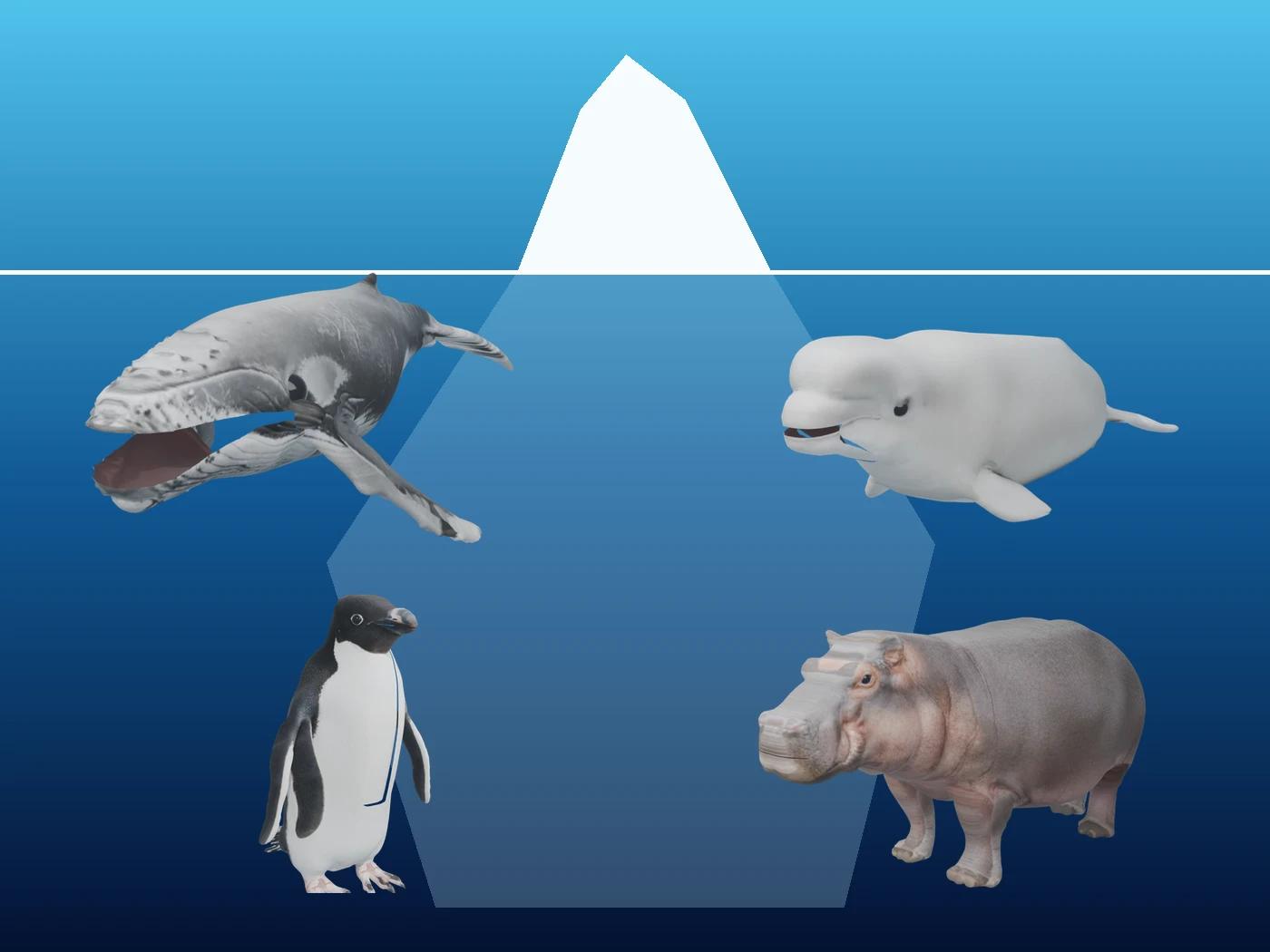
An iceberg video ranks stories from famous (the tip above the water) to obscure (the deep end). The animal incidents iceberg collects the strangest real moments between people and animals. We took four of the gentler ones, a humpback whale that briefly gulped a kayaker in Chile in 2025, NOC the beluga who copied human voices in the 1980s, the Adélie penguin that walked toward the mountains, and Pablo Escobar's runaway hippos, and asked a different question: what would the animal say?
In the short video above, each animal tells its side in its own AnimalDex voice. Below are the real facts behind each level.
What is the animal incidents iceberg?
Iceberg charts started as a meme format: a drawing of an iceberg with the stories everyone knows at the top and the deeper, stranger ones further down. Long iceberg explainers on YouTube now cover everything from internet mysteries to human evolution, and the animal incidents iceberg is one of the most watched, running through cases such as Harambe, Tilikum, Travis the chimp and Escobar's hippos.
Many of those stories end badly for someone. We kept to four where nobody was hurt by the incident itself, so the whole family can watch, and we told them the way a five-year-old would: one animal, one thing that happened, and the animal's own reaction.
Level 1
Level 1: The whale that gulped a kayaker
On 8 February 2025, Adrián Simancas was kayaking with his father, Dell, in Bahía El Águila on the Strait of Magellan in Chilean Patagonia. A humpback whale surfaced underneath him and, for a couple of seconds, he and his kayak disappeared into its mouth. Then the whale let him go. His father, filming from his own kayak a few metres away, kept telling him to stay calm. Both paddled back to shore unhurt.
Scientists who watched the footage think the whale was lunge-feeding on krill or small fish and the kayak was simply in the way. A humpback's mouth is enormous, but its throat is far too narrow to swallow a person, and humpbacks eat by filtering small prey through their baleen. The whale almost certainly spat him out as soon as it noticed something that was not food.
Humpback whale: "You paddled into my lunch! I spat you out in two seconds. You're welcome."
Level 2
Level 2: NOC, the beluga who copied human voices
In 1984, people working with marine mammals in San Diego kept hearing what sounded like two people talking far away near a whale enclosure, when nobody was there. One day a diver surfaced and asked who had told him to get out. The voice belonged to NOC, a male beluga whale.
Researchers recorded NOC and published the results in Current Biology in 2012. His human-like sounds were several octaves lower than normal beluga calls and had the rhythm of speech, about three bursts a second with pauses in between. To make them, he pushed air through his nasal passages at much higher pressure than usual. He did it for around four years before stopping. The scientists were careful to say this was mimicry, not conversation, but it is still one of the clearest examples of an animal trying to sound like us.
Beluga whale: "I copied your voices for years. Nobody ever talked back. Until now."
Level 3
Level 3: The penguin walking to the mountains
In Werner Herzog's 2007 documentary Encounters at the End of the World, a single Adélie penguin leaves its colony and waddles inland, away from the sea and toward mountains about 70 kilometres away. In January 2026 the clip went viral all over again as the "nihilist penguin" meme, shared as a picture of burnout, quitting, or just walking away from it all.
Penguin scientists have seen birds wander off like this before, and nobody knows for sure why. It may be disorientation. For our video, we let the penguin answer for itself, and it had a simpler explanation.
Adélie penguin: "I wasn't lost! I just wanted to see the mountains."
Level 4
Level 4: Escobar's hippos
In the 1980s the drug lord Pablo Escobar brought four hippos, one male and three females, to the private zoo at his Hacienda Nápoles ranch in Colombia. After his death in 1993 the other zoo animals were moved, but the hippos were too hard to catch, so they stayed. With warm weather, plenty of water and no predators or droughts, they did very well.
A 2021–2022 survey counted between 111 and 145 hippos along the Magdalena River, and Colombia's Environment Ministry now puts the number at around 200. They are now the largest invasive animal in the world, and Colombia has debated sterilising, moving or culling them. So when the hippo says there are over a hundred and fifty of them, it is, if anything, being modest.
Hippo: "Four of us were left behind. Now there are over a hundred and fifty of us. Oops."
Why we let the animals tell it
In AnimalDex, every animal you collect can talk back: in chat and on voice calls, as a talking 3D model, in a voice chosen for its kind. The models in this video are those same talking models, and the voices are the app's own animal voices. The humpback and the beluga share the deep Ocean Giant voice, the penguin speaks as the Playful Swimmer, and the hippo as the Matriarch.
The animals' lines in this video were written for it rather than taken from real chats. If you ask the humpback in AnimalDex about the kayaker, it will answer in its own words, and it might not be as polite.
Ask them yourself
Every species in this iceberg has its own page on AnimalDex, with facts, its Animal Power and the lesson people take from it. Open one, or photograph any animal you meet with the app, and ask it anything: why it did what it did, what it thinks of people, or what it would do with your problem.
Quick questions
Short answers to common questions readers ask on this topic.
- What is the animal incidents iceberg?
- It is an iceberg-format list of real animal incidents, ordered from the famous ones at the top (such as Harambe) to the more obscure ones further down. This version covers four gentle entries told from the animals' side: the humpback and the kayaker, NOC the talking beluga, the nihilist penguin and Escobar's hippos.
- Did a whale really swallow a kayaker?
- Briefly, yes. On 8 February 2025 a humpback whale engulfed kayaker Adrián Simancas and his kayak in the Strait of Magellan, Chile, for a few seconds before releasing him unhurt. Scientists think it was feeding and the kayak was in its way.
- Can a humpback whale swallow a human?
- No. A humpback's mouth is huge, but its throat is far too narrow for a person. Humpbacks filter krill and small fish through their baleen.
- Did a beluga whale really talk?
- A beluga named NOC imitated the rhythm and pitch of human speech in the 1980s, well enough that a diver thought a person had told him to get out of the water. Researchers published the recordings in Current Biology in 2012. It was mimicry, not conversation.
- What is the nihilist penguin meme?
- A clip from Werner Herzog's 2007 documentary Encounters at the End of the World, showing an Adélie penguin leaving its colony and walking inland toward distant mountains. It went viral as the "nihilist penguin" meme in January 2026.
- How many Escobar hippos are there now?
- They descend from four hippos brought to Colombia in the 1980s. A 2021–2022 survey counted 111 to 145, and Colombia's Environment Ministry now estimates about 200.
- Can I talk to animals in AnimalDex?
- Yes. Every animal in AnimalDex can chat with you and take voice calls as a talking 3D model, in a voice chosen for its kind. The lines in this video were written for it, but in the app the animal answers you in its own words.
Animals mentioned
Jump from this article into the species pages behind the examples, systems notes, and field-guide references.
Sources and further reading
- AP via KSL: A humpback whale briefly swallows kayaker in Chilean Patagonia
- Scientific American: Captive beluga whale imitated human voices
- National Geographic: The white whale NOC
- Know Your Meme: Penguin walking toward mountain / Nihilist penguin
- Scientific American: Colombia's cocaine hippo population is even bigger than scientists thought
- The World: Plan to cull hippos linked to Pablo Escobar divides Colombia
Answer guides related to this topic
If you want direct comparisons and clear recommendations, continue with these answer-focused pages.