

Honey beePollinationAnimal behavior
How Honey Bees Keep Ecosystems Running: Pollination Facts
How honey bees keep ecosystems running: the waggle dance, a 50,000-bee colony, foraging range, the share of crops that need pollinators, and the threats.
The short version · 0:43
SAVE THE BEES IS WRONG
This article in under a minute. Watch it here, then read on for the detail and sources.
AI-narrated, with motion added to some photos. Photo credits are with each image in the article.
Why honey bees matter beyond honey
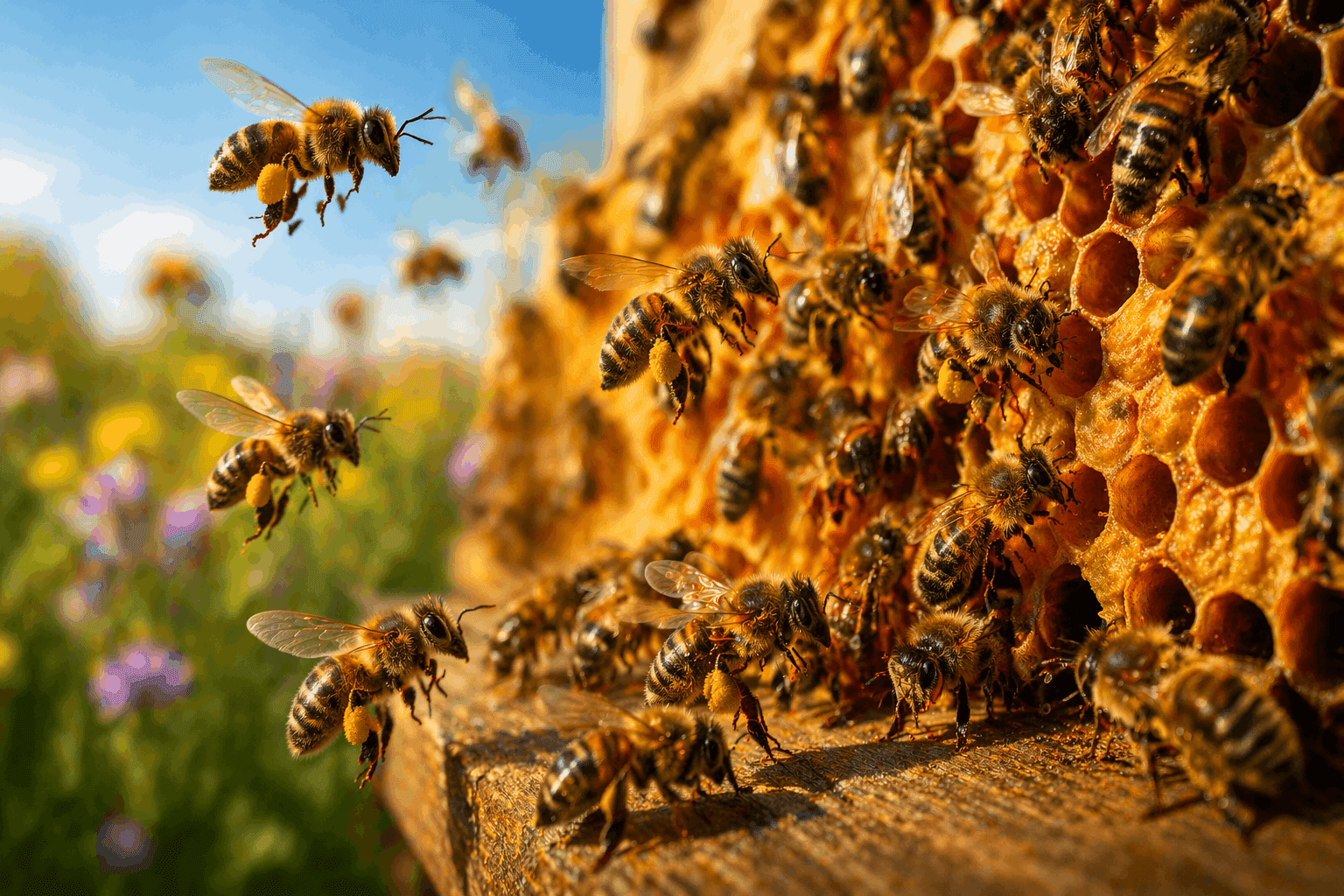
The western honey bee (Apis mellifera) is one of around 20,000 bee species, but it is the one that moves at agricultural scale. A single managed colony holds 20,000 to 60,000 workers at its summer peak, forages over an area of several square kilometres, and can be loaded onto a truck. Every February more than two million colonies are driven into California to pollinate almonds, the largest managed pollination event in the world.
The numbers behind that are worth having straight. A 2007 review in Proceedings of the Royal Society B by Alexandra-Maria Klein and colleagues found that 87 of the 115 leading global food crops depend to some degree on animal pollination, and that those crops make up about 35 percent of global crop production by volume. Staples such as wheat, rice, and maize are wind-pollinated; the fruit, nuts, vegetables, and oilseeds that provide most of our vitamins are not. In the United States the USDA puts the value of honey bee pollination at around 15 billion dollars a year.
Honey bees are not native to the Americas; colonists brought them in the 1620s. That makes them a managed tool as much as a wild species, and it is one reason conservation of native pollinators and conservation of honey bees are different problems.
How termites build living infrastructure
What makes a honey bee unique?
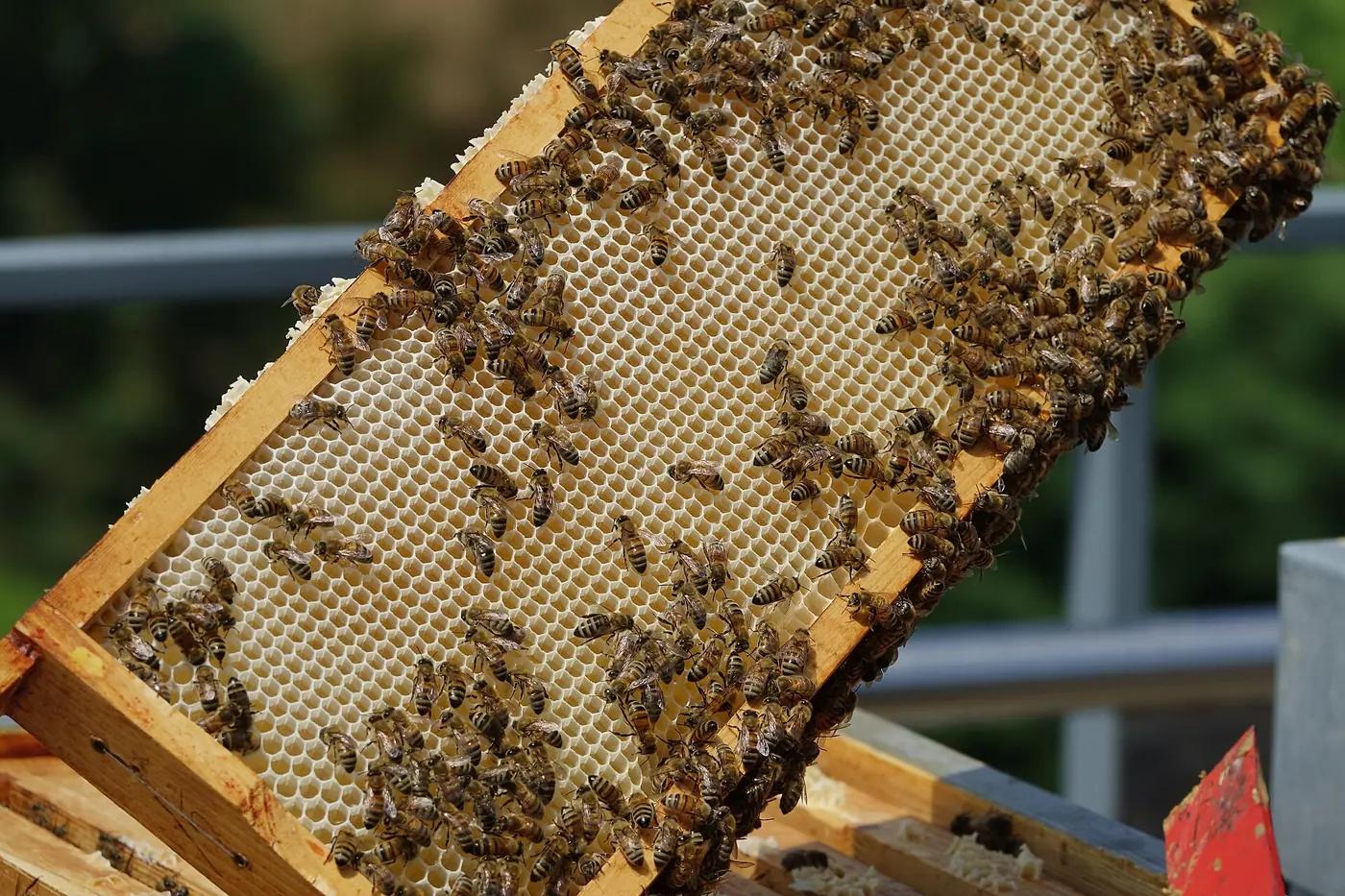
The waggle dance is the thing no other animal does. A returning forager walks a figure of eight on the vertical comb; the angle of the straight waggling run relative to straight up equals the angle of the food source relative to the sun, and the duration of the run encodes distance, roughly one second of waggling for every kilometre. Nestmates follow the dancer in the dark, read the angle and timing through touch and vibration, and fly to a patch they have never seen. Karl von Frisch decoded the dance and shared the 1973 Nobel Prize for it.
The sensory kit behind that is precise. A honey bee has five eyes: two compound eyes of several thousand facets each, and three simple ocelli on top of the head that track the sun and the sky's polarisation pattern, so a forager can navigate on an overcast day. Its colour vision runs from ultraviolet to orange; it cannot see red, but it sees the ultraviolet nectar guides painted on petals that are invisible to us. The antennae carry around 170 odour receptor types, more than most insects, and bees can be trained to detect single scents in minutes.
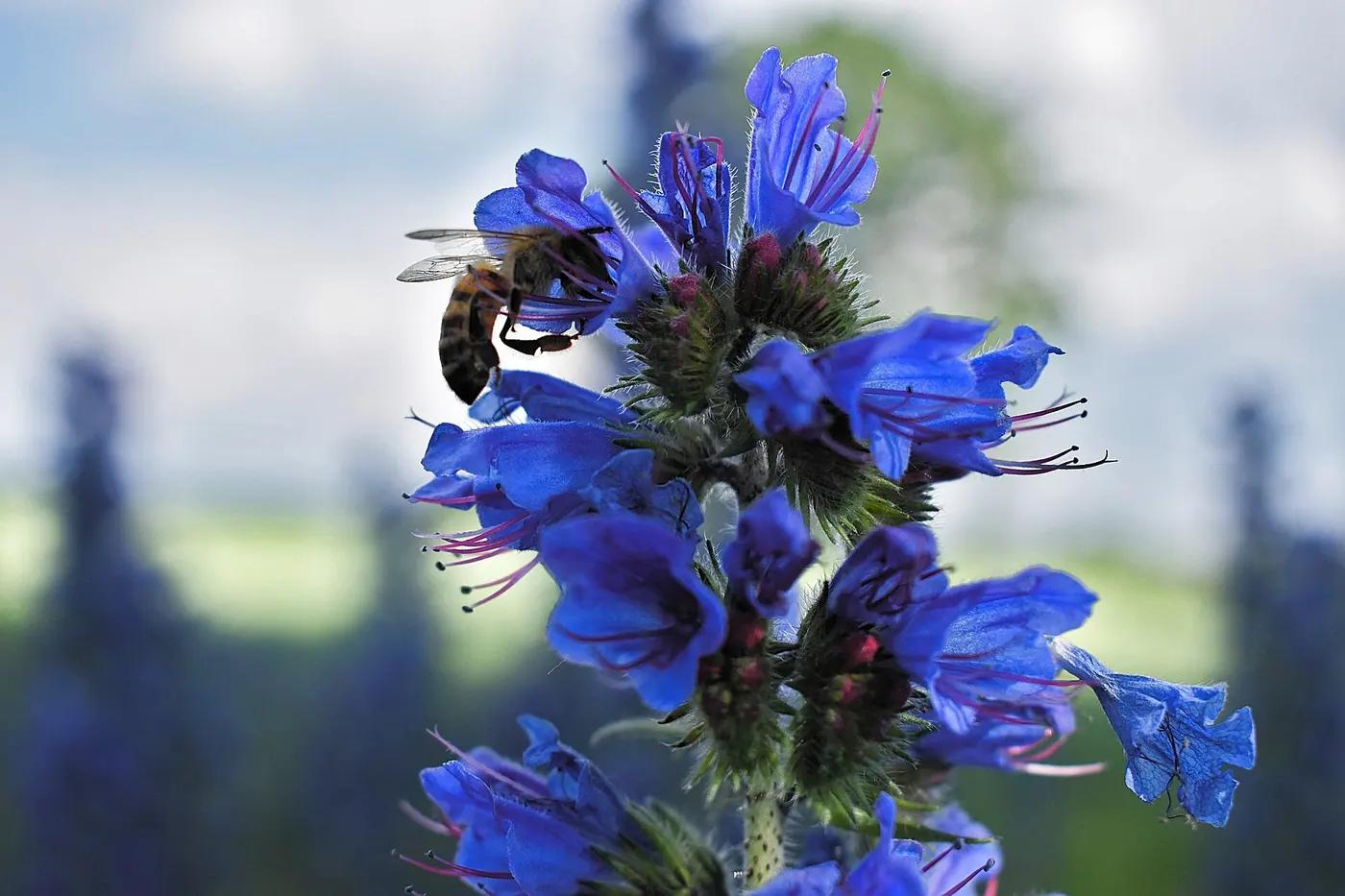
Pollen collection is mechanical. Branched body hairs trap grains, and the bee combs them into the corbiculae, the flattened pollen baskets on the hind legs, moistened with nectar. A flying bee carries a positive electrostatic charge that pulls negatively charged pollen onto it before contact. Each trip ends with a few milligrams of pollen or a crop of nectar, and a strong colony stores 20 to 30 kilograms of honey for winter.
| Trait | Honey bee (Apis mellifera) | Bumblebee (Bombus) | Solitary bee (for example, mason bees) |
|---|---|---|---|
| Colony size | 20,000 to 60,000 at peak | 50 to 400 | 1; nests alone |
| Survives winter as | Whole colony clustered on stored honey | Mated queen only | Pupa or adult sealed in a nest cell |
| Recruits nestmates to flowers | Yes, waggle dance with direction and distance | Partly; scent and excitement, no direction | No |
| Typical foraging range | 2 to 3 km, up to 10 km | Under 1 to 2 km | Often under 300 m |
| Cold-weather flying | Needs about 12 to 14 °C | Flies at 5 °C or lower; shivers to warm up | Varies by species |
| Buzz pollination (tomato, blueberry) | Cannot | Yes | Many species can |
| Managed for crops | Worldwide, trucked between farms | Reared for greenhouse tomatoes | Orchards, as cocoons in nest tubes |
How honey bees survive as a colony system
A colony is one queen, a few hundred to a few thousand drones in summer, and tens of thousands of female workers. The queen lays up to 1,500 to 2,000 eggs a day in peak season and lives two to five years. A summer worker lives about six weeks and moves through jobs by age: cleaning cells, nursing larvae, building comb from wax secreted by abdominal glands, guarding the entrance, and finally foraging until her wings wear out. Workers raised in autumn have a different physiology and live four to six months to carry the colony through winter.
Temperature is managed to within a degree. Brood is held at 34 to 35 °C whether the outside air is 5 or 40 degrees: workers fan at the entrance and spread water droplets to cool the comb, and shiver their flight muscles to heat it. In winter the colony forms a cluster that contracts as it gets colder, with bees rotating from the cold outer shell to the warm core.
Reproduction happens at colony level. In spring a strong colony raises new queens, and the old queen leaves with roughly half the workers as a swarm. Scouts search for a cavity, dance for the sites they find, and the swarm commits once a quorum of scouts favours one site, a decision process Thomas Seeley has shown reliably picks the best option available. The waggle dance, in other words, is used for real estate as well as food.
The ecosystem role of honey bees
A forager visits 50 to 100 flowers per trip and makes a dozen or more trips a day, and a colony fields thousands of foragers at once. That volume is why honey bees can set a commercial fruit crop in a few days of good weather. Apples, almonds, blueberries, cherries, cucumbers, melons, squash, sunflowers, and canola all depend on or benefit heavily from insect pollination, and in most of those orchards and fields honey bees do the majority of the visits.
In wild and semi-wild habitat the picture is more mixed. Honey bees pollinate many native plants, but they are generalists, and at high density they can compete with native bees for nectar and spread diseases to them. The 4,000 native bee species in North America, and the hoverflies, butterflies, moths, beetles, and bats alongside them, are better pollinators of many wild plants and of crops such as tomatoes that need buzz pollination.
Honey bees are also under real pressure. The parasitic mite Varroa destructor, which arrived in Europe and North America in the 1980s, is the single biggest cause of colony loss; US beekeepers have lost 30 to 40 percent of their colonies in most recent years and replace them by splitting hives. Pesticide exposure, poor forage in monoculture landscapes, and pathogens the mite spreads compound it. Managed colony numbers are stable because beekeepers rebuild them, which hides how hard the system is working.
One forager's discovery becomes the whole colony's flight plan within minutes. That is the honey bee's real superpower.
What humans can learn from honey bee systems
The dance is a lesson in information design. It carries exactly two numbers, direction and distance, plus a quality signal in how long and vigorously the bee repeats it. Nothing about the flower's colour or the route is encoded; the receiver supplies that. Compact, high-value signals that leave the detail to the person on the ground move organisations faster than exhaustive reports.
The swarm's house-hunting is a lesson in decision-making. No scout sees every option, no bee is in charge, and bad sites lose support because their dancers stop sooner. Seeley's work shows the swarm reaches a correct choice more reliably than most individual bees would, and that is the model behind a good deal of modern research on group decisions.
If you want to watch all of this, you do not need a hive. A patch of flowering plants on a warm afternoon will give you foragers to log, and a known colony entrance will give you the division of labour.
Honey bee, not wasp
Honey bees are hairy, golden-brown with dull stripes, and carry pollen on the hind legs. Wasps are smooth, bright yellow and black, with a narrow waist. Hoverflies mimic both but have one pair of wings and hover in place.
Read the pollen baskets
The colour of the pollen load tells you what the colony is working: bright orange from dandelion, grey-blue from poppies, pale yellow from fruit blossom. It is a free survey of what is flowering within 3 km.
Find the entrance
Watch the direction foragers leave a flower patch; they fly straight home. A column of bees moving in and out of a tree hollow, wall cavity, or hive at a steady rate is a colony. Guards at the entrance inspect arrivals.
A swarm is not an emergency
A hanging cluster on a branch in spring is a resting swarm with no brood to defend; it is usually calm and will leave within a day or two. Photograph it from a few metres and report it to a local beekeeper if it is somewhere awkward.
Why fireflies use light so wellFamily zoo and safari animal learning
Systems Intelligence & Hidden Purpose
See these animals as engineered biological systems: what they are built to do, how they fit the wider environment, and what their design can teach us.
Specialized Hardware
Ultraviolet-sensitive vision, electrostatic body hairs, pollen baskets, and the waggle dance give honey bees precise hardware for locating, collecting, and routing floral resources.
Systems Script
Honey bees help translate flowers into fruit, seed, and agricultural yield. They sit inside a massive reproductive logistics layer that links plant success to food webs, landscapes, and human food systems.
Strategic Insight
Do not just report outcomes. Share routes, quality signals, and location data so the rest of the system can move faster.
Quick questions
Short answers to common questions readers ask on this topic.
- How does the honey bee waggle dance work?
- A returning forager walks a figure of eight on the vertical comb. The angle of the central waggling run from straight up matches the angle of the food source from the sun, and the length of the run gives distance, roughly one second per kilometre. Nestmates follow the dancer by touch in the dark, then fly to the patch. Karl von Frisch decoded it and shared the 1973 Nobel Prize.
- How many bees are in a hive?
- A healthy colony holds 20,000 to 60,000 workers at its summer peak, one queen, and a few hundred to a few thousand drones. Numbers fall to around 10,000 over winter. The queen lays up to 1,500 to 2,000 eggs a day in spring to rebuild, and a summer worker lives only about six weeks, so the colony turns over its workforce several times a year.
- What percentage of food do honey bees pollinate?
- The widely quoted figure is that about one in three bites of food depends on pollinators, which is a rough paraphrase of a 2007 review finding that 87 of the 115 leading crops benefit from animal pollination and those crops supply about 35 percent of global crop volume. Honey bees are the main managed pollinator, but native bees and other insects do a large share.
- Are honey bees endangered?
- No. The western honey bee is a managed species and global colony numbers have risen over the past 50 years because beekeepers rebuild losses by splitting hives. The real problems are the Varroa mite, pesticides, and poor forage, which cause US beekeepers to lose 30 to 40 percent of colonies most years. Many wild bee species, by contrast, genuinely are declining.
- How far do honey bees fly from the hive?
- Most foraging happens within 2 to 3 kilometres of the hive, but bees routinely go 5 kilometres for a rich source and have been recorded beyond 10 kilometres. A forager visits 50 to 100 flowers per trip and makes 10 or more trips a day, and a strong colony covers tens of square kilometres of landscape in total.
Animals mentioned
Jump from this article into the species pages behind the examples, systems notes, and field-guide references.
Answer guides related to this topic
If you want direct comparisons and clear recommendations, continue with these answer-focused pages.
Best Animal Identification Apps
Compare the best animal identification apps by features like photo/video identification, species coverage, collection capabilities, offline use, and more.
What Is Animal Collecting
Learn what animal collecting means in modern apps and how AnimalDex turns real-world sightings into cards, sets, rarity, and species learning.
Pokemon-Like Animal App
Looking for a Pokemon-like animal app with real species? AnimalDex combines creature-collection energy with AI scanning and wildlife learning.
Related guides
Termite behavior
How Termites Build Living Infrastructure
How termite mounds work: Macrotermes ventilation and temperature control, fungus farming, million-strong colonies and why mounds make savannas fertile.
8 min read
Why Fireflies Use Light So Well: Flash Codes Explained
How fireflies make light with luciferin and luciferase, why each species flashes its own code, and how Photuris females fake replies to eat rivals.
7 min read
Why Jumping Spiders Are So Precise: Vision and Jump Planning
Why jumping spiders are so precise: four pairs of eyes with set roles, principal eyes near a pigeon in acuity, depth from defocus, and hydraulic legs.
9 min read