

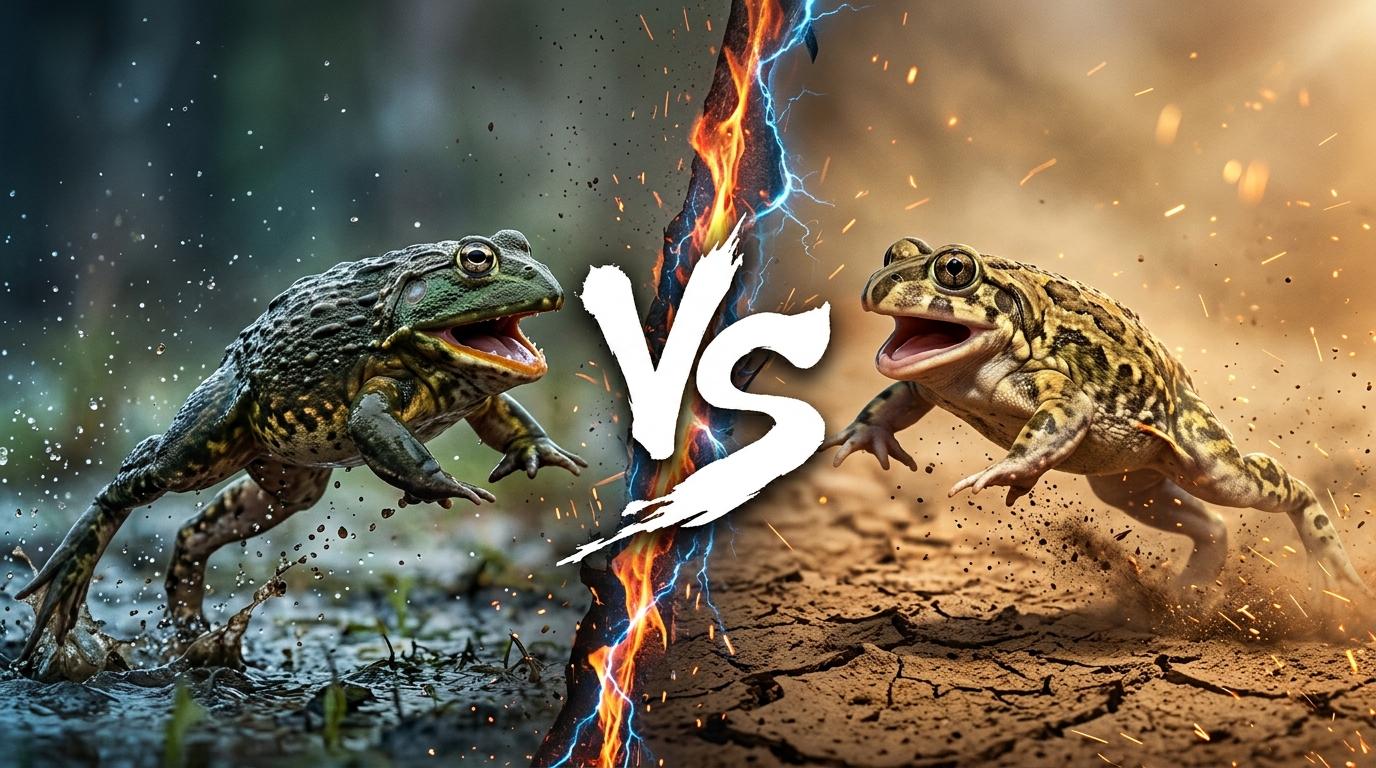
African Bullfrog vs Couch's Spadefoot: Who Actually Wins?
African bullfrog vs Couch's spadefoot toad: a biology-first breakdown of size, bite, defenses, and burrowing to settle who would win.
African Bullfrog vs Couch's Spadefoot
Matchup winner
African Bullfrog
Quick verdict
Start with the direct answer, then use the structured comparison below to see what changes the outcome.
The African bullfrog wins, and it isn't close. Males can reach about 24 cm and well over 1 kg. They have tooth-like odontoid projections on the lower jaw, real teeth on the upper jaw, and a feeding reflex that swallows anything that fits. Couch's spadefoot is a roughly 5–9 cm desert toad, so it is badly outsized. Bullfrogs routinely eat other frogs, and an adult spadefoot falls inside their prey range. The spadefoot has two real assets. One is a skin secretion that can irritate predators. The other is spade-like hind-foot tubercles that let it vanish into soil. Neither one cancels a gape that can engulf it whole. The spadefoot's best outcome is never being found.
Read the full explanation
African Bullfrog wins clearly. It is many times heavier and has a predatory, frog-eating bite.
Couch's spadefoot is small enough to fall inside the bullfrog's normal prey range.
Spadefoot skin secretions can irritate predators, but they offer only partial protection against a determined gulp-feeder.
The spadefoot's real edge is burrowing and evasion, not fighting.
Reader vote
Who do you think wins?
Pick a side — no account needed. Results update live.
No votes yet — be the first to call it.
Editorial note
Why people disagree
Both are burrowing, rain-triggered amphibians, so people assume they are rough equals. Ecologically they are similar, but physically they are not.
Explosive power
Encounters between frogs end at the first lunge, and only the bullfrog has a lunge that ends fights.
Bite & weaponry
The bullfrog is built to grip and swallow vertebrates. The spadefoot is built to eat termites.
Mass advantage
A weight gap this large turns a contest into a feeding event.
Read the full explanation +
Spadefoot skin secretions sound like a trump card. In practice they can deter or annoy predators but don't reliably stop a large, committed one.
Some readers count escape as a win. In a forced encounter, though, size and bite decide the outcome.
Comparison FAQ
Short, direct answers to the next questions readers usually ask after the headline verdict.
Would an African bullfrog beat a Couch's spadefoot?+
Yes, decisively. The bullfrog's size and bite let it overpower and likely swallow the spadefoot.
Which is stronger, the African bullfrog or the Couch's spadefoot?+
The African bullfrog, by a huge margin. It can weigh over a kilogram, while the spadefoot weighs only tens of grams.
Why is the Couch's spadefoot still dangerous to predators?+
Its skin secretions can irritate a predator's mouth and eyes, and it can burrow out of sight in seconds. It wins by not being caught.
Do African bullfrogs eat other frogs?+
Yes. They are opportunistic predators that eat frogs, rodents, reptiles, and even their own kind.
Could the spadefoot ever win?+
Only by escaping, for example by burrowing in loose soil before contact. In a direct fight it has no way to injure the bullfrog.
Head-to-head species stats
These are the same core AnimalDex stat dimensions used on the dedicated animal pages, pulled side by side so the matchup is faster to scan.
African Bullfrog
Tier CCouch's Spadefoot
Tier CTrait-by-trait comparison
Only the categories that matter to this matchup are included. The goal is not filler stats, but the real design differences that change the result.
Heavy lunge, huge gape
Explosive power
African Bullfrog
Small hop, no strike
Explosive power
African Bullfrog
Odontoid 'fangs', upper teeth, crushing jaw
Bite & weaponry
African Bullfrog
Small mouth built for insects
Bite & weaponry
African Bullfrog
Often over 1 kg (males)
Mass advantage
African Bullfrog
Tens of grams
Mass advantage
African Bullfrog
Mainly bite and bluff
Chemical deterrence
Couch's Spadefoot
Irritating skin secretions
Chemical deterrence
Couch's Spadefoot
Powerful digger, slower to seal in
Burrow escape
Couch's Spadefoot
Rapid backward dig with hind-foot spades
Burrow escape
Couch's Spadefoot
Thick body, tolerates struggle
Close-range durability
African Bullfrog
Fragile, easily engulfed
Close-range durability
African Bullfrog
How the verdict forms
Verdict timeline
01 · Explosive power
African Bullfrog
02 · Bite & weaponry
African Bullfrog
03 · Mass advantage
African Bullfrog
04 · Chemical deterrence
Couch's Spadefoot
05 · Burrow escape
Couch's Spadefoot
06 · Close-range durability
African Bullfrog
Change the conditions
Scenario breakdown
This is where shallow battle content usually fails. Terrain, spacing, timing, and engagement style can change the answer.
Scenario lean
African Bullfrog
Verdict confidence
82%
The bullfrog ambushes from cover and swallows.
In vegetation or a shallow depression, the bullfrog's sit-and-wait strategy works perfectly. Any small moving frog within lunge range triggers its feeding strike. The spadefoot has no reach and nothing to answer with.
AnimalDex field profiles
Explore these animals
African Bullfrog
Pyxicephalus adspersus
savannah, seasonal pool, grassland, and dry country breeding basin
Couch's Spadefoot
—
Habitat details are not published on a dedicated AnimalDex species page yet.
Species guide coming soon.
Systems Intelligence & Hidden Purpose
See the animals behind this comparison as engineered biological systems: what each one is built to do, where it gains leverage, and why the matchup changes by scenario.
Specialized Hardware
huge frog body, powerful bite, and burrowing dry-season survival give the African Bullfrog a body plan tuned for its niche.
Systems Script
African Bullfrogs operate through savannah, seasonal pool, grassland, and dry country breeding basin Their design links movement, shelter, and feeding into one workable survival system.
Strategic Insight
Some systems are built not for steady flow, but for sudden opportunity.
Final take
The African Bullfrog is the clear winner. It is a heavyweight ambush predator that treats smaller frogs as prey, and Couch's spadefoot sits squarely in that size class.
Read the full explanation
The spadefoot isn't helpless. Its skin secretions and lightning-fast burrowing are elite survival tools. But they are tools for avoiding a fight, not winning one. In any forced encounter, bite and mass decide it, and the bullfrog wins.
Collect both animals in AnimalDex
Track the species behind this matchup, compare their real traits, and build the rivalry into your AnimalDex collection.
Related comparisons
Continue with nearby matchups to compare more real-world animal traits without dropping into junky who-wins filler.
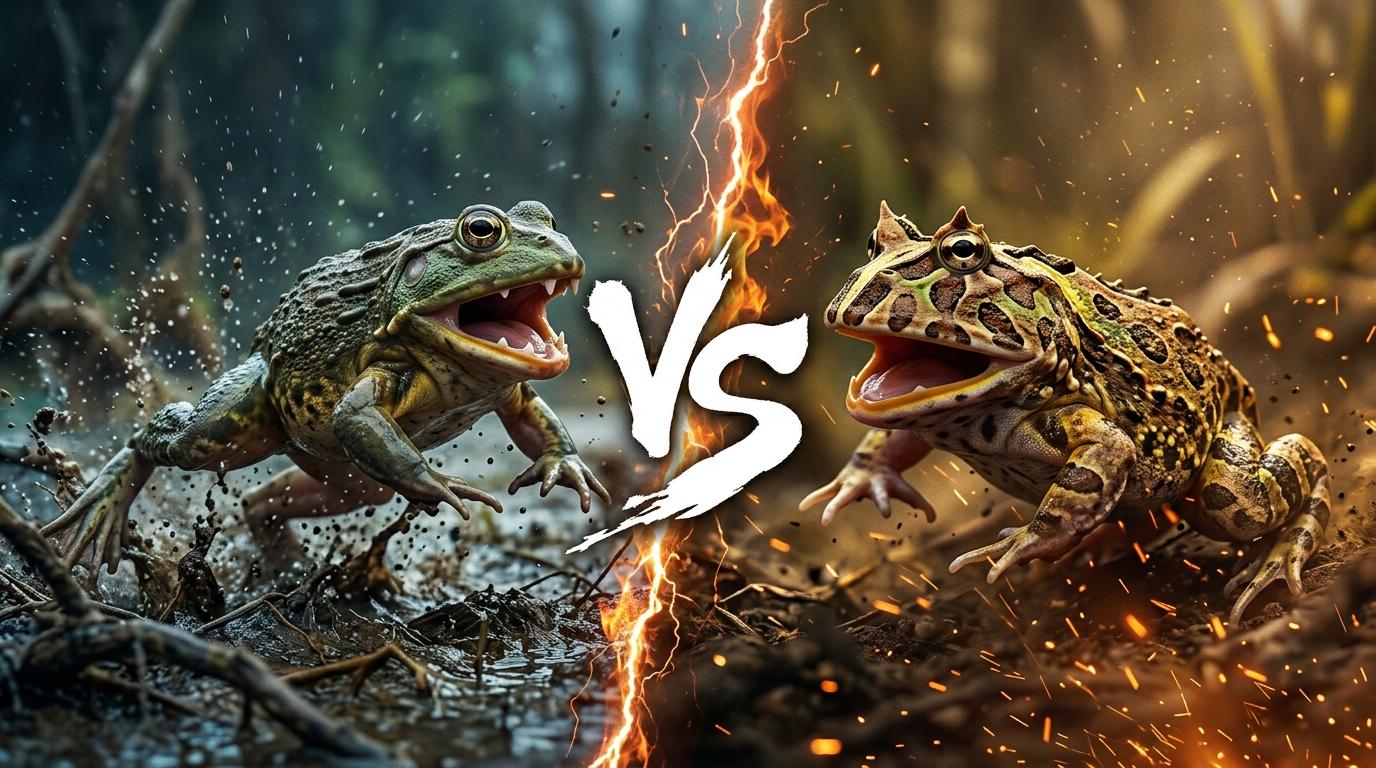
African Bullfrog vs Ornate Horned Frog: Who Actually Wins?
The African bullfrog wins, and it is not especially close. Males of Pyxicephalus adspersus can pass 1 kg and reach over 20 cm in length. They have bony, tooth-like odontoid projections on the lower jaw and a temperament built for guarding tadpoles against predators. The ornate horned frog is a superb sit-and-wait ambusher with a huge gape and a stubborn grip. At roughly 10–14 cm and a few hundred grams at most, though, it is giving up several times its own mass. Horned frogs routinely try to swallow prey too large for them. Against a bullfrog, that boldness becomes a liability, because the bigger frog can bite back, shove, pin, and potentially swallow it.
Read comparison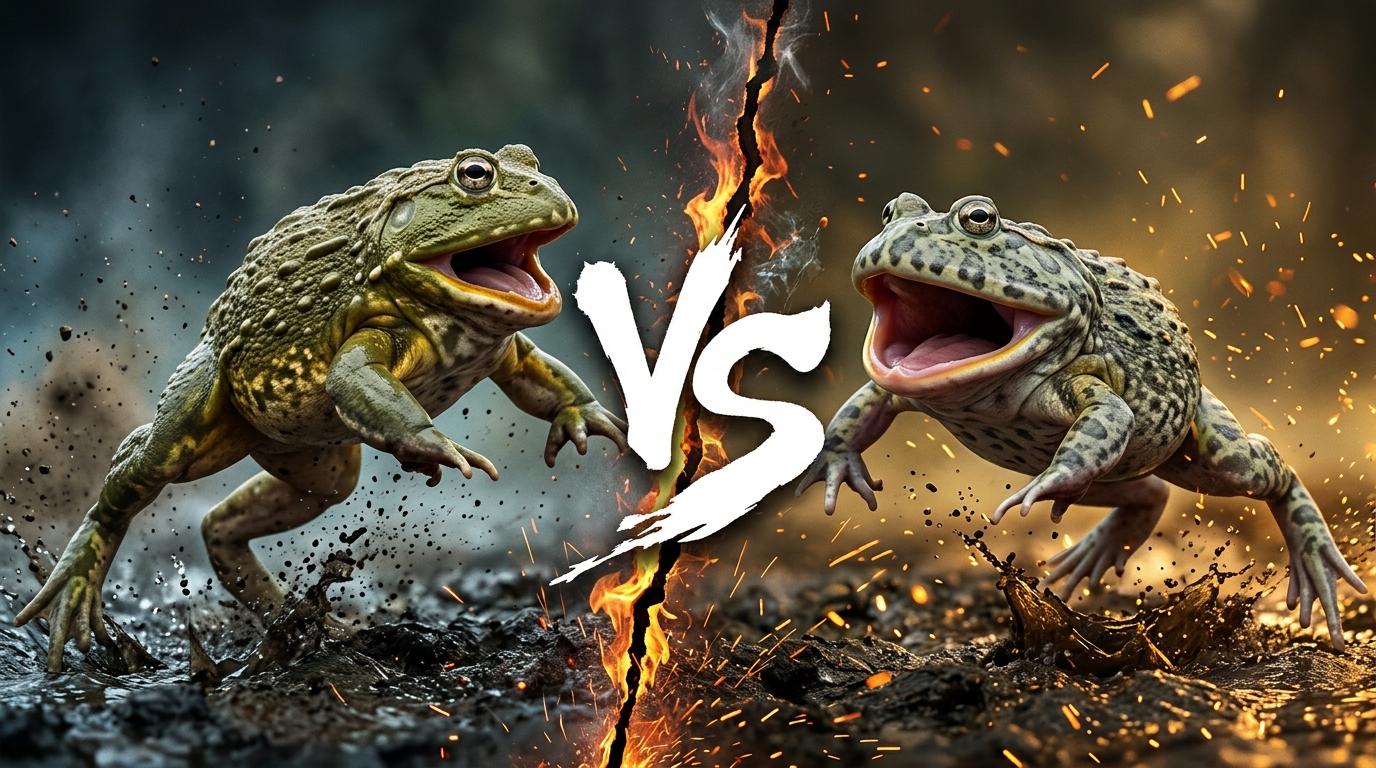
African Bullfrog vs Budgett's Frog: Who Actually Wins?
The African bullfrog wins this matchup clearly. A large male Pyxicephalus adspersus can reach about 23–25 cm and weigh well over 1 kg, while an adult Budgett's frog usually tops out around 10–13 cm. Both are sit-and-wait gape predators with wide mouths, bony odontoid projections in the lower jaw, and real willingness to bite, so this is not a contest of temperament. It comes down to mass, and the bullfrog has several times more of it. Its jaw can close over prey that a Budgett's frog could never swallow, and its thick, heavy body absorbs lunges that would send the smaller frog tumbling. Budgett's frog is famous for screaming, inflating, and biting far above its weight, and that bluff works on many animals. Against a frog that eats frogs its size for breakfast, it mostly makes a louder meal.
Read comparison
Discussion
What do you think?
Share your reasoning with other readers. Be civil and stick to the animals.
Sign in to join the discussion.
Sign inNo comments yet. Start the conversation.