


African Civet vs Senegal Bushbaby: Who Actually Wins?
African civet vs Senegal bushbaby: a biology-first look at size, bite, agility and escape. Here's who wins and why the tiny primate is still hard to catch.
African Civet vs Senegal Bushbaby
Matchup winner
African Civet
Quick verdict
Start with the direct answer, then use the structured comparison below to see what changes the outcome.
The African civet wins clearly. At roughly 7–20 kg against a bushbaby of about 150–300 g, the civet carries something like forty to sixty times the body mass. It also has a carnivoran skull with real canines and shearing teeth, and its omnivorous diet already includes small vertebrates. Any contact on the ground or within reach is decided almost instantly. The bushbaby's real weapon is not fighting. It is vertical escape: spring-loaded hind legs can launch it a couple of meters straight up, and it lives in the acacia canopy, where the mostly terrestrial civet rarely follows. So the matchup is lopsided whenever the two actually meet, and the bushbaby's only win condition is to never be there.
Read the full explanation
The African civet wins any real confrontation through overwhelming size and a true carnivoran bite.
The bushbaby weighs about as much as a large apple and has no meaningful fighting toolkit against a predator this big.
The bushbaby's survival edge is leaping and canopy use. It escapes rather than wins.
On open ground or in a confined space, the civet is decisive.
Reader vote
Who do you think wins?
Pick a side — no account needed. Results update live.
No votes yet — be the first to call it.
Editorial note
Why people disagree
Similar speed and intelligence scores make it look close on paper. Body mass and weaponry are the stats that actually decide contact.
Mass advantage
A gap of dozens of times in body mass means the civet can pin, hold and overpower without effort.
Bite weaponry
Only one of these animals has a skull designed to kill vertebrates.
Vertical escape
This is the bushbaby's entire survival plan, and it is a very good one.
Read the full explanation +
Some readers count 'escapes up a tree' as a win. In a battle frame, avoiding the fight is survival, not victory.
Civets are often pictured as fruit-eaters, which hides how readily they kill rodents, birds and other small animals.
Comparison FAQ
Short, direct answers to the next questions readers usually ask after the headline verdict.
Would an African civet beat a Senegal bushbaby in a fight?+
Yes, decisively. The civet is dozens of times heavier and has a predator's bite, so any real fight ends quickly in its favor.
Which animal is stronger?+
The African civet, by a wide margin. Its body mass, jaw strength and robust frame dwarf the bushbaby's.
Why is the bushbaby still hard to catch?+
It detects danger early with huge eyes and sensitive ears, then leaps meters into trees. A mostly ground-dwelling civet rarely follows it there, so escape, not fighting, keeps it alive.
Do civets eat bushbabies?+
Civets are opportunistic omnivores that take small vertebrates. A bushbaby caught on the ground would be within its prey range, though canopy behavior keeps such encounters rare.
Is the bushbaby dangerous at all?+
Only in a small way. It can bite and scratch defensively, but it poses no serious threat to a civet. Its real danger to a predator is wasted effort, since it often gets away.
Head-to-head species stats
These are the same core AnimalDex stat dimensions used on the dedicated animal pages, pulled side by side so the matchup is faster to scan.
African Civet
Tier CSenegal Bushbaby
Tier ATrait-by-trait comparison
Only the categories that matter to this matchup are included. The goal is not filler stats, but the real design differences that change the result.
~7–20 kg, low and stocky
Mass advantage
African Civet
~0.15–0.3 kg, featherweight
Mass advantage
African Civet
Carnivoran canines and crushing jaws
Bite weaponry
African Civet
Small teeth and a toothcomb built for gum and insects
Bite weaponry
African Civet
Ground-bound, limited climber
Vertical escape
Senegal Bushbaby
Elite leaper, launches meters upward
Vertical escape
Senegal Bushbaby
Strong nose, nocturnal forager
Night senses
Senegal Bushbaby
Huge eyes, mobile ears that track insects in flight
Night senses
Senegal Bushbaby
Thick coat, loose skin, robust frame
Close-range durability
African Civet
Fragile, light skeleton
Close-range durability
African Civet
Raised crest, musky civetone scent
Deterrence
African Civet
Alarm calls, urine scent-marking
Deterrence
African Civet
How the verdict forms
Verdict timeline
01 · Mass advantage
African Civet
02 · Bite weaponry
African Civet
03 · Vertical escape
Senegal Bushbaby
04 · Night senses
Senegal Bushbaby
05 · Close-range durability
African Civet
06 · Deterrence
African Civet
Change the conditions
Scenario breakdown
This is where shallow battle content usually fails. Terrain, spacing, timing, and engagement style can change the answer.
Scenario lean
Senegal Bushbaby
Verdict confidence
82%
The bushbaby survives by leaving.
With vertical structure nearby, the bushbaby's detection and explosive jumping let it reach branches the civet won't pursue into. It never wins the fight, but it denies the civet a kill. That makes this the one context that goes the small primate's way.
AnimalDex field profiles
Explore these animals
African Civet
Civettictis civetta
woodland, savannah edge, riverine thicket, and mixed scrub
Senegal Bushbaby
Galago senegalensis
woodland, savannah edge, and riverine thicket
Systems Intelligence & Hidden Purpose
See the animals behind this comparison as engineered biological systems: what each one is built to do, where it gains leverage, and why the matchup changes by scenario.
Specialized Hardware
bold black-and-white pattern, night-active scavenging and hunting, and scent-heavy territorial life give the African Civet a body plan tuned for its niche.
Systems Script
African Civets operate through woodland, savannah edge, riverine thicket, and mixed scrub Their design links movement, shelter, and feeding into one workable survival system.
Strategic Insight
Versatility matters most when the environment changes faster than any one plan can.
Specialized Hardware
huge night-adapted eyes, spring-like leaping legs, and tree-gum and insect feeding give the Senegal Bushbaby a body plan tuned for its niche.
Systems Script
Senegal Bushbabys operate through woodland, savannah edge, and riverine thicket Their design links movement, shelter, feeding, and survival into one workable system.
Strategic Insight
When the world is dark, spring-loaded movement and sharp senses make a powerful pair.
Final take
The African civet wins this battle comfortably. It is a stocky, ground-hunting carnivoran facing a palm-sized primate, and in any real exchange the size gap and the difference in jaws make the outcome close to certain.
Read the full explanation
The bushbaby deserves respect as a survivor, not a fighter. Its leaping legs, enormous eyes and life in the canopy are built for one thing: making sure the fight never starts.
Collect both animals in AnimalDex
Track the species behind this matchup, compare their real traits, and build the rivalry into your AnimalDex collection.
Related comparisons
Continue with nearby matchups to compare more real-world animal traits without dropping into junky who-wins filler.
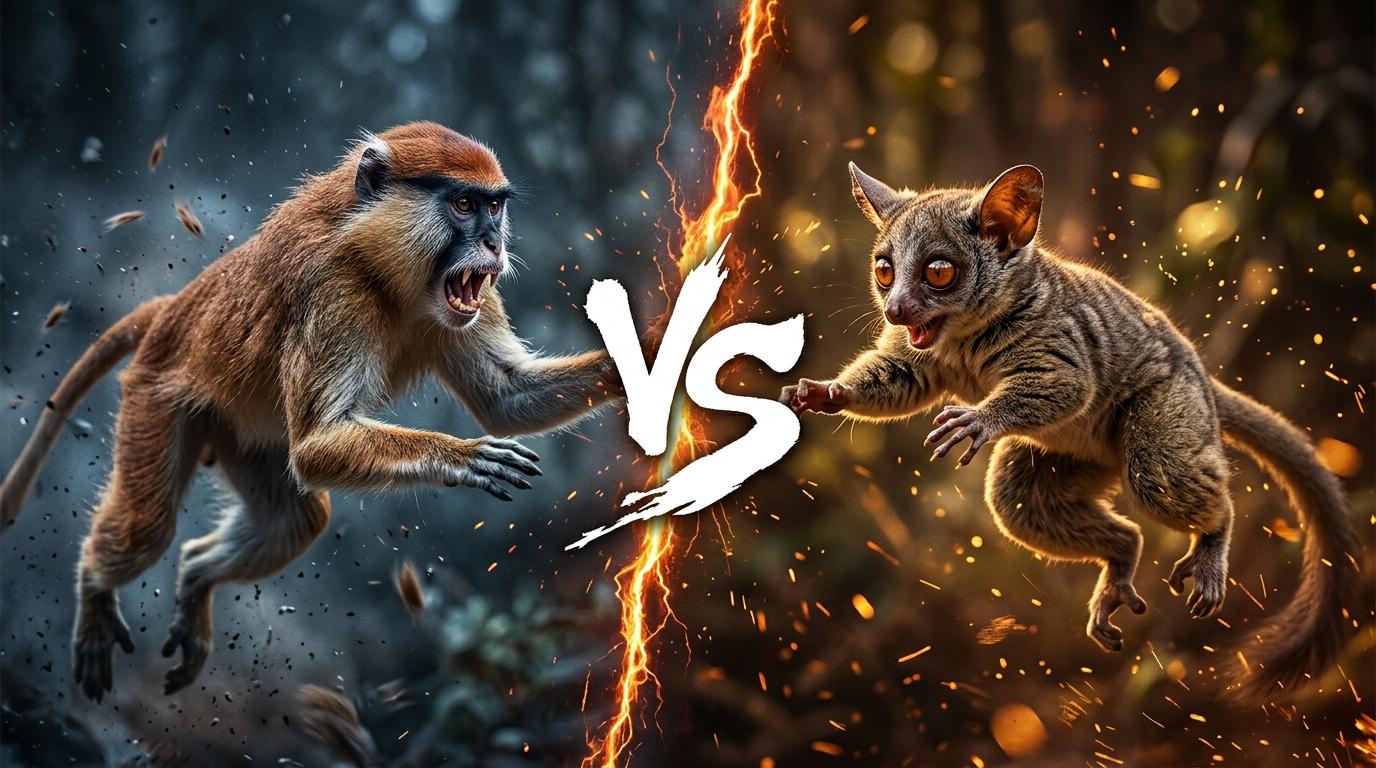
Patas Monkey vs Senegal Bushbaby: Who Actually Wins?
The Patas Monkey wins, and it is not close in a direct confrontation. An adult male patas weighs roughly 7–13 kg against a Senegal bushbaby's 150–300 g, so the patas has 30 to 50 times the mass. It also has long canines, a sprinter's frame built for 50+ km/h dashes across open savanna, and the daytime alertness of a monkey that survives by spotting threats early. The bushbaby is a brilliant small primate. It leaps several meters, has enormous night-tuned eyes and ears, and holds an elite vertical jump for its size. But all of that equipment is built for escape and for catching insects, not for fighting. Any contact on the patas's terms ends quickly. The bushbaby's real win condition is never being caught, and that only works at night in thorny canopy.
Read comparison
Discussion
What do you think?
Share your reasoning with other readers. Be civil and stick to the animals.
Sign in to join the discussion.
Sign inNo comments yet. Start the conversation.