


African Forest Elephant vs Pygmy Hippopotamus: Who Actually Wins?
African forest elephant vs pygmy hippo: who would win? We compare size, power, weapons, and behavior across West African rainforest scenarios. The elephant wins clearly.
African Forest Elephant vs Pygmy Hippopotamus
Matchup winner
African Forest Elephant
Quick verdict
Start with the direct answer, then use the structured comparison below to see what changes the outcome.
The African forest elephant wins, and it isn't close. A forest elephant bull can weigh around 2,500–4,000 kg and stands up to about 2.5 m at the shoulder. A pygmy hippo weighs roughly 180–275 kg and stands under a meter tall. That makes the elephant about ten to fifteen times heavier. The elephant also carries long, straight, downward-pointing tusks built for pushing through dense forest. It has a trunk that can shove, pin, and lift, and enough mass to knock over small trees. The pygmy hippo has sharp canines and a surprisingly dense, low-slung body. But it is a shy, mostly nocturnal browser built to slip away into swamps and streams, not to fight a megaherbivore. In nearly every realistic encounter the hippo retreats, and if it doesn't, the elephant's reach, weight, and tusks decide it fast.
Read the full explanation
Winner: African forest elephant, by a huge margin in size and weaponry.
The elephant outweighs the pygmy hippo roughly 10–15x and has tusks plus a trunk for control.
The pygmy hippo's best move is escape into water or dense undergrowth, not combat.
The pygmy hippo can still bite hard enough to injure people. It just can't seriously threaten an adult elephant.
Reader vote
Who do you think wins?
Pick a side — no account needed. Results update live.
No votes yet — be the first to call it.
Editorial note
Why people disagree
People picture common hippos, which can weigh 1,500 kg or more and are famously aggressive. The pygmy hippo is a different, far smaller, far more retiring animal.
Raw mass & momentum
In a shove or charge, mass dominates. The elephant can simply push the hippo over or pin it.
Primary weapons
The tusks strike from beyond the hippo's bite range. The hippo has to close distance just to land anything.
Reach & control
Controlling where the fight happens is half the outcome, and the elephant controls it.
Read the full explanation +
Forest elephants are smaller than savanna elephants, so some readers assume they're beatable. 'Smaller' still means multiple tonnes.
Water feels like the hippo's trump card. But pygmy hippos live in shallow forest streams and swamps that an elephant can wade through easily.
Comparison FAQ
Short, direct answers to the next questions readers usually ask after the headline verdict.
Would an African forest elephant beat a pygmy hippo?+
Yes, decisively. The elephant is roughly 10–15 times heavier and has tusks and a trunk that outreach the hippo's bite.
Which is stronger, a forest elephant or a pygmy hippo?+
The forest elephant, by an enormous margin. It can push over small trees and lift heavy loads with its trunk. A pygmy hippo is strong for its size, but its size is small.
Do forest elephants and pygmy hippos ever fight?+
There are essentially no documented fights. Their ranges overlap in parts of West Africa, but pygmy hippos are shy and nocturnal and avoid large animals.
Why is the pygmy hippo still dangerous?+
It has sharp canines, a wide gape, and dense muscle. A cornered pygmy hippo can deliver serious bites to people or smaller animals. It loses to an elephant because of scale, not because it's harmless.
Is a pygmy hippo just a baby hippo?+
No. It is a separate species, Choeropsis liberiensis, and much smaller and less aggressive than the common hippo even as an adult.
Head-to-head species stats
These are the same core AnimalDex stat dimensions used on the dedicated animal pages, pulled side by side so the matchup is faster to scan.
African Forest Elephant
Tier CPygmy Hippopotamus
Tier BTrait-by-trait comparison
Only the categories that matter to this matchup are included. The goal is not filler stats, but the real design differences that change the result.
~2.5–4 tonnes, tall frame
Raw mass & momentum
African Forest Elephant
~180–275 kg, low barrel body
Raw mass & momentum
African Forest Elephant
Straight, downward tusks plus a muscular trunk
Primary weapons
African Forest Elephant
Sharp canines and incisors in a wide gape
Primary weapons
African Forest Elephant
Trunk can grab, strike, and steer from meters away
Reach & control
African Forest Elephant
Short legs, bite-range only
Reach & control
African Forest Elephant
Thick hide, massive skeleton
Close-range durability
African Forest Elephant
Thick, mucus-protected skin, dense build for its size
Close-range durability
African Forest Elephant
Rarely needs to flee
Escape tools
Pygmy Hippopotamus
Bolts into streams, swamp, and tunnels through undergrowth
Escape tools
Pygmy Hippopotamus
Long memory, social learning, threat assessment
Cognitive strategy
African Forest Elephant
Cautious, solitary, avoidance-first
Cognitive strategy
African Forest Elephant
How the verdict forms
Verdict timeline
01 · Raw mass & momentum
African Forest Elephant
02 · Primary weapons
African Forest Elephant
03 · Reach & control
African Forest Elephant
04 · Close-range durability
African Forest Elephant
05 · Escape tools
Pygmy Hippopotamus
06 · Cognitive strategy
African Forest Elephant
Change the conditions
Scenario breakdown
This is where shallow battle content usually fails. Terrain, spacing, timing, and engagement style can change the answer.
Scenario lean
African Forest Elephant
Verdict confidence
82%
Elephant wins outright if contact happens.
Forest elephants are adapted to thick vegetation. Their compact build and straight tusks let them push through tangled understory. A cornered pygmy hippo might lunge and bite, but the elephant's trunk and tusks reach it first. A single shove or tusk blow from tonnes of body mass is decisive. The cover mostly helps the hippo vanish before anything starts.
AnimalDex field profiles
Explore these animals
African Forest Elephant
Loxodonta cyclotis
dense rainforest, swamp forest, and forest clearings
Pygmy Hippopotamus
Choeropsis liberiensis
rainforest, swamp edge, and shaded river corridor
Systems Intelligence & Hidden Purpose
See the animals behind this comparison as engineered biological systems: what each one is built to do, where it gains leverage, and why the matchup changes by scenario.
Specialized Hardware
rounded ears for tight forest travel, gentle path-making strength, and deep rumbling family calls give the African Forest Elephant a body plan tuned for its niche.
Systems Script
African Forest Elephants operate through dense rainforest, swamp forest, and forest clearings Their design links movement, shelter, feeding, and survival into one workable system.
Strategic Insight
Big strength becomes even more useful when it clears the way for others too.
Specialized Hardware
smaller forest hippo body, wet skin for humid life, and secretive streamside movement give the Pygmy Hippopotamus a body plan tuned for its niche.
Systems Script
Pygmy Hippopotamuss operate through rainforest, swamp edge, and shaded river corridor Their design links movement, shelter, feeding, and survival into one workable system.
Strategic Insight
A quieter version of a powerful design can work better in a tighter world.
Final take
The African forest elephant is the clear winner. This matchup pits a multi-tonne rainforest engineer against a quarter-tonne swamp specialist. Size, tusks, trunk control, and intelligence all favor the elephant.
Read the full explanation
The pygmy hippo is not a pushover, though. It is a tough, well-armored animal whose whole life plan is to avoid conflict. In the wild, the smartest thing it can do near an elephant is exactly what it usually does: disappear.
Collect both animals in AnimalDex
Track the species behind this matchup, compare their real traits, and build the rivalry into your AnimalDex collection.
Related comparisons
Continue with nearby matchups to compare more real-world animal traits without dropping into junky who-wins filler.
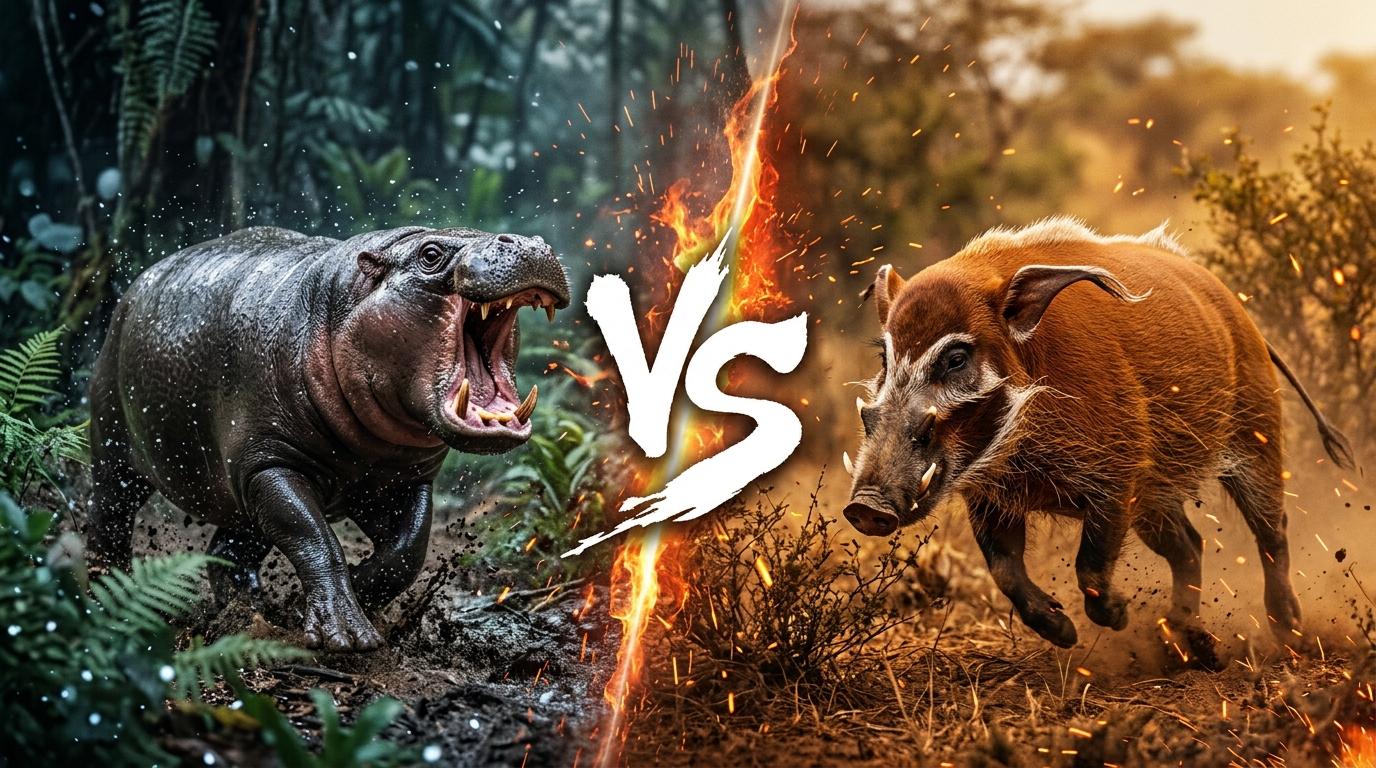
Pygmy Hippopotamus vs Red River Hog: Who Actually Wins?
The pygmy hippopotamus wins this matchup in most realistic encounters. An adult pygmy hippo weighs roughly 180–275 kg, against about 45–115 kg for a red river hog. That puts two to three times the mass behind every shove. The hippo also has a wide gape, ever-growing canine and incisor tusks, and thick skin built to absorb blows. The red river hog is faster to pivot, sharper-tusked for its size, and far bolder in groups, so it can slash and harass. What it cannot do is move, pin, or seriously injure a heavier, lower-slung, bite-armed animal that simply holds its ground. In a one-on-one test of force, mass and bite beat agility and nerve.
Read comparison
Discussion
What do you think?
Share your reasoning with other readers. Be civil and stick to the animals.
Sign in to join the discussion.
Sign inNo comments yet. Start the conversation.