

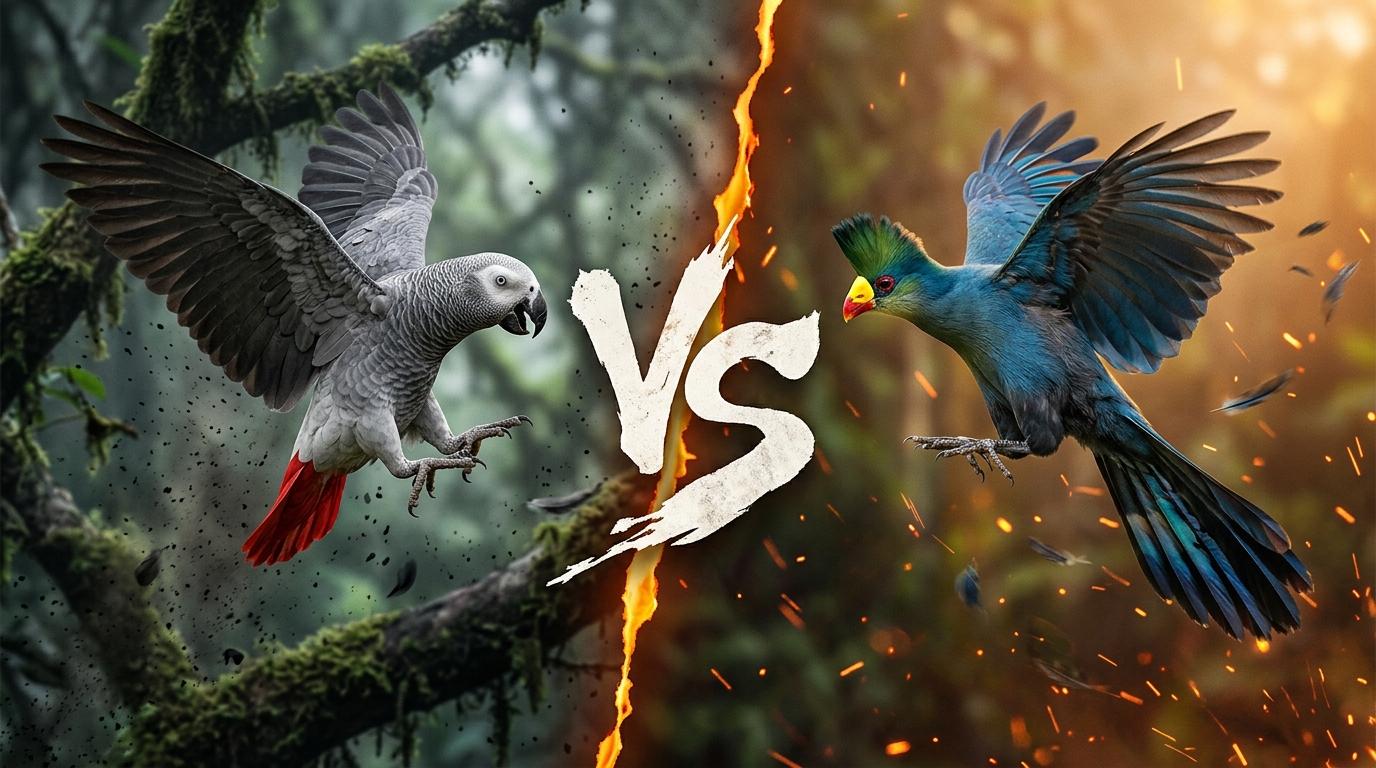
African Grey Parrot vs Great Blue Turaco: Who Actually Wins?
African grey parrot vs great blue turaco: the smaller parrot's nut-cracking beak and agile grip face the turaco's bigger body and canopy footwork. Here's who wins and why.
African Grey Parrot vs Great Blue Turaco
Matchup winner
African Grey Parrot
Quick verdict
Start with the direct answer, then use the structured comparison below to see what changes the outcome.
The African grey parrot wins this one. The great blue turaco is the larger bird, nearly 75 cm long and often around a kilogram, compared with the grey's roughly 33 cm and 400–650 g. But size is not the deciding factor here. The grey carries a hooked beak built to crack hard palm nuts and seeds, backed by strong jaw muscles and a zygodactyl grip that lets it clamp, climb and lever at close range. The turaco is a leaf- and fruit-eater with a relatively light bill made for plucking soft food. It lacks a real crushing tool. It moves well along branches, running and bounding through the canopy, but it is a weak, gliding flier and has little to answer a bird that can bite through a nut shell. In any close contest, the parrot's beak and quick problem-solving outweigh the turaco's extra mass. The turaco's best plan is to bluff with its size and loud calls, then bound away.
Read the full explanation
African grey parrot wins in most realistic encounters.
The grey's crushing, hooked beak is the only true weapon in this matchup.
The turaco is bigger and heavier, but its bill is built for soft fruit and leaves, not for fighting.
The turaco's best tools are size, loud calls, and fast branch-running to escape.
Reader vote
Who do you think wins?
Pick a side — no account needed. Results update live.
No votes yet — be the first to call it.
Editorial note
Why people disagree
Size bias: the turaco is noticeably longer and heavier, so people assume it should win.
Crushing bite
The grey is the only bird here that can deliver an injury-causing bite. That decides most close contacts.
Body mass and reach
Extra mass helps the turaco shove, intimidate and hold a perch, but mass without a weapon only buys time.
Grip and grapple control
The grey can anchor itself and turn a scuffle into a beak-range fight.
Read the full explanation +
Most people picture the turaco's crest and long tail as signs of strength, but they are display and balance features, not weapons.
Parrot fans sometimes overrate intelligence. In a real clash, the decisive factor is beak hardware, not puzzle-solving.
Comparison FAQ
Short, direct answers to the next questions readers usually ask after the headline verdict.
Would an African grey parrot beat a great blue turaco?+
Usually, yes. The grey's powerful hooked beak and strong grip give it the only real weapon in the matchup, even though the turaco is larger.
Which bird is stronger?+
The turaco is bigger and heavier, but the grey has far more useful strength in its jaws and feet. In a fight, bite power matters more than body weight.
Why is the great blue turaco still dangerous to a parrot?+
Its size, loud calls and group presence can drive off a lone grey at food sources. Its fast branch-running also lets it dodge and reposition, which makes the parrot work to land a bite.
Do these birds actually meet in the wild?+
Their ranges overlap in the forests of West and Central Africa, and both feed in the canopy. Encounters there are almost always brief displays over food, not real fights.
Does the parrot's intelligence matter in a fight?+
It helps the grey read threats and choose good angles, but the beak is the deciding factor. Intelligence makes a strong weapon more effective. It doesn't replace one.
Head-to-head species stats
These are the same core AnimalDex stat dimensions used on the dedicated animal pages, pulled side by side so the matchup is faster to scan.
African Grey Parrot
Tier BGreat Blue Turaco
Tier BTrait-by-trait comparison
Only the categories that matter to this matchup are included. The goal is not filler stats, but the real design differences that change the result.
Hooked nut-cracking beak with powerful jaw muscles
Crushing bite
African Grey Parrot
Light, serrated bill made for fruit and leaves
Crushing bite
African Grey Parrot
About 400–650 g, compact build
Body mass and reach
Great Blue Turaco
Often around 800 g to over 1 kg, long-bodied
Body mass and reach
Great Blue Turaco
Zygodactyl feet that clamp, climb and manipulate objects
Grip and grapple control
African Grey Parrot
Semi-zygodactyl feet tuned for running along branches
Grip and grapple control
African Grey Parrot
Methodical climber that uses its beak as a third limb
Canopy footwork
Great Blue Turaco
Fast hopping and running along branches
Canopy footwork
Great Blue Turaco
Fast, direct flier with strong wingbeats
Open-air flight
African Grey Parrot
Weak flier that mostly glides between trees
Open-air flight
African Grey Parrot
Elite cognition and quick threat reading
Tactical adaptability
African Grey Parrot
Social and vocal, with simpler problem-solving
Tactical adaptability
African Grey Parrot
How the verdict forms
Verdict timeline
01 · Crushing bite
African Grey Parrot
02 · Body mass and reach
Great Blue Turaco
03 · Grip and grapple control
African Grey Parrot
04 · Canopy footwork
Great Blue Turaco
05 · Open-air flight
African Grey Parrot
06 · Tactical adaptability
African Grey Parrot
Change the conditions
Scenario breakdown
This is where shallow battle content usually fails. Terrain, spacing, timing, and engagement style can change the answer.
Scenario lean
African Grey Parrot
Verdict confidence
82%
Grey wins if contact happens. The turaco may avoid it by bounding away.
Thick branches favor the turaco's running style and give it escape lanes. But once the two birds are within beak range on a shared limb, the grey's grip and crushing bite take over. The turaco has nothing to answer a hooked beak, so its best outcome is retreat.
AnimalDex field profiles
Explore these animals
African Grey Parrot
Psittacus erithacus
Tropical forest, forest edge, and woodland feeding areas.
Great Blue Turaco
Corythaeola cristata
rainforest canopy and dense tropical forest
Systems Intelligence & Hidden Purpose
See the animals behind this comparison as engineered biological systems: what each one is built to do, where it gains leverage, and why the matchup changes by scenario.
Specialized Hardware
Soft gray body with bright red tail, curved black bill, and pale face around the eyes give the African Grey Parrot a body plan tuned for its niche.
Systems Script
African Grey Parrots operate in tropical forest, forest edge, and woodland feeding areas. Their design helps them match food access, shelter, and timing inside that environment.
Strategic Insight
Communication gets stronger when memory and imitation stay linked.
Specialized Hardware
towering blue canopy body, yellow bill and crest, and heavy fruit-carrying flight give the Great Blue Turaco a body plan tuned for its niche.
Systems Script
Great Blue Turacos operate through rainforest canopy and dense tropical forest. Their design links movement, feeding, shelter, and timing into one workable survival system.
Strategic Insight
Dense environments reward precision, patience, and the ability to read layered cover.
Final take
The African grey parrot is the overall winner. The great blue turaco brings more body, more reach and more presence, but it is built to eat leaves and fruit, not to fight. The grey carries a crushing tool on its face and the grip and judgment to use it well.
Read the full explanation
The turaco is far from helpless. Around a fruiting tree, its size, group behavior and loud calls can win without any contact, and its branch-running makes it hard to pin down. Even so, when a fight becomes physical, a hooked, nut-cracking beak beats a bigger frame that lacks weapons.
Collect both animals in AnimalDex
Track the species behind this matchup, compare their real traits, and build the rivalry into your AnimalDex collection.
Discussion
What do you think?
Share your reasoning with other readers. Be civil and stick to the animals.
Sign in to join the discussion.
Sign inNo comments yet. Start the conversation.