

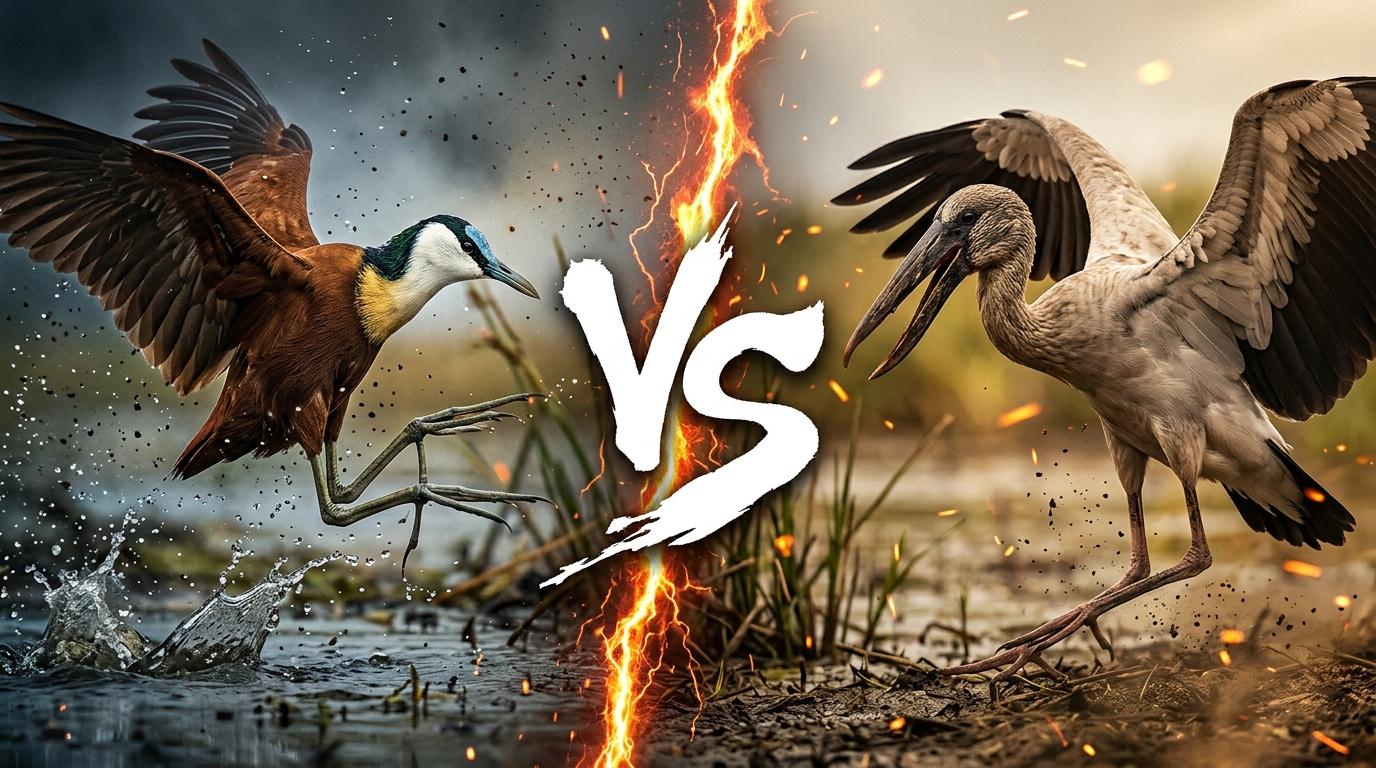
African Jacana vs African Openbill: Who Actually Wins?
African Jacana vs African Openbill: a biology-first look at size, weapons, wetland agility and behavior to decide which African waterbird would win a confrontation.
African Jacana vs African Openbill
Matchup winner
African Openbill
Quick verdict
Start with the direct answer, then use the structured comparison below to see what changes the outcome.
The African Openbill wins this matchup clearly. It is a true stork, standing roughly 80–94 cm tall and weighing around 1 kg, against a jacana of about 25–30 cm that weighs between 140 and 260 g. That makes the openbill several times heavier, with a long, stout bill and real reach. Jacanas are famously feisty, and females especially defend territories hard. They also carry small carpal spurs on the wings and have lily-pad-walking toes that make them uncannily agile on floating vegetation. None of that offsets a stork that can look down on the jacana from roughly three times its height. In almost any direct contest over space or food, the openbill's mass and reach push the jacana aside. The jacana's best result is not losing badly: it dances across floating plants where a heavy stork cannot follow.
Read the full explanation
Winner: African Openbill, thanks to a large size and reach advantage.
The openbill is several times heavier and roughly three times taller.
The jacana is the more agile bird on floating vegetation and the more aggressive defender of territory.
Real-world outcome: the jacana retreats or gets displaced. Serious fights are rare.
Reader vote
Who do you think wins?
Pick a side — no account needed. Results update live.
No votes yet — be the first to call it.
Editorial note
Why people disagree
Jacanas behave far bigger than they are. Territorial females chase off rivals boldly, which makes some readers overrate their fighting odds.
Size and mass
In bird confrontations, the bigger bird usually wins displacement contests without a real fight.
Reach and weaponry
The openbill can strike or jostle from a distance the jacana cannot close safely.
Floating-vegetation agility
The jacana's terrain gives it a built-in escape route and refuge.
Read the full explanation +
The openbill's bill is built for prying apart snails, not stabbing. That leads people to underrate it, but mass and reach still dominate in a shove-and-jab contest.
Habitat matters. On dense lily pads the jacana is untouchable, so people picture different battlefields.
Comparison FAQ
Short, direct answers to the next questions readers usually ask after the headline verdict.
Would an African Jacana beat an African Openbill in a fight?+
No. The African Openbill would win. It is several times heavier and roughly three times taller, with far greater reach.
Which is stronger, the African Jacana or the African Openbill?+
The African Openbill is much stronger, with a bigger body, a heavier bill and a sturdier frame overall.
Why is the African Jacana still dangerous to the openbill?+
It is highly aggressive and has small wing spurs. It can also harass the stork from floating vegetation the openbill cannot safely walk on, which makes pursuing it costly and pointless.
Do jacanas and openbills fight in the wild?+
Rarely. They share wetlands but eat different foods: jacanas mostly take insects, while openbills specialize in snails and mussels. Most interactions are brief displacements, not fights.
What is the openbill's bill for?+
The gap in its bill helps it grip and pry open snails and freshwater mussels. It is a specialized tool rather than a weapon, but it still provides strong reach.
Head-to-head species stats
These are the same core AnimalDex stat dimensions used on the dedicated animal pages, pulled side by side so the matchup is faster to scan.
African Jacana
Tier CAfrican Openbill
Tier DTrait-by-trait comparison
Only the categories that matter to this matchup are included. The goal is not filler stats, but the real design differences that change the result.
About 25–30 cm, under 300 g
Size and mass
African Openbill
About 80–94 cm, around 1 kg
Size and mass
African Openbill
Short bill, small wing spurs
Reach and weaponry
African Openbill
Long, heavy, gapped bill
Reach and weaponry
African Openbill
Elite. Long toes spread its weight across lily pads
Floating-vegetation agility
African Jacana
Wades in shallows and avoids flimsy mats
Floating-vegetation agility
African Jacana
Highly combative, especially females
Territorial aggression
African Jacana
Mostly tolerant and often feeds in groups
Territorial aggression
African Jacana
Light, fragile frame
Close-range durability
African Openbill
Robust stork body
Close-range durability
African Openbill
Quick hops and short, agile flights
Evasive mobility
African Jacana
Strong soaring flight but slower to maneuver
Evasive mobility
African Jacana
How the verdict forms
Verdict timeline
01 · Size and mass
African Openbill
02 · Reach and weaponry
African Openbill
03 · Floating-vegetation agility
African Jacana
04 · Territorial aggression
African Jacana
05 · Close-range durability
African Openbill
06 · Evasive mobility
African Jacana
Change the conditions
Scenario breakdown
This is where shallow battle content usually fails. Terrain, spacing, timing, and engagement style can change the answer.
Scenario lean
African Openbill
Verdict confidence
82%
The openbill dominates.
In open, firm shallow water the stork's height, stride and bill reach take over. The jacana has no cover and no floating mat to retreat onto. A few jabs and body checks from a bird four or more times its weight end the contest quickly.
AnimalDex field profiles
Explore these animals
African Jacana
Actophilornis africanus
marsh, floating wetland, and shallow pond edge
African Openbill
Anastomus lamelligerus
marsh, lake edge, and floodplain habitat
Systems Intelligence & Hidden Purpose
See the animals behind this comparison as engineered biological systems: what each one is built to do, where it gains leverage, and why the matchup changes by scenario.
Specialized Hardware
extremely long spreading toes, chestnut and black wetland body, and lily-pad walking balance give the African Jacana a body plan tuned for its niche.
Systems Script
African Jacanas operate through marsh, floating wetland, and shallow pond edge. Their design links movement, feeding, shelter, and timing into one workable survival system.
Strategic Insight
Where water controls movement, position and timing often matter more than speed.
Specialized Hardware
gap between upper and lower mandibles, black-and-white stork body, and snail-specialist wetland feeding give the African Openbill a body plan tuned for its niche.
Systems Script
African Openbills operate through marsh, lake edge, and floodplain habitat. Their design links movement, feeding, shelter, and timing into one workable survival system.
Strategic Insight
Where water controls movement, position and timing often matter more than speed.
Final take
The African Openbill is the clear winner. This is a size mismatch between a medium stork and a small, lightweight wader, and in bird encounters mass, height and reach decide almost everything.
Read the full explanation
The African Jacana earns respect for attitude and engineering. It is a territorial, agile specialist whose feet turn floating vegetation into a fortress. It does not win by overpowering the stork. It wins when it never has to fight in the first place.
Collect both animals in AnimalDex
Track the species behind this matchup, compare their real traits, and build the rivalry into your AnimalDex collection.
Discussion
What do you think?
Share your reasoning with other readers. Be civil and stick to the animals.
Sign in to join the discussion.
Sign inNo comments yet. Start the conversation.