

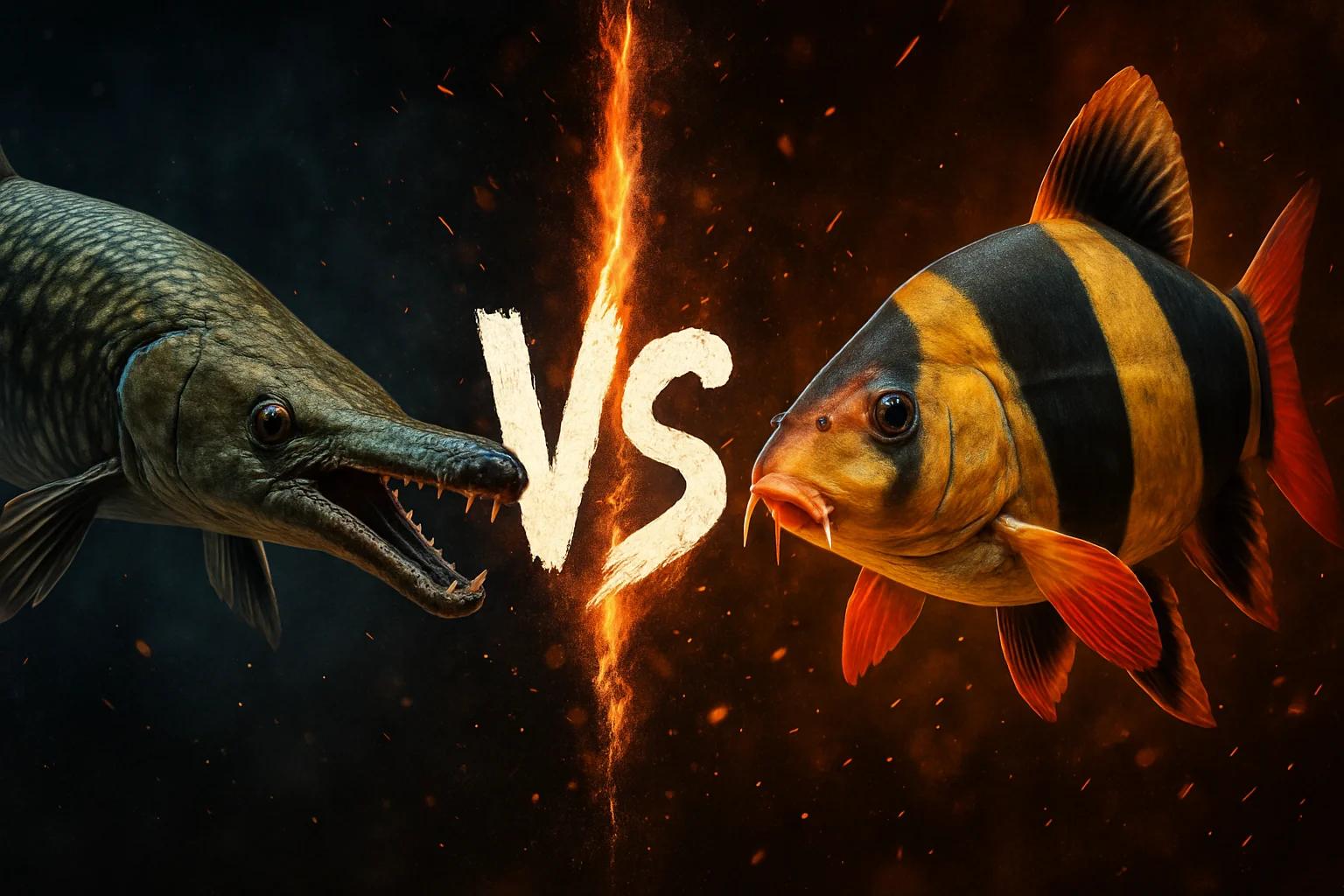
Alligator Gar vs Clown Loach: Who Actually Wins?
Alligator gar vs clown loach: a biology-first look at size, armor, bite, and defenses. See who wins and why the tiny loach still isn't helpless.
Alligator Gar vs Clown Loach
Matchup winner
Alligator Gar
Quick verdict
Start with the direct answer, then use the structured comparison below to see what changes the outcome.
The alligator gar wins, and it isn't close. This is a meeting between one of North America's largest freshwater fish, which can pass 2 meters and 100 kg, and a Southeast Asian bottom-dweller that rarely tops 30 cm in the wild. The gar brings ganoid scales that work like enamel-coated armor, a long jaw lined with two rows of needle teeth, and a sit-and-wait strike built for grabbing fish sideways. The clown loach's best tools are defensive: a retractable spine under each eye, a slippery body, schooling behavior, and a talent for wedging into rock crevices. Those tricks can make it a painful or unrewarding meal. They cannot change a mass gap of several hundred to one. In any open or contested water, the gar controls the encounter.
Read the full explanation
Alligator gar wins decisively thanks to overwhelming size, armor, and an ambush bite built for fish.
Clown loach has suborbital spines that can injure a predator's mouth, so swallowing one is risky.
The loach's real 'win condition' is hiding in tight cover, not fighting.
Realistically they never meet: gar live in the Americas, clown loaches in Indonesian rivers.
Reader vote
Who do you think wins?
Pick a side — no account needed. Results update live.
No votes yet — be the first to call it.
Editorial note
Why people disagree
Aquarium keepers see clown loaches act bold and scrappy in tanks and overestimate them against true predators.
Raw size and mass
A size gap this large settles almost every physical contest between fish before any tactics come into play.
Close-range durability
The gar's armor shrugs off anything the loach could deliver. The loach has no protection against a crushing bite.
Ambush strike
Only one of these fish is built to catch and hold other fish.
Read the full explanation +
The loach's eye spines are a genuine deterrent, which leads some to argue the gar would simply refuse the meal.
Gar look slow and log-like, so people underrate how fast that sideways jaw snap actually is.
Comparison FAQ
Short, direct answers to the next questions readers usually ask after the headline verdict.
Would an alligator gar beat a clown loach in a fight?+
Yes, easily. The gar's size, armor, and toothed jaws overwhelm the loach in any open encounter.
Which is stronger, alligator gar or clown loach?+
The alligator gar by an enormous margin. It can outweigh a clown loach by several hundred times.
Why is a clown loach still dangerous to predators?+
It has sharp, erectable spines below its eyes that can wound a predator's mouth or throat. Combined with crevice-hiding and schooling, this makes it a costly, risky target.
Do alligator gar and clown loaches live together?+
No. Alligator gar are North American, mainly in the Gulf drainage. Clown loaches come from the rivers of Borneo and Sumatra.
Can you keep them in the same aquarium?+
It isn't advisable. Gar grow huge and are predatory, so tankmates small enough to swallow are at risk.
Head-to-head species stats
These are the same core AnimalDex stat dimensions used on the dedicated animal pages, pulled side by side so the matchup is faster to scan.
Alligator Gar
Tier BClown Loach
Tier BTrait-by-trait comparison
Only the categories that matter to this matchup are included. The goal is not filler stats, but the real design differences that change the result.
Up to 2–3 m, 100+ kg
Raw size and mass
Alligator Gar
Usually 15–30 cm, under 0.5 kg
Raw size and mass
Alligator Gar
Interlocking ganoid scale armor
Close-range durability
Alligator Gar
Small scales, slick skin
Close-range durability
Alligator Gar
Long toothed snout, sideways snap
Ambush strike
Alligator Gar
Small downturned mouth for invertebrates
Ambush strike
Alligator Gar
None needed
Deterrent hardware
Clown Loach
Erectable suborbital spines
Deterrent hardware
Clown Loach
Too large for tight refuges
Crevice escape
Clown Loach
Wedges into rocks and roots
Crevice escape
Clown Loach
Mostly solitary
Group vigilance
Clown Loach
Lives in active schools
Group vigilance
Clown Loach
How the verdict forms
Verdict timeline
01 · Raw size and mass
Alligator Gar
02 · Close-range durability
Alligator Gar
03 · Ambush strike
Alligator Gar
04 · Deterrent hardware
Clown Loach
05 · Crevice escape
Clown Loach
06 · Group vigilance
Clown Loach
Change the conditions
Scenario breakdown
This is where shallow battle content usually fails. Terrain, spacing, timing, and engagement style can change the answer.
Scenario lean
Clown Loach
Verdict confidence
82%
The loach survives by disappearing.
Among rocks, roots, and narrow crevices, the clown loach can wedge in where a long-bodied gar can't follow. It can also flare its spines to anchor itself. Here the loach 'wins' by denying the strike entirely. It doesn't harm the gar. It simply makes the hunt unprofitable.
AnimalDex field profiles
Explore these animals
Alligator Gar
Atractosteus spatula
slow river, backwater, and brackish estuary habitat
Clown Loach
Chromobotia macracanthus
forest stream, floodplain river, and submerged root habitat
Systems Intelligence & Hidden Purpose
See the animals behind this comparison as engineered biological systems: what each one is built to do, where it gains leverage, and why the matchup changes by scenario.
Specialized Hardware
long armored gar body, broad toothy snout, and surface-cruising ambush style give the Alligator Gar a body plan tuned for its niche.
Systems Script
Alligator Gars operate through slow river, backwater, and brackish estuary habitat. Their design links movement, feeding, shelter, and timing into one workable survival system.
Strategic Insight
Where water controls movement, position and timing often matter more than speed.
Specialized Hardware
orange body with bold black bands, downturned barbels, and social river-bottom shoaling give the Clown Loach a body plan tuned for its niche.
Systems Script
Clown Loachs operate through forest stream, floodplain river, and submerged root habitat. Their design links movement, feeding, shelter, and timing into one workable survival system.
Strategic Insight
Dense environments reward precision, patience, and the ability to read layered cover.
Final take
The alligator gar is the clear winner. It is an armored, ambush-built predatory fish meeting a small bottom-forager whose whole design is about not being eaten.
Read the full explanation
The clown loach deserves respect, though. Its eye spines, schooling, and crevice skills are a smart defensive package. They explain why it can be a bad meal even when it can't win a fight. Its best move is to never give the gar an open shot.
Collect both animals in AnimalDex
Track the species behind this matchup, compare their real traits, and build the rivalry into your AnimalDex collection.
Discussion
What do you think?
Share your reasoning with other readers. Be civil and stick to the animals.
Sign in to join the discussion.
Sign inNo comments yet. Start the conversation.