

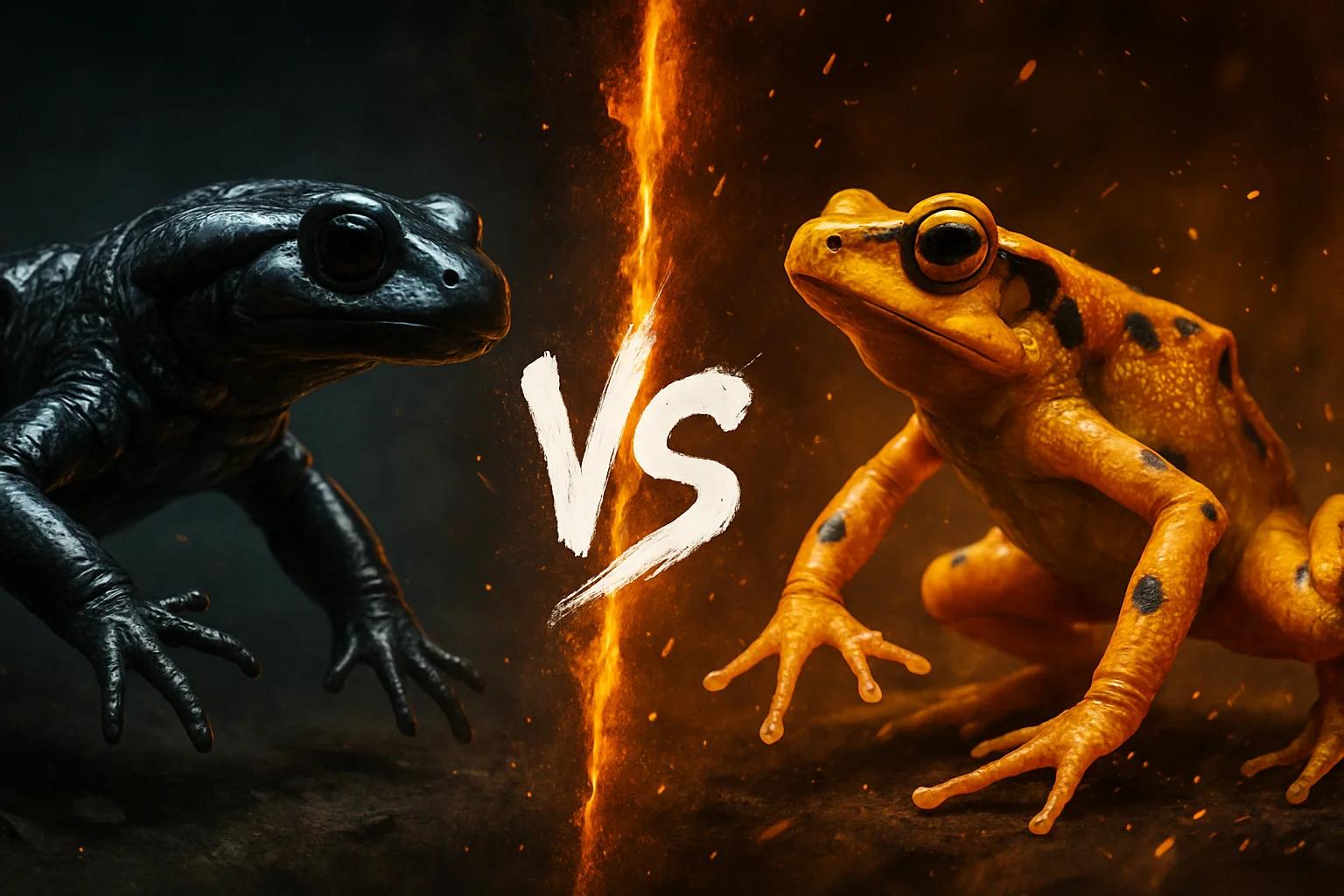
Alpine Salamander vs Panamanian Golden Frog: Who Actually Wins?
Alpine Salamander vs Panamanian Golden Frog. A biology-first breakdown of size, toxins, defense and behavior, with a clear verdict on which poisonous amphibian comes out ahead.
Alpine Salamander vs Panamanian Golden Frog
Matchup winner
Alpine Salamander
Quick verdict
Start with the direct answer, then use the structured comparison below to see what changes the outcome.
The Alpine Salamander wins this one, though not by a knockout. Both animals are small, slow, toxic amphibians built to discourage attackers rather than defeat them, so the real question is which defensive system holds up better at close range. The salamander's advantages decide it. It is roughly two to three times the frog's body length and several times its mass. It has a long, low, tough-skinned frame. Its parotoid glands are loaded with samandarine-type alkaloids that act as a dense chemical wall. The Panamanian Golden Frog carries zetekitoxin, one of the most potent amphibian toxins known, and advertises it with blazing yellow warning colors. But its toxin is purely a deterrent. It cannot push, pin, or outlast a heavier opponent. In a cool, damp encounter where neither side runs, the salamander's mass, grip and staying power tip the outcome. The frog remains far more dangerous to anything that bites it.
Read the full explanation
Overall winner: Alpine Salamander, mainly on size, mass and close-range durability.
The Golden Frog's zetekitoxin is likely the more potent chemical, but it only punishes a biter. It does not win shoving contests.
Neither species hunts the other in nature. This is a defensive-systems matchup, not a predator-prey one.
The frog's best outcome is deterrence. The salamander's best outcome is simply outlasting it.
Reader vote
Who do you think wins?
Pick a side — no account needed. Results update live.
No votes yet — be the first to call it.
Editorial note
Why people disagree
Toxin fans point to zetekitoxin's extreme potency and assume the deadliest skin wins. Potency only matters if the opponent bites, though, and a salamander pressing with its body may never take a full dose.
Body mass and frame
Among small amphibians, mass decides who gets displaced. The salamander simply outweighs the frog.
Chemical deterrence
The frog's skin is the scarier mouthful. This is the main reason it stays dangerous even while losing.
Close-range durability
The salamander can absorb contact and stay on its feet far longer.
Read the full explanation +
Some readers treat the frog's bright yellow as aggression. Biologically it is a warning signal (aposematism), not an attack tool.
The two never meet in the wild: one lives in the Alps, the other in Panama. That leaves room for argument about which habitat counts as the neutral arena.
Comparison FAQ
Short, direct answers to the next questions readers usually ask after the headline verdict.
Would an Alpine Salamander beat a Panamanian Golden Frog?+
Usually yes. It is much larger and more durable, so it wins most contact and territory contests.
Which is stronger?+
The Alpine Salamander. It has several times the frog's body mass and a sturdier frame.
Which is more poisonous?+
The Golden Frog's zetekitoxin is generally considered the more potent toxin, though both species are toxic to handle or eat.
Why is the Golden Frog still dangerous if it loses?+
Its skin toxin can severely harm or kill a predator that bites it. Its loss comes from size, not from weak defenses.
Do they ever meet in the wild?+
No. The salamander lives in the European Alps and the frog in Panama, so any meeting is purely hypothetical.
Head-to-head species stats
These are the same core AnimalDex stat dimensions used on the dedicated animal pages, pulled side by side so the matchup is faster to scan.
Alpine Salamander
Tier CPanamanian Golden Frog
Tier ATrait-by-trait comparison
Only the categories that matter to this matchup are included. The goal is not filler stats, but the real design differences that change the result.
About 9–15 cm long, stout and low-slung
Body mass and frame
Alpine Salamander
About 3.5–6 cm long, light and spindly
Body mass and frame
Alpine Salamander
Samandarine alkaloids from parotoid and dorsal glands
Chemical deterrence
Panamanian Golden Frog
Zetekitoxin, an extremely potent sodium-channel blocker
Chemical deterrence
Panamanian Golden Frog
Thick, glandular skin and a robust body
Close-range durability
Alpine Salamander
Thin limbs and a fragile build
Close-range durability
Alpine Salamander
All-black body, little visual signaling
Warning display
Panamanian Golden Frog
Vivid gold color plus hand-waving semaphore
Warning display
Panamanian Golden Frog
Slow, deliberate crawl
Burst mobility
Panamanian Golden Frog
Slow walker that can make short hops
Burst mobility
Panamanian Golden Frog
Tolerates cold; gives birth to live young away from open water
Environmental grit
Alpine Salamander
Highly vulnerable to chytrid fungus and habitat change
Environmental grit
Alpine Salamander
How the verdict forms
Verdict timeline
01 · Body mass and frame
Alpine Salamander
02 · Chemical deterrence
Panamanian Golden Frog
03 · Close-range durability
Alpine Salamander
04 · Warning display
Panamanian Golden Frog
05 · Burst mobility
Panamanian Golden Frog
06 · Environmental grit
Alpine Salamander
Change the conditions
Scenario breakdown
This is where shallow battle content usually fails. Terrain, spacing, timing, and engagement style can change the answer.
Scenario lean
Alpine Salamander
Verdict confidence
82%
Salamander controls the crevice.
In tight cover, body length and weight decide who holds a hiding spot. The salamander can wedge in and displace the smaller frog, which has no way to dislodge it. The frog's warning colors are also less useful in dim, cluttered cover.
AnimalDex field profiles
Explore these animals
Alpine Salamander
Salamandra atra
alpine meadow, rocky slope, and mountain forest edge
Panamanian Golden Frog
Atelopus zeteki
cloud forest, spray zone, and mountain stream
Systems Intelligence & Hidden Purpose
See the animals behind this comparison as engineered biological systems: what each one is built to do, where it gains leverage, and why the matchup changes by scenario.
Specialized Hardware
glossy black mountain body, live-bearing alpine reproduction, and slow wet-weather ridge movement give the Alpine Salamander a body plan tuned for its niche.
Systems Script
Alpine Salamanders operate through alpine meadow, rocky slope, and mountain forest edge. Their design links movement, feeding, shelter, and timing into one workable survival system.
Strategic Insight
In steep terrain, balance and route control matter more than brute force.
Specialized Hardware
bright yellow body, semaphore foot-waving signals, and fast mountain-stream life give the Panamanian Golden Frog a body plan tuned for its niche.
Systems Script
Panamanian Golden Frogs operate through cloud forest, spray zone, and mountain stream. Their design links movement, feeding, shelter, and timing into one workable survival system.
Strategic Insight
In steep terrain, balance and route control matter more than brute force.
Final take
The Alpine Salamander takes the overall win because three of the four realistic contexts reward its mass, durability and staying power. The Golden Frog is a masterpiece of deterrence, but deterrence is not control.
Read the full explanation
Respect the loser. The Panamanian Golden Frog's toxin is potentially the more lethal substance, and any animal careless enough to bite one pays dearly. It is also critically endangered and may be extinct in the wild because of chytrid fungus, which makes it far more precious than any hypothetical matchup.
Collect both animals in AnimalDex
Track the species behind this matchup, compare their real traits, and build the rivalry into your AnimalDex collection.
Discussion
What do you think?
Share your reasoning with other readers. Be civil and stick to the animals.
Sign in to join the discussion.
Sign inNo comments yet. Start the conversation.