

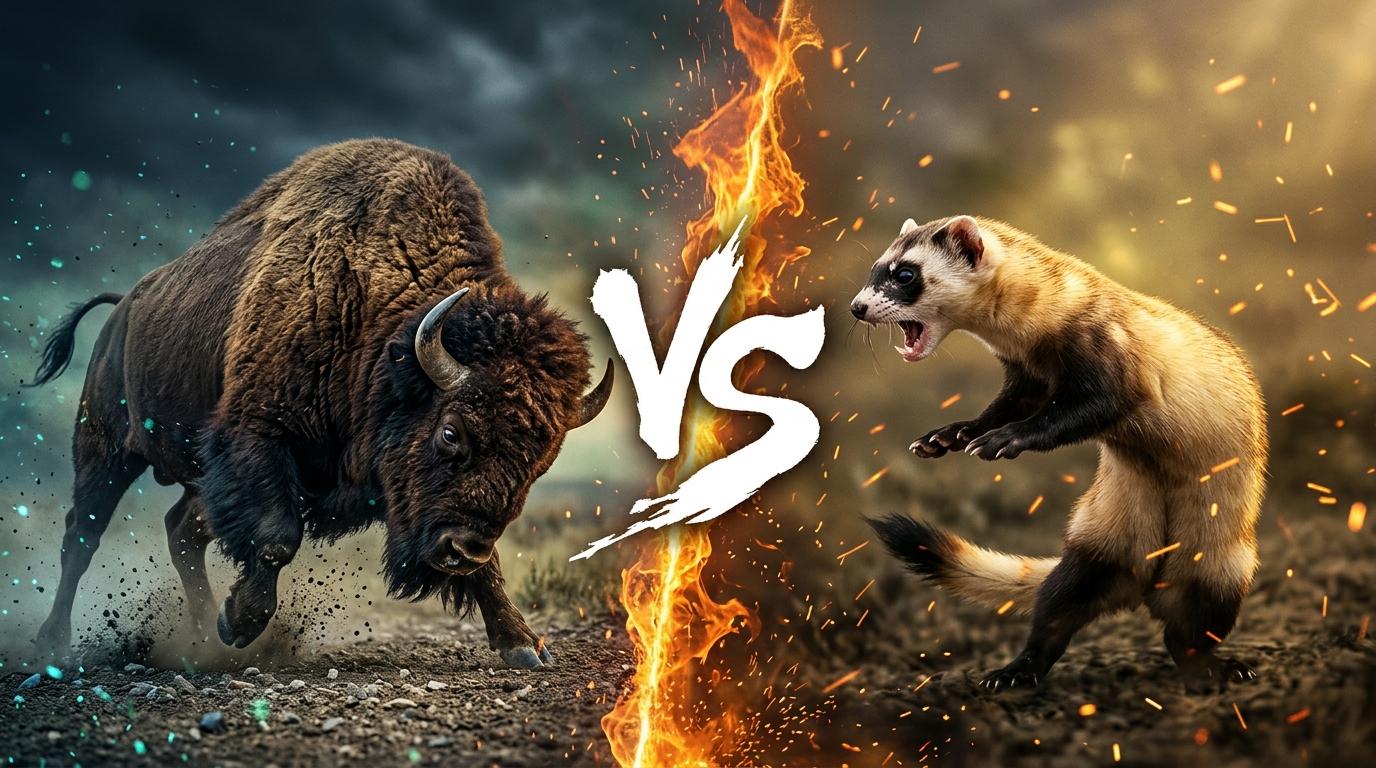
American Bison vs Black-footed Ferret: Who Actually Wins?
American bison vs black-footed ferret: a biology-first look at size, defense, burrow tactics and ecology, and why the bison wins any real confrontation.
American Bison vs Black-footed Ferret
Matchup winner
American Bison
Quick verdict
Start with the direct answer, then use the structured comparison below to see what changes the outcome.
The American bison wins, and it isn't close in a direct confrontation. A bull bison can weigh around 900 kg, while a black-footed ferret weighs about 1 kg, a mass gap of nearly a thousand to one. The bison's charge, horns, hooves and thick hide mean the ferret has no meaningful way to injure it. The ferret's real strengths are elsewhere: it is a specialist predator built to slip into prairie dog burrows and kill prey its own size in total darkness. That makes it nearly impossible for the bison to catch underground, but avoiding a fight is not the same as winning one. On open prairie, where both species actually live, the bison controls the space and the ferret's only sensible move is to disappear.
Read the full explanation
The American bison wins any direct contest because it outweighs the ferret by roughly a thousand to one.
The ferret cannot penetrate bison hide or cause damage that matters.
The ferret's real advantage is escaping into burrows, which keeps it alive but doesn't produce a win.
These two species are prairie neighbors, not rivals. Both help keep grassland ecosystems healthy.
Reader vote
Who do you think wins?
Pick a side — no account needed. Results update live.
No votes yet — be the first to call it.
Editorial note
Why people disagree
Some readers count 'the bison can't reach it in a burrow' as a ferret win. Survival and victory are different outcomes.
Mass advantage
At this scale, size decides everything. The bison can injure the ferret almost by accident, while the ferret has no comparable effect on the bison.
Explosive power
The ferret's killing lunge works on prairie dogs, not on a hump of muscle with a thick coat over it.
Close-range durability
The bison can absorb whatever the ferret delivers. The ferret cannot survive a single solid impact.
Read the full explanation +
Ferrets are famously fierce for their size. Ferocity scaled to a 1 kg body still can't overcome a 900 kg animal.
The pairing feels absurd, but it is ecologically real. Both live on the Great Plains, and bison grazing shapes the short-grass habitat where prairie dogs, and therefore ferrets, thrive.
Comparison FAQ
Short, direct answers to the next questions readers usually ask after the headline verdict.
Who would win, an American bison or a black-footed ferret?+
The American bison, decisively. Its size, horns, hooves and hide make the ferret unable to harm it in any meaningful way.
Which animal is stronger?+
The bison, by an enormous margin. It weighs up to roughly a thousand times more and can charge at around 55 km/h.
Can a black-footed ferret hurt a bison?+
Not seriously. Its bite is designed to kill prairie dogs and cannot get through bison hide and wool to do real damage.
Why is the ferret still dangerous if it loses?+
It is dangerous to its prey, not to bison. It is a precise, aggressive night hunter that kills animals as large as itself, and its ability to escape into burrows means a bison almost never actually catches one.
Do bison and black-footed ferrets live together?+
Historically, yes. Both are native to the Great Plains, and bison grazing helps maintain the short-grass prairie dog towns the ferret depends on.
Head-to-head species stats
These are the same core AnimalDex stat dimensions used on the dedicated animal pages, pulled side by side so the matchup is faster to scan.
American Bison
Tier BBlack-footed Ferret
Tier CTrait-by-trait comparison
Only the categories that matter to this matchup are included. The goal is not filler stats, but the real design differences that change the result.
Up to ~900 kg bull
Mass advantage
American Bison
~0.7–1.1 kg
Mass advantage
American Bison
Charges up to ~55 km/h with hooking horns
Explosive power
American Bison
Fast lunge and bite at the neck
Explosive power
American Bison
Thick hide, dense wool, heavy skull
Close-range durability
American Bison
Slender body, little armor
Close-range durability
American Bison
Cannot enter or dig out tunnels
Evasion and burrow control
Black-footed Ferret
Built for tunnels, active at night
Evasion and burrow control
Black-footed Ferret
Wide turning radius
Tight-space agility
Black-footed Ferret
Flexible spine, quick direction changes
Tight-space agility
Black-footed Ferret
Herd defense, intimidating displays
Threat projection
American Bison
Hisses and chatters, but low real threat
Threat projection
American Bison
How the verdict forms
Verdict timeline
01 · Mass advantage
American Bison
02 · Explosive power
American Bison
03 · Close-range durability
American Bison
04 · Evasion and burrow control
Black-footed Ferret
05 · Tight-space agility
Black-footed Ferret
06 · Threat projection
American Bison
Change the conditions
Scenario breakdown
This is where shallow battle content usually fails. Terrain, spacing, timing, and engagement style can change the answer.
Scenario lean
American Bison
Verdict confidence
82%
Bison dominates.
Without cover, the ferret is exposed to charges and trampling. Its speed may let it dodge briefly, but it cannot win, so retreating is its only rational strategy. On open ground, the bison owns the space.
AnimalDex field profiles
Explore these animals
American Bison
Bison bison
Prairie, grassland, open woodland, and managed conservation ranges.
Black-footed Ferret
Mustela nigripes
shortgrass prairie and prairie dog colony habitat
Systems Intelligence & Hidden Purpose
See the animals behind this comparison as engineered biological systems: what each one is built to do, where it gains leverage, and why the matchup changes by scenario.
Specialized Hardware
Large shoulder hump and heavy forequarters, shaggy head and neck fur, and short curved horns give the American Bison a body plan tuned for its niche.
Systems Script
American Bisons operate in prairie, grassland, open woodland, and managed conservation ranges. Their design helps them match food access, shelter, and timing inside that environment.
Strategic Insight
Slow heavy force can reshape a landscape without needing speed or noise.
Specialized Hardware
long prairie-tunnel body, dark facial mask, and burrow-chasing hunting style give the Black-footed Ferret a body plan tuned for its niche.
Systems Script
Black-footed Ferrets operate through shortgrass prairie and prairie dog colony habitat. Their design links movement, feeding, shelter, and timing into one workable survival system.
Strategic Insight
Open landscapes reward early detection, clean movement, and fast decisions once the space opens up.
Final take
The American bison wins this matchup clearly. A mass gap of nearly a thousand to one, armored durability, and charging power settle any direct contest.
Read the full explanation
The black-footed ferret is still a remarkable animal. It is one of North America's rarest mammals, saved from apparent extinction, and it is perfectly adapted to tunnel hunting. Its survival depends on burrows, and those burrows exist partly because grazers like bison keep the grass short enough for prairie dog colonies to flourish. In an actual fight the bison wins, but on a healthy prairie the two species support each other.
Collect both animals in AnimalDex
Track the species behind this matchup, compare their real traits, and build the rivalry into your AnimalDex collection.
Related comparisons
Continue with nearby matchups to compare more real-world animal traits without dropping into junky who-wins filler.
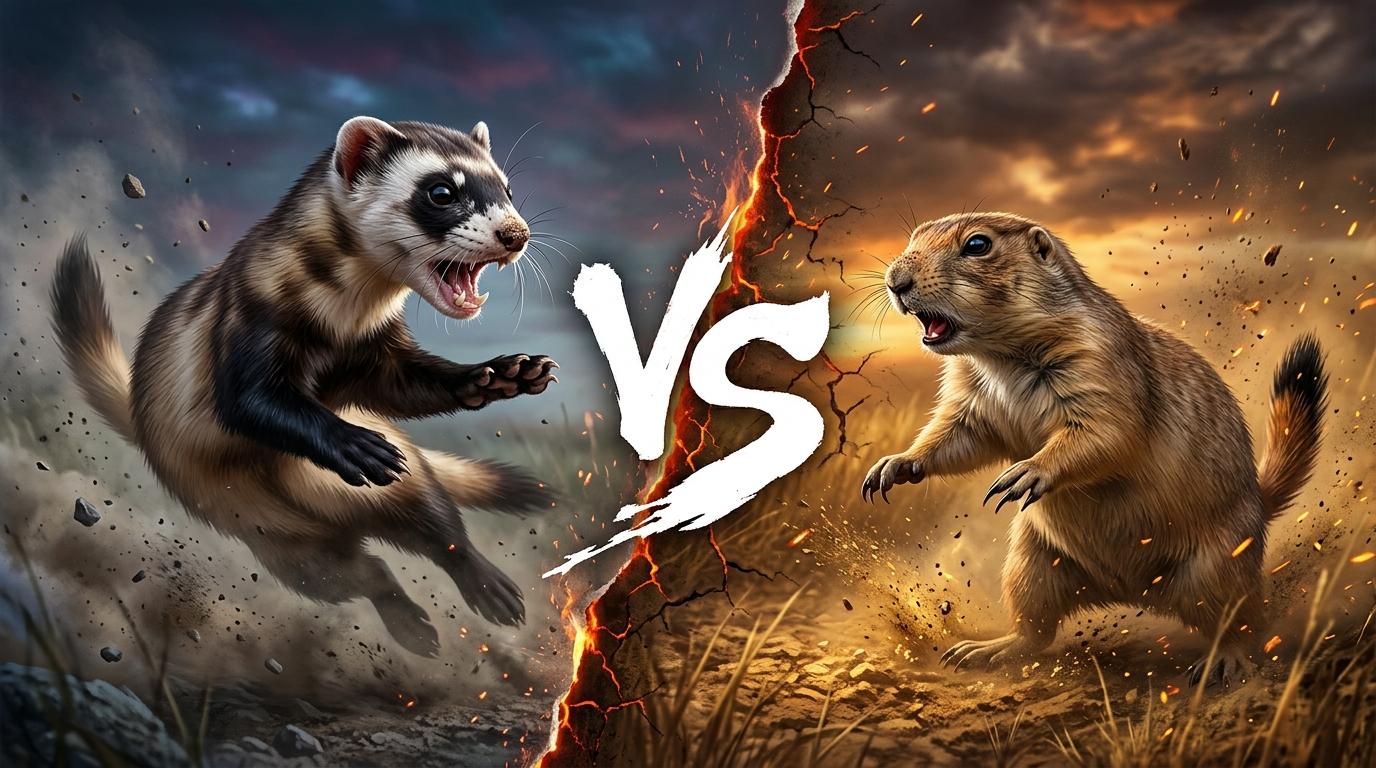
Black-footed Ferret vs Prairie Dog: Who Actually Wins?
The black-footed ferret wins, and it is not an upset. It is the outcome evolution designed. Prairie dogs make up roughly 90 percent of this ferret's diet, and a single ferret kills more than 100 of them a year. The prairie dog is often slightly heavier, and it fights back with chisel incisors and real grit. The ferret answers with a long, flexible body that moves easily through tunnels, night-hunting senses, and a precise bite to the throat or neck that ends the struggle quickly. The ferret's edge is specialization: it hunts at night, underground, in the prairie dog's own home, where the colony's main defense of watching and warning each other matters least. In daylight on open ground, with a coterie on alert, the prairie dog can bluff, dodge, or hold a tight tunnel. One on one, in the dark, the ferret wins.
Read comparison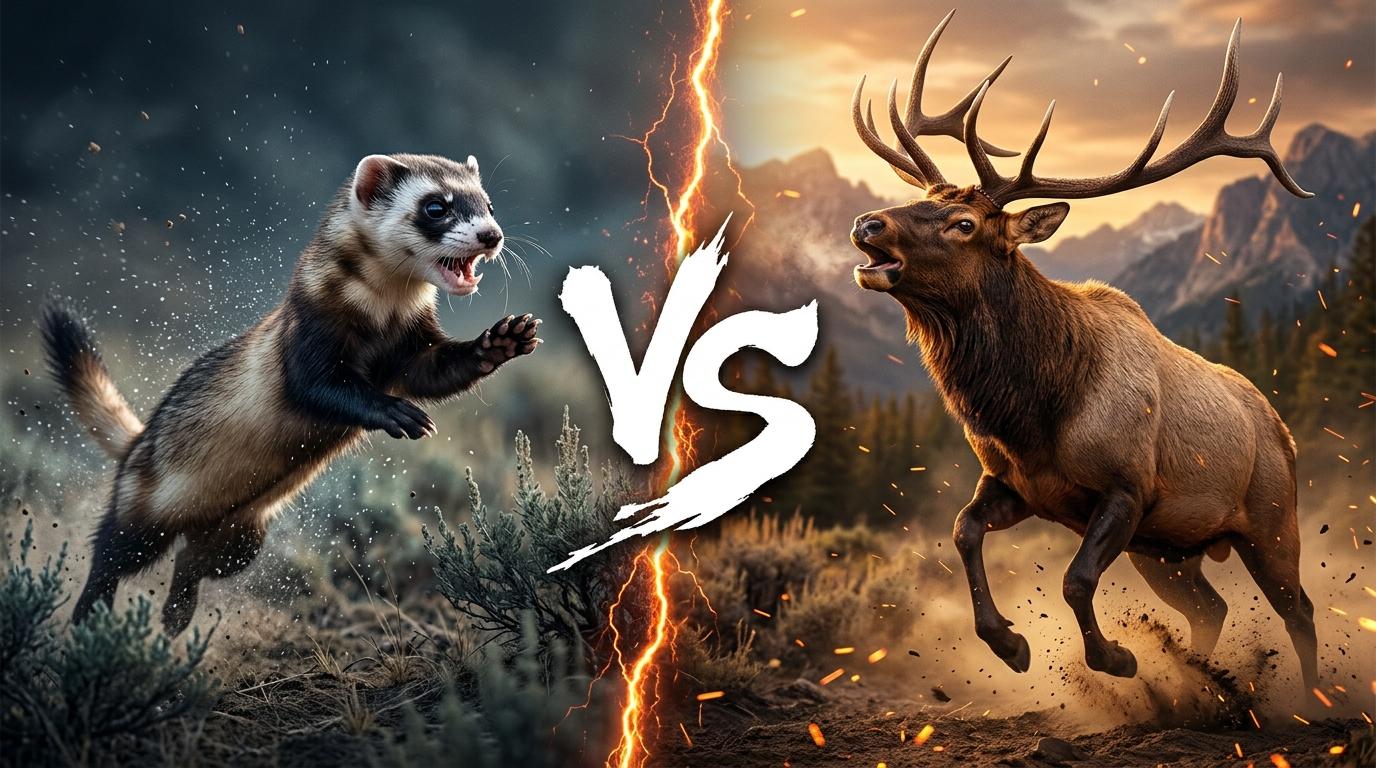
Black-footed Ferret vs Elk: Who Actually Wins?
The elk wins, and it is not close. A bull elk can weigh 300–450 kg against a black-footed ferret's roughly 1 kg, carries antlers and sharp hooves, and runs over 60 km/h. The ferret is a superb specialist at hunting prairie dogs in the dark of their burrows, but it has no tool for injuring an animal hundreds of times its size, and nothing in its behavior pushes it to try. In any realistic meeting the elk either ignores the ferret, steps away, or drives it off with a stamp, and the ferret's best outcome is a quick retreat underground.
Read comparison
Discussion
What do you think?
Share your reasoning with other readers. Be civil and stick to the animals.
Sign in to join the discussion.
Sign inNo comments yet. Start the conversation.