

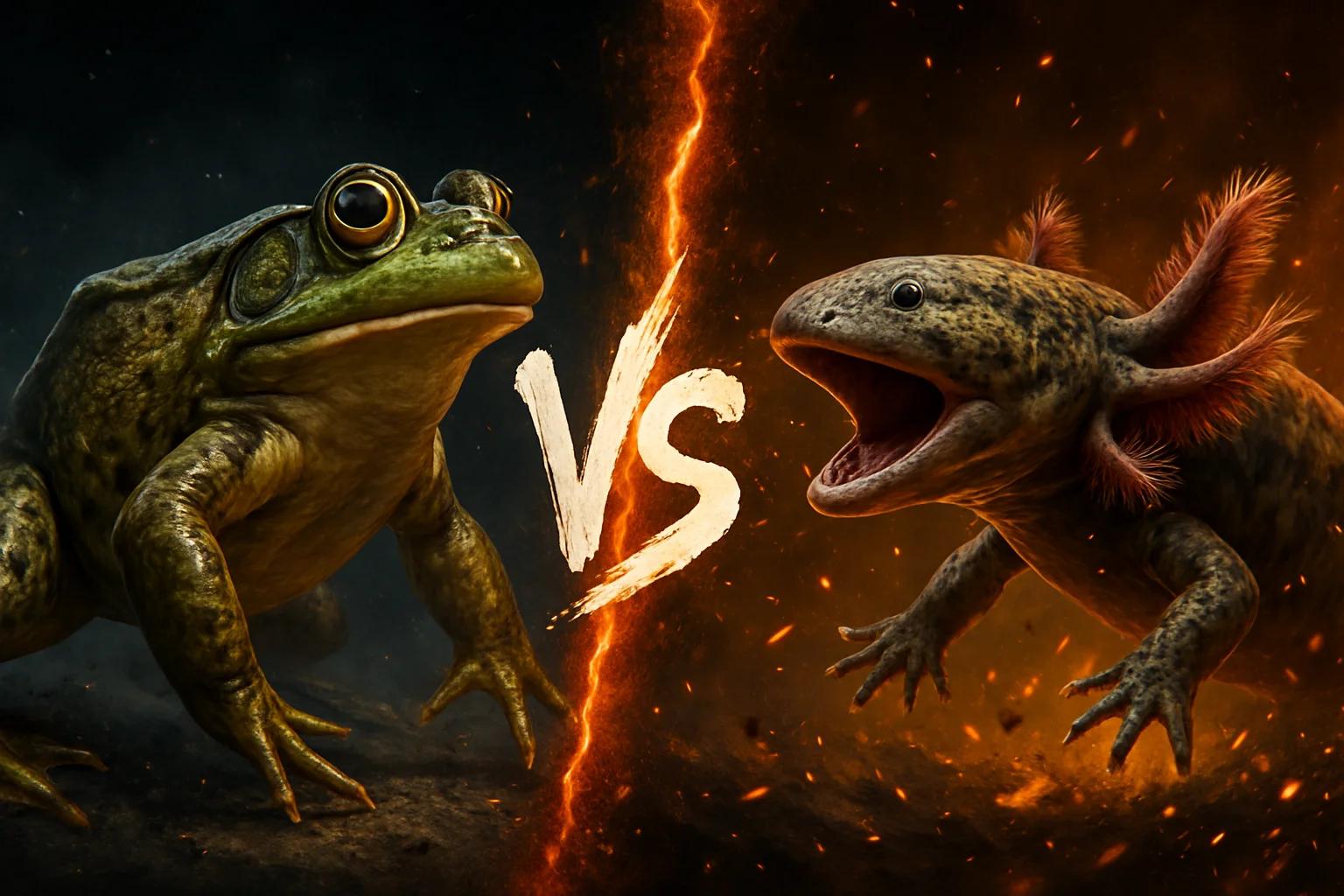
American Bullfrog vs Mudpuppy: Who Actually Wins?
American Bullfrog vs Mudpuppy: a biology-first breakdown of size, gape, speed, and habitat to answer who would win between North America's giant frog and its gilled river salamander.
American Bullfrog vs Mudpuppy
Matchup winner
Mudpuppy
Quick verdict
Start with the direct answer, then use the structured comparison below to see what changes the outcome.
The American Bullfrog wins this matchup. Both are aquatic ambush feeders that swallow prey whole, but the bullfrog brings advantages the mudpuppy cannot match: a far heavier, more muscular body (adults often reach 400–500 g, against a mudpuppy's typical 100–200 g), an enormous gape that can engulf animals nearly its own length, explosive leg-driven strikes, and a well-documented habit of eating other amphibians, including salamanders. The mudpuppy is a capable bottom predator with good chemical senses and a slippery, elongated body, but it is built for slow foraging under rocks rather than for confrontation. When the two meet, it is far more likely to be prey than predator. The mudpuppy's real edge is cold, deep, flowing water where bullfrogs are sluggish or absent. In a direct encounter in shared shallows, the frog's mass and mouth decide the outcome.
Read the full explanation
American Bullfrog wins in most realistic encounters.
The bullfrog's size, gape, and explosive lunge let it overpower and swallow smaller amphibians.
The mudpuppy's best defense is avoidance: cold water, rocky cover, and nighttime bottom activity.
In cold, deep, fast water the mudpuppy holds the advantage because bullfrogs rarely operate there.
Reader vote
Who do you think wins?
Pick a side — no account needed. Results update live.
No votes yet — be the first to call it.
Editorial note
Why people disagree
Mudpuppies look long and serpentine, so people overestimate their mass. A foot-long salamander is mostly tail and slender trunk, while a bullfrog packs its weight into a dense, muscular body.
Explosive power
The bullfrog closes distance and engulfs prey in a fraction of a second. A mudpuppy cannot match that strike speed.
Engulfing capacity
In a contest between swallow-whole predators, the bigger mouth decides who becomes the meal.
Body mass and bracing
Mass lets the bullfrog pin, hold, and gulp. The mudpuppy's length does not translate into overpowering force.
Read the full explanation +
Both species are gulp-and-swallow ambushers, which makes the matchup look even. Gape size is the real tiebreaker, and the bullfrog's is enormous.
Habitat changes everything. Mudpuppies thrive in cold lakes and rivers where bullfrogs are inactive, so the 'winner' can depend on where you imagine the meeting.
Comparison FAQ
Short, direct answers to the next questions readers usually ask after the headline verdict.
Would an American Bullfrog beat a mudpuppy?+
Yes, in most realistic encounters. The bullfrog's size, strike speed, and huge gape let it overpower and potentially swallow a mudpuppy, especially in warm shallow water.
Which is stronger, a bullfrog or a mudpuppy?+
The bullfrog. Its powerful legs and dense, muscular body produce far more force than the mudpuppy's slender, tail-driven frame.
Do bullfrogs eat salamanders?+
Yes. American Bullfrogs are opportunistic predators that eat frogs, salamanders, fish, snakes, and even small birds. Anything that fits in their mouth is fair game.
Why is the mudpuppy still dangerous?+
Mudpuppies are effective nocturnal predators of invertebrates and small fish. They can bite, and their slippery bodies make them hard to hold. In cold water, where they stay active and bullfrogs slow down, they hold the advantage.
Can a mudpuppy escape a bullfrog?+
Often, yes. If the bullfrog misses its first strike, the mudpuppy's slick body and its habit of hiding under rocks give it a good chance to escape into cover.
Head-to-head species stats
These are the same core AnimalDex stat dimensions used on the dedicated animal pages, pulled side by side so the matchup is faster to scan.
American Bullfrog
Tier DMudpuppy
Tier DTrait-by-trait comparison
Only the categories that matter to this matchup are included. The goal is not filler stats, but the real design differences that change the result.
Leg-powered lunge strikes
Explosive power
American Bullfrog
Tail-driven bursts, mostly short
Explosive power
American Bullfrog
Huge gape that swallows near-body-length prey
Engulfing capacity
American Bullfrog
Moderate gape suited to invertebrates and small fish
Engulfing capacity
American Bullfrog
Dense, heavy-bodied adult
Body mass and bracing
American Bullfrog
Lighter, elongated frame
Body mass and bracing
American Bullfrog
Sluggish in cold water and hibernates in winter
Cold-water endurance
Mudpuppy
Active even under winter ice
Cold-water endurance
Mudpuppy
Sit-and-wait surface and edge striker
Ambush control
American Bullfrog
Nocturnal bottom forager using smell
Ambush control
American Bullfrog
Fast jumps and strong swimming
Escape slipperiness
Mudpuppy
Slimy, wriggling body that slips into crevices
Escape slipperiness
Mudpuppy
How the verdict forms
Verdict timeline
01 · Explosive power
American Bullfrog
02 · Engulfing capacity
American Bullfrog
03 · Body mass and bracing
American Bullfrog
04 · Cold-water endurance
Mudpuppy
05 · Ambush control
American Bullfrog
06 · Escape slipperiness
Mudpuppy
Change the conditions
Scenario breakdown
This is where shallow battle content usually fails. Terrain, spacing, timing, and engagement style can change the answer.
Scenario lean
Mudpuppy
Verdict confidence
82%
The mudpuppy survives by disappearing.
In rocky cover, the mudpuppy can wedge itself into crevices that a bulky bullfrog cannot penetrate. This is not a win through combat. The mudpuppy denies the bullfrog a clean engulfing strike and outlasts the encounter.
AnimalDex field profiles
Explore these animals
American Bullfrog
Lithobates catesbeianus
Ponds, lakes, marshes, canals, and warm slow freshwater with aquatic vegetation.
Mudpuppy
Necturus maculosus
Cool rivers, lakes, reservoirs, and rocky freshwater bottoms.
Systems Intelligence & Hidden Purpose
See the animals behind this comparison as engineered biological systems: what each one is built to do, where it gains leverage, and why the matchup changes by scenario.
Specialized Hardware
Large gape, powerful hind limbs, and broad diet flexibility make bullfrogs generalist hardware for ponds, marshes, and human-shaped water bodies.
Systems Script
Bullfrogs turn almost any still-water system into an opportunity by eating widely and reproducing effectively. They show how generalist biology can become infrastructure-level competitive advantage.
Strategic Insight
Breadth becomes power when you can perform adequately across many conditions while specialists wait for perfect ones.
Specialized Hardware
Feathery red external gills, flattened body and tail, and spotted brown coloration give the Mudpuppy a body plan tuned for its niche.
Systems Script
Mudpuppys operate in cool rivers, lakes, reservoirs, and rocky freshwater bottoms. Their design helps them match food access, shelter, and timing inside that environment.
Strategic Insight
Some systems work by never leaving the environment they were built for.
Final take
The American Bullfrog is the overall winner. It is the heavier animal with a much larger gape and a faster strike, and it has a proven taste for other amphibians. In the warm, shallow water where these species overlap, the mudpuppy is at a structural disadvantage.
Read the full explanation
The mudpuppy is still no pushover. It is a resilient survivor that wins by choosing its battlefield: cold, deep, rocky water where bullfrogs lose their edge. Its victories are escapes rather than knockouts, and in nature that is often the smarter strategy.
Collect both animals in AnimalDex
Track the species behind this matchup, compare their real traits, and build the rivalry into your AnimalDex collection.
Related comparisons
Continue with nearby matchups to compare more real-world animal traits without dropping into junky who-wins filler.

Mudpuppy vs Platypus: Who Actually Wins?
The platypus wins this one clearly. It is the bigger animal, roughly 40–50 cm long and up to about 2 kg against a mudpuppy that usually measures 20–33 cm and weighs a fraction of that. The platypus also brings an electroreceptive bill that tracks prey by the muscle signals of living animals, a dense waterproof coat, and powerful webbed forelimbs that make it a much stronger swimmer. Males add venomous ankle spurs that can cause intense pain even in humans. The mudpuppy is a tough, slippery, nocturnal ambush feeder with a grabbing bite built for crayfish and small fish. But it has no weapon that can seriously threaten an animal of the platypus's size and armor, and its feathery external gills are an obvious soft target. These two never meet in the wild, since the mudpuppy lives in North America and the platypus in eastern Australia. In a hypothetical encounter, the platypus controls the exchange and the mudpuppy's best result is escaping.
Read comparison
Discussion
What do you think?
Share your reasoning with other readers. Be civil and stick to the animals.
Sign in to join the discussion.
Sign inNo comments yet. Start the conversation.