

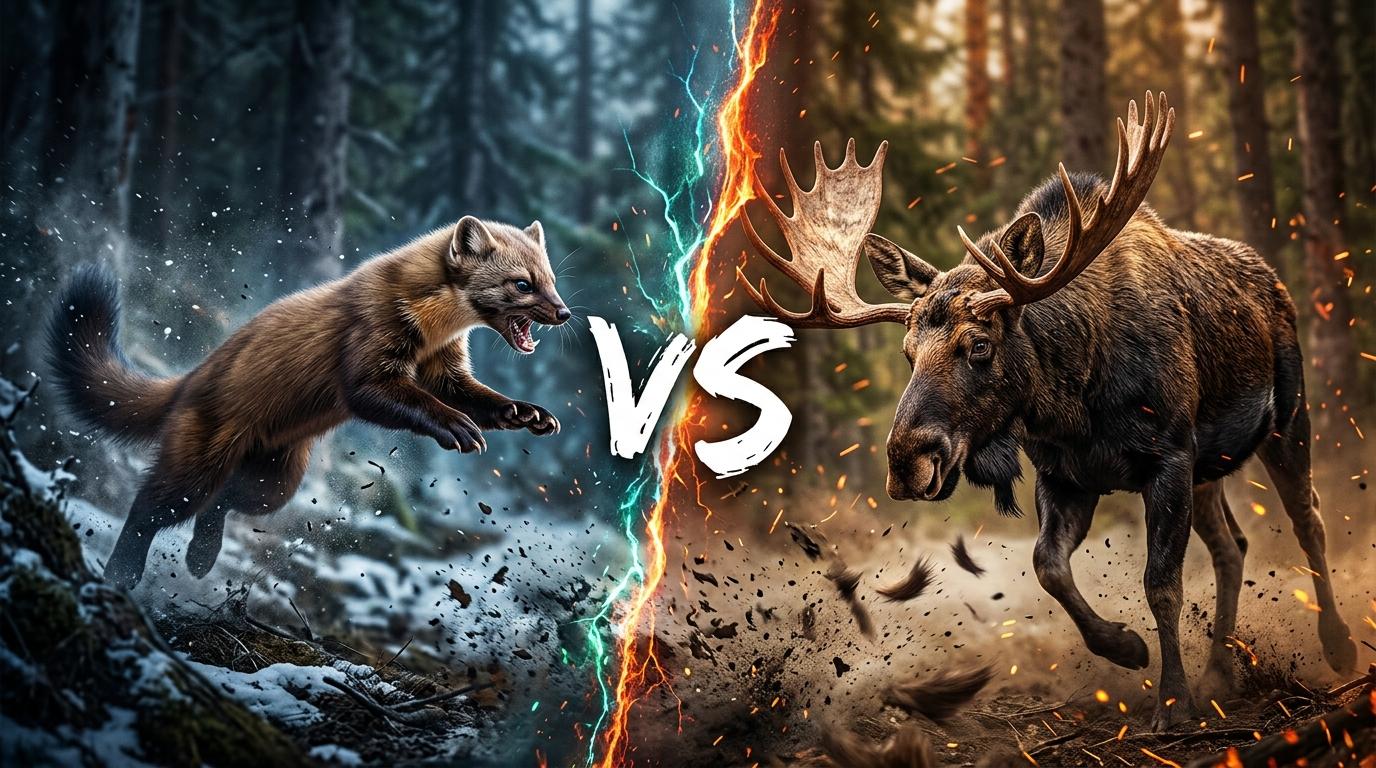
American Marten vs Moose (Eurasian Elk): Who Actually Wins?
American marten vs moose: who would win? A biology-first look at size, power, defense, and why a 1 kg forest hunter cannot beat a 500 kg browser.
American Marten vs Moose
Matchup winner
Moose
Quick verdict
Start with the direct answer, then use the structured comparison below to see what changes the outcome.
The moose wins, and it isn't close. An adult moose (Alces alces, called the elk in Europe) weighs roughly 400–700 kg and stands about 2 m at the shoulder. It defends itself with front-hoof strikes that can seriously injure wolves and bears, and bulls add heavy antlers. The American marten weighs about 0.5–1.3 kg. It is a superb climber and a fast, precise killer of voles, squirrels and snowshoe hares, but its bite and body mass are built for prey a fraction of its own size. A marten has no way to wound a moose meaningfully, and a moose that felt threatened could kill the marten with one stamp. The marten's real advantages are escape and agility, not offense. Any realistic encounter ends with the marten climbing a tree or the moose ignoring it.
Read the full explanation
Moose wins decisively: it outweighs the marten by roughly 400–1,000 times.
Moose hooves and antlers can kill large predators. The marten's bite is sized for squirrels.
The marten 'wins' only by avoiding the fight, usually by climbing a tree.
There is no natural predator–prey or rivalry link between these two species.
Reader vote
Who do you think wins?
Pick a side — no account needed. Results update live.
No votes yet — be the first to call it.
Editorial note
Why people disagree
Martens are famously fierce for their size, which leads people to overestimate what ferocity can do against a huge size gap.
Raw mass and frame
Mass sets the ceiling on what damage can be dealt and absorbed. Here the gap is beyond what any skill could close.
Striking power
Moose strikes are documented killing wolves. A marten bite cannot reach anything vital through a moose's hide and fur.
Close-range durability
The moose can shrug off scratches. The marten cannot survive even one solid hit.
Read the full explanation +
Readers mix up 'elk' (Eurasian name for moose) with North American wapiti, which muddies the matchup.
Some count surviving the encounter by escaping as a marten win. In a battle frame, though, escape is not victory.
Comparison FAQ
Short, direct answers to the next questions readers usually ask after the headline verdict.
Would an American marten beat a moose?+
No. The moose wins decisively. The marten cannot do meaningful damage, and one moose stomp could kill it.
Which is stronger, a marten or a moose?+
The moose, by an enormous margin. It is hundreds of times heavier and can kick hard enough to injure wolves and bears.
Why is the marten still dangerous?+
It is a fast, precise killer of small prey such as squirrels and voles, and its climbing makes it extremely hard to catch. It is dangerous to its own prey, not to moose.
Do martens hunt moose?+
No. Martens eat small mammals, birds, berries and carrion. Like many scavengers, they may feed on a moose carcass.
Is the Eurasian elk the same as a moose?+
Yes. Alces alces is called the moose in North America and the elk in Europe.
Head-to-head species stats
These are the same core AnimalDex stat dimensions used on the dedicated animal pages, pulled side by side so the matchup is faster to scan.
American Marten
Tier CMoose
Tier BTrait-by-trait comparison
Only the categories that matter to this matchup are included. The goal is not filler stats, but the real design differences that change the result.
About 0.5–1.3 kg, slender weasel build
Raw mass and frame
Moose
About 400–700 kg, long-legged giant
Raw mass and frame
Moose
Sharp bite aimed at the neck of small prey
Striking power
Moose
Front-hoof stomps and antler shoves
Striking power
Moose
Fragile against any heavy blow
Close-range durability
Moose
Thick hide, dense winter coat, huge muscle mass
Close-range durability
Moose
Elite tree climber, quick direction changes
Agility and escape
American Marten
Powerful trotter, cannot climb or follow into canopy
Agility and escape
American Marten
Bold, but avoids large threats
Defensive aggression
Moose
Cows defending calves and rutting bulls are highly aggressive
Defensive aggression
Moose
How the verdict forms
Verdict timeline
01 · Raw mass and frame
Moose
02 · Striking power
Moose
03 · Close-range durability
Moose
04 · Agility and escape
American Marten
05 · Defensive aggression
Moose
Change the conditions
Scenario breakdown
This is where shallow battle content usually fails. Terrain, spacing, timing, and engagement style can change the answer.
Scenario lean
Moose
Verdict confidence
82%
The moose holds the ground. The marten leaves through the trees.
Dense conifer forest suits the marten best. Even so, cover only gives it a better escape route. It still has no way to hurt the moose. The moose keeps its position and the marten retreats, so the outcome still goes to the moose.
AnimalDex field profiles
Explore these animals
American Marten
Martes americana
conifer forest, mixed woodland, and snowy boreal cover
Moose
Alces alces
Boreal forest, wetlands, willow thickets, and lake edges.
Systems Intelligence & Hidden Purpose
See the animals behind this comparison as engineered biological systems: what each one is built to do, where it gains leverage, and why the matchup changes by scenario.
Specialized Hardware
slender climbing mustelid body, bushy balancing tail, and snowy forest stealth hunting give the American Marten a body plan tuned for its niche.
Systems Script
American Martens operate through conifer forest, mixed woodland, and snowy boreal cover. Their design links movement, feeding, shelter, and timing into one workable survival system.
Strategic Insight
Dense environments reward precision, patience, and the ability to read layered cover.
Specialized Hardware
Long legs and tall shoulder height, large drooping nose and heavy head, and broad paddle-shaped antlers on adult males give the Moose a body plan tuned for its niche.
Systems Script
Mooses operate in boreal forest, wetlands, willow thickets, and lake edges. Their design helps them match food access, shelter, and timing inside that environment.
Strategic Insight
Height becomes useful when it opens paths and food that smaller bodies cannot reach.
Final take
The moose is the clear winner. This matchup is a lesson in scale: a 500 kg herbivore whose defenses were shaped by wolves and bears against a 1 kg predator built to hunt squirrels.
Read the full explanation
The marten deserves credit as an agile, fearless specialist of the boreal forest. Its survival strategy, though, is to slip away into the canopy, not to stand and fight giants.
Collect both animals in AnimalDex
Track the species behind this matchup, compare their real traits, and build the rivalry into your AnimalDex collection.
Discussion
What do you think?
Share your reasoning with other readers. Be civil and stick to the animals.
Sign in to join the discussion.
Sign inNo comments yet. Start the conversation.