

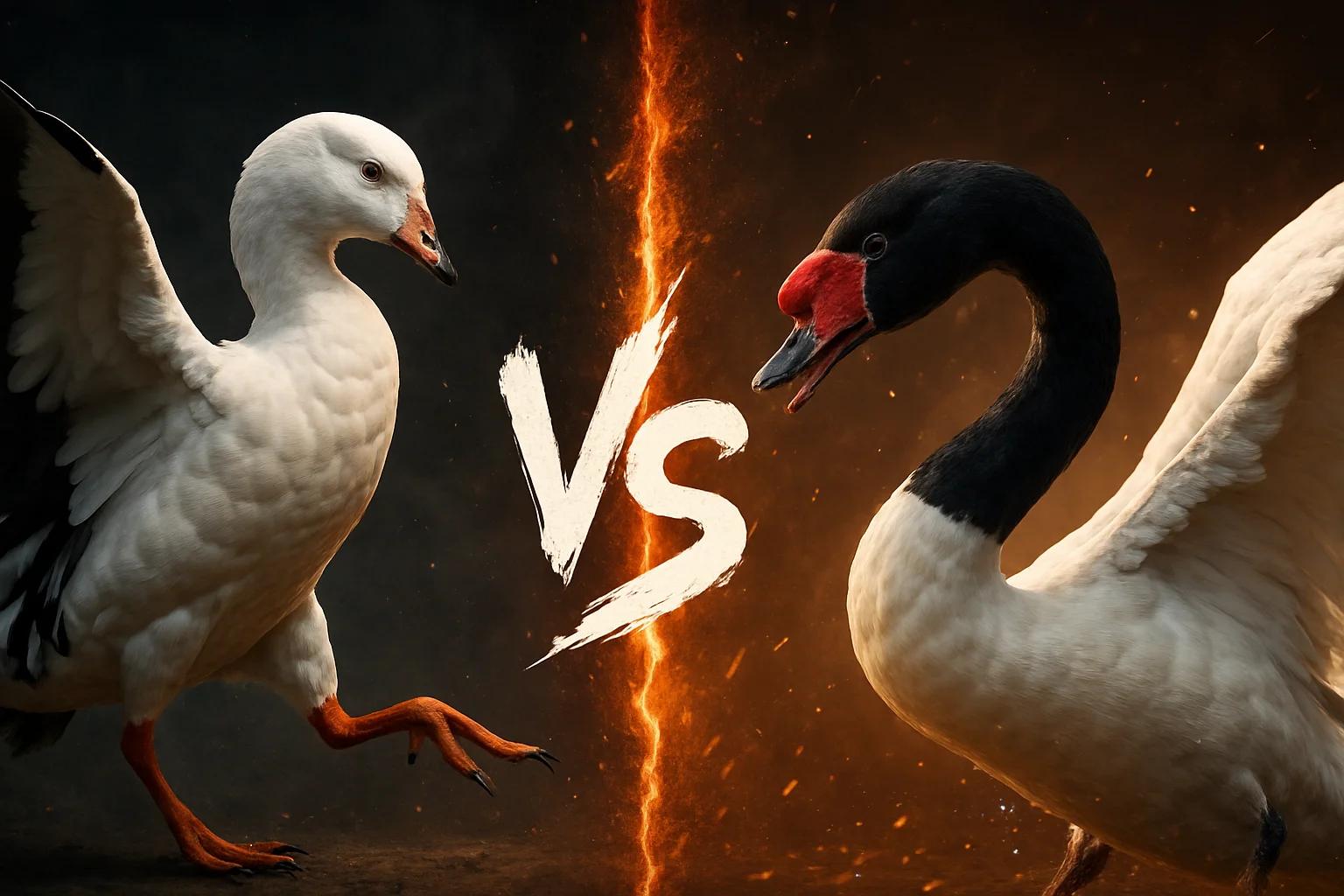
Andean Goose vs Black-necked Swan: Who Actually Wins?
Andean Goose vs Black-necked Swan: a biology-first look at size, aggression, terrain, and territorial grit to decide which South American waterfowl wins a head-to-head clash.
Andean Goose vs Black-necked Swan
Matchup winner
Andean Goose
Quick verdict
Start with the direct answer, then use the structured comparison below to see what changes the outcome.
The Andean Goose wins, narrowly. The Black-necked Swan is the heavier bird. Males can reach roughly 5–6.7 kg, against about 3–3.6 kg for the goose. The swan also owns the water. But this is a land-based standoff, and on land the swan's legs, set far back for paddling, make it slow and clumsy. The Andean Goose is a dedicated highland grazer that rarely swims. It is built to walk, rush, and fight on firm ground. Few South American waterfowl are as quarrelsome in defense of territory. It escalates fast, strikes with hard wing wrists, and keeps pressing. Give the swan deep water and the result flips. On the shorelines and grassy flats where a real dispute would most likely play out, the goose's footing and temperament beat the swan's extra mass.
Read the full explanation
Andean Goose wins most land and shoreline clashes thanks to agility and relentless territorial aggression.
Black-necked Swan is heavier and dominates on open water, where it can use mass and a long neck freely.
The swan is awkward walking on land, a real handicap in a ground-level fight.
It's close: the win comes from terrain and temperament, not raw size.
Reader vote
Who do you think wins?
Pick a side — no account needed. Results update live.
No votes yet — be the first to call it.
Editorial note
Why people disagree
Size bias: the swan is clearly heavier, so many people assume it wins by default.
Raw mass
Extra weight helps the swan absorb blows and push in a grapple, especially in water.
Ground mobility
In a fight on land, footing decides who can charge, pivot, and retreat at will.
Territorial aggression
Willingness to commit often beats size in bird disputes, since most end when one side backs off.
Read the full explanation +
Habitat mismatch: the goose lives in high Andean wetlands, while the swan prefers lower lakes and Patagonian waters, so the 'where' decides the 'who.'
Swan reputation: Northern Hemisphere swans are famously fierce, but the Black-necked Swan is the smallest Cygnus and comparatively shy on land.
Comparison FAQ
Short, direct answers to the next questions readers usually ask after the headline verdict.
Would an Andean Goose beat a Black-necked Swan?+
Usually, on land or along shorelines. The goose is more agile on foot and far more aggressive. In open water the swan would likely win.
Which is stronger, the Andean Goose or the Black-necked Swan?+
In raw mass and pushing power the Black-necked Swan is stronger, roughly 1.5–2 times the goose's weight. Strength alone doesn't decide the fight, though, because mobility and aggression matter more on land.
Why is the Black-necked Swan still dangerous if it loses?+
Its weight, long neck, and powerful wings can deliver heavy blows. Near water it can retreat and turn the fight into one it controls, so a goose that follows it in is in trouble.
Do they actually meet in the wild?+
Rarely. Andean Geese live in high-altitude Andean wetlands, while Black-necked Swans favor lower lakes and southern South American waters. The matchup is mostly hypothetical.
Is the Andean Goose aggressive toward people or other birds?+
It is known for fierce territorial behavior during breeding and will drive off other birds, including larger ones, from its patch.
Head-to-head species stats
These are the same core AnimalDex stat dimensions used on the dedicated animal pages, pulled side by side so the matchup is faster to scan.
Andean Goose
Tier CBlack-necked Swan
Tier CTrait-by-trait comparison
Only the categories that matter to this matchup are included. The goal is not filler stats, but the real design differences that change the result.
About 2.7–3.6 kg, compact
Raw mass
Black-necked Swan
About 4–6.7 kg, smallest true swan but still heavier
Raw mass
Black-necked Swan
Upright terrestrial grazer, quick on its feet
Ground mobility
Andean Goose
Legs set far back, laborious walker
Ground mobility
Andean Goose
Notoriously pugnacious, escalates quickly
Territorial aggression
Andean Goose
Defends nests but tends to avoid land confrontation
Territorial aggression
Andean Goose
Swims only when needed
Water command
Black-necked Swan
Highly aquatic, powerful paddler
Water command
Black-necked Swan
Hard, bony wing wrists used as clubs
Wing-strike arsenal
Andean Goose
Longer wings and neck reach, heavier but less practiced blows
Wing-strike arsenal
Andean Goose
Fast takeoff from ground
Escape & burst speed
Black-necked Swan
Strong flier but needs a long water run to launch
Escape & burst speed
Black-necked Swan
How the verdict forms
Verdict timeline
01 · Raw mass
Black-necked Swan
02 · Ground mobility
Andean Goose
03 · Territorial aggression
Andean Goose
04 · Water command
Black-necked Swan
05 · Wing-strike arsenal
Andean Goose
06 · Escape & burst speed
Black-necked Swan
Change the conditions
Scenario breakdown
This is where shallow battle content usually fails. Terrain, spacing, timing, and engagement style can change the answer.
Scenario lean
Andean Goose
Verdict confidence
82%
Goose dominates on grassland.
On firm, open turf the goose can charge, sidestep, and club with its wings while the swan struggles to turn and brace. The swan's aquatic anatomy becomes dead weight, and the goose's terrestrial build lets it control spacing.
AnimalDex field profiles
Explore these animals
Andean Goose
Chloephaga melanoptera
altiplano lake, puna grassland, and mountain wetland
Black-necked Swan
Cygnus melancoryphus
lake, marsh, and Patagonian wetland
Systems Intelligence & Hidden Purpose
See the animals behind this comparison as engineered biological systems: what each one is built to do, where it gains leverage, and why the matchup changes by scenario.
Specialized Hardware
white body with black flight feathers, pink legs, and high-altitude grazing give the Andean Goose a body plan tuned for its niche.
Systems Script
Andean Gooses operate through altiplano lake, puna grassland, and mountain wetland. Their design links movement, feeding, shelter, and timing into one workable survival system.
Strategic Insight
In steep terrain, balance and route control matter more than brute force.
Specialized Hardware
black velvet neck, white lake body, and scarlet bill knob give the Black-necked Swan a body plan tuned for its niche.
Systems Script
Black-necked Swans operate through lake, marsh, and Patagonian wetland. Their design links movement, feeding, shelter, and timing into one workable survival system.
Strategic Insight
Where water controls movement, position and timing often matter more than speed.
Final take
The Andean Goose takes this matchup because fights between waterfowl are rarely about raw weight. They turn on terrain and willingness to commit. The goose brings a body built for land and a temperament built for territorial conflict.
Read the full explanation
The Black-necked Swan is no pushover. On open water it is the stronger bird, and its mass makes it hard to dislodge. But a swan forced onto land is fighting outside its design, and that is where the goose wins its edge.
Collect both animals in AnimalDex
Track the species behind this matchup, compare their real traits, and build the rivalry into your AnimalDex collection.
Discussion
What do you think?
Share your reasoning with other readers. Be civil and stick to the animals.
Sign in to join the discussion.
Sign inNo comments yet. Start the conversation.