


Archerfish vs Mudskipper: Who Actually Wins?
Banded archerfish vs mudskipper: a biology-first breakdown of size, speed, aim, armor, and mangrove tactics to answer who would win in a real encounter.
Archerfish vs Mudskipper
Matchup winner
Archerfish
Quick verdict
Start with the direct answer, then use the structured comparison below to see what changes the outcome.
The banded archerfish wins overall. At up to roughly 20–30 cm and deep-bodied, it outweighs most mudskippers several times over. It is a fast, maneuverable open-water swimmer with a visual system tuned to correct for refraction, and in water it can simply overpower, bite, and outlast a smaller goby. The mudskipper's genius is amphibious escape: it breathes air through its skin and gill chambers, skips across exposed mud, and retreats into burrows the archerfish can't follow. So the fight goes to the archerfish wherever water is deep enough to swim, while the mudskipper's real win condition is leaving the fight entirely.
Read the full explanation
Archerfish wins in most matchups because it is bigger, heavier, and faster in water.
The mudskipper wins only by escaping onto mud or into a burrow, where the archerfish cannot follow.
The archerfish's famous water jet is a hunting tool for insects, not a weapon that could defeat a mudskipper.
Overall winner: Banded Archerfish, with high confidence because of its size and swimming advantage.
Reader vote
Who do you think wins?
Pick a side — no account needed. Results update live.
No votes yet — be the first to call it.
Editorial note
Why people disagree
Viral videos show archerfish knocking prey off leaves, so people overrate the spit as a combat weapon. It can stun a small insect, but it does nothing decisive to a mudskipper.
Body mass & frame
Among small fish, mass decides bites, shoves, and who controls the water column.
Open-water speed
In water the mudskipper can't outrun or outmaneuver the archerfish.
Amphibious escape
Being able to leave the water is the mudskipper's only reliable way to end the fight.
Read the full explanation +
Mudskippers look tough and territorial, with dorsal-fin displays and gaping mouths. That aggression is mostly ritualized contests with other mudskippers, not a way to beat a larger fish.
They share mangrove habitat, so 'who wins' depends heavily on tide. At high tide the archerfish controls the space, and at low tide the mudskipper owns it.
Comparison FAQ
Short, direct answers to the next questions readers usually ask after the headline verdict.
Would an archerfish beat a mudskipper in a fight?+
Yes, in water. The archerfish is larger, faster, and stronger, so it would win most direct encounters. The mudskipper's best outcome is escaping onto mud or into its burrow.
Which is stronger, an archerfish or a mudskipper?+
The archerfish. It is several times heavier and is a far more powerful swimmer, which matters most for fish of this size.
Can an archerfish's water jet hurt a mudskipper?+
Not meaningfully. The jet is built to dislodge small insects from vegetation. At most it might startle a mudskipper on a bank, but it is not a weapon that could injure one.
Why is the mudskipper still dangerous to underestimate?+
It can breathe air, travel across land, and hide in deep burrows, so it controls terrain no aquatic fish can reach. It is also fiercely territorial and will bite and display at intruders near its burrow.
Do archerfish eat mudskippers?+
Archerfish mainly eat insects and small aquatic animals. A very small mudskipper could be taken opportunistically, but mudskippers are not a typical prey item.
Head-to-head species stats
These are the same core AnimalDex stat dimensions used on the dedicated animal pages, pulled side by side so the matchup is faster to scan.
Archerfish
Tier CMudskipper
Tier CTrait-by-trait comparison
Only the categories that matter to this matchup are included. The goal is not filler stats, but the real design differences that change the result.
Deep-bodied, up to ~30 cm
Body mass & frame
Archerfish
Slender goby, mostly ~10–15 cm
Body mass & frame
Archerfish
Quick, agile surface cruiser
Open-water speed
Archerfish
Weak, short-burst swimmer
Open-water speed
Archerfish
Strictly aquatic
Amphibious escape
Mudskipper
Breathes air, skips and climbs on mud
Amphibious escape
Mudskipper
Refraction-corrected water jets
Precision targeting
Archerfish
Close-range snapping
Precision targeting
Archerfish
No refuge structure
Burrow control
Mudskipper
Digs and defends mud burrows
Burrow control
Mudskipper
Larger body absorbs bites
Close-range durability
Archerfish
Small body, thin defenses
Close-range durability
Archerfish
How the verdict forms
Verdict timeline
01 · Body mass & frame
Archerfish
02 · Open-water speed
Archerfish
03 · Amphibious escape
Mudskipper
04 · Precision targeting
Archerfish
05 · Burrow control
Mudskipper
06 · Close-range durability
Archerfish
Change the conditions
Scenario breakdown
This is where shallow battle content usually fails. Terrain, spacing, timing, and engagement style can change the answer.
Scenario lean
Archerfish
Verdict confidence
82%
Clear archerfish win.
With the mangrove flooded, the mudskipper is reduced to a mediocre swimmer. The archerfish's size, speed, and gape let it chase, bite, and dominate. A mudskipper might even be small enough to be treated as prey.
AnimalDex field profiles
Explore these animals
Archerfish
Toxotes jaculatrix
estuary, mangrove, and slow coastal freshwater
Mudskipper
Periophthalmus argentilineatus
mudflat, mangrove, and tidal estuary
Systems Intelligence & Hidden Purpose
See the animals behind this comparison as engineered biological systems: what each one is built to do, where it gains leverage, and why the matchup changes by scenario.
Specialized Hardware
water-spitting hunting shot, surface-looking eyes, and mangrove-edge feeding give the Archerfish a body plan tuned for its niche.
Systems Script
Archerfishs operate through estuary, mangrove, and slow coastal freshwater Their design links movement, shelter, feeding, and survival into one workable system.
Strategic Insight
A clever angle can let one environment reach into another.
Specialized Hardware
walking fin-like limbs, bulging above-water eyes, and land-and-water living give the Mudskipper a body plan tuned for its niche.
Systems Script
Mudskippers operate through mudflat, mangrove, and tidal estuary Their design links movement, shelter, feeding, and survival into one workable system.
Strategic Insight
Edge spaces reward systems that can handle both sides of the border.
Final take
The banded archerfish is the winner. In any contest decided in water, which covers most mangrove encounters at mid to high tide, its size, swimming power, and visual precision outclass the mudskipper.
Read the full explanation
The mudskipper isn't a pushover, though. It is a different kind of specialist. Its strategy is to make the fight irrelevant by leaving the water, a habitat the archerfish cannot enter. That makes it hard to catch, even though it is easy to beat once caught.
Collect both animals in AnimalDex
Track the species behind this matchup, compare their real traits, and build the rivalry into your AnimalDex collection.
Related comparisons
Continue with nearby matchups to compare more real-world animal traits without dropping into junky who-wins filler.

Archerfish vs Electric Eel: Who Actually Wins?
The electric eel wins, and it is not close. An adult Electrophorus can exceed 2 meters and fire discharges of several hundred volts, up to roughly 860 V in the most powerful species, through the water around it. A banded archerfish is a palm-sized, 20–30 cm brackish-water specialist whose famous weapon is a precision water jet built to knock insects off leaves above the surface. That jet is useless underwater against a submerged predator. The eel also carries a low-voltage electrolocation system that finds prey in murky water, plus high-voltage volleys that cause involuntary muscle spasms and immobilize fish nearby. Any encounter in shared water ends with the archerfish stunned and swallowed. The only thing that would spare it is the real-world fact that the two species rarely meet: archerfish live in Indo-Pacific mangroves and electric eels in South American freshwater.
Read comparison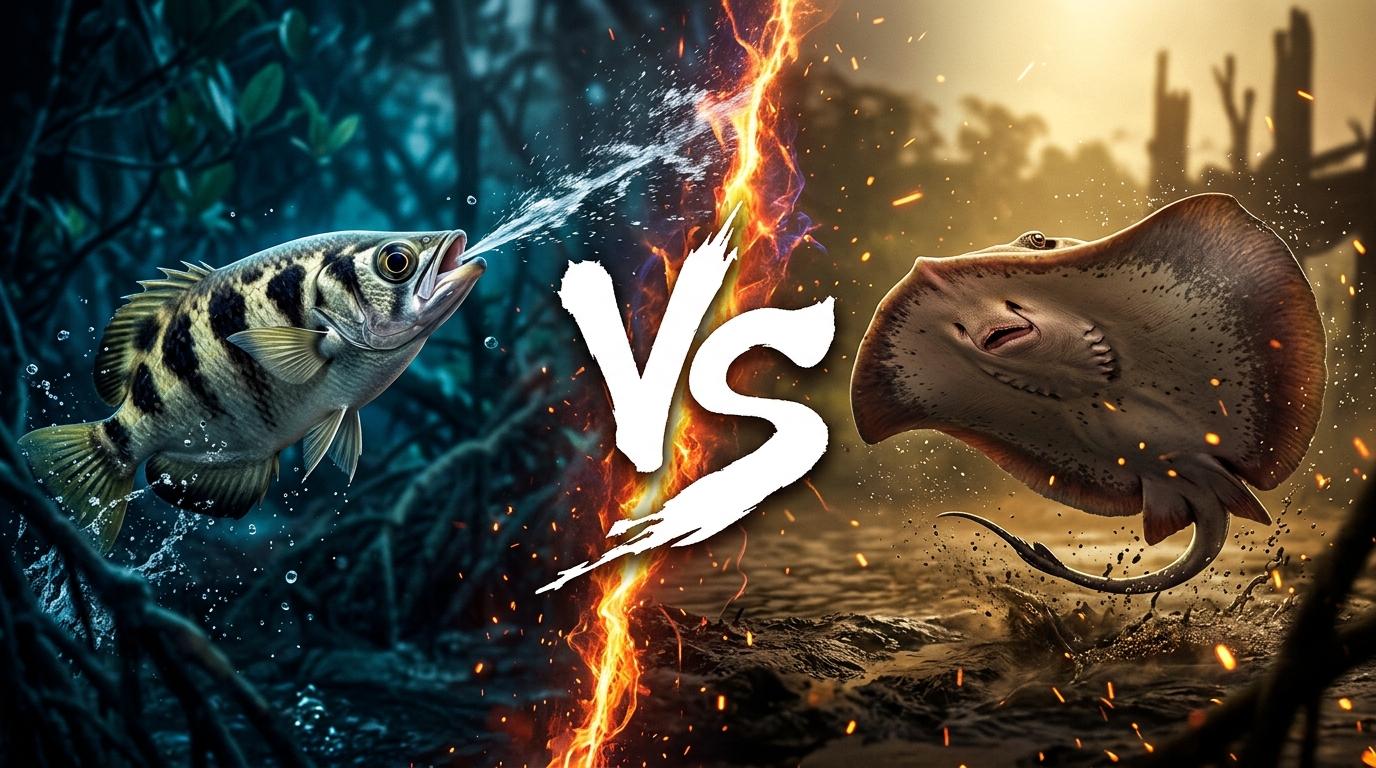
Banded Archerfish vs Giant Freshwater Stingray: Who Actually Wins?
The Giant Freshwater Stingray wins, and it is not close. This river giant can reach about 2 meters across and weigh around 300 kg. It carries a serrated, venomous tail spine and lives on the bottom of big tropical rivers. The Banded Archerfish is usually about 15–25 cm long and weighs a few hundred grams. Its famous weapon is a precise jet of water that knocks insects off leaves above the surface. That makes it a brilliant hunter of tiny prey, but useless against a fish thousands of times heavier. The archerfish's real strengths are its eyes and its aim. The ray's strengths are mass, armor, sensing and a defensive weapon. In any real meeting, the ray controls the outcome. The archerfish's best result is to avoid notice entirely.
Read comparison
Archerfish vs Barramundi: Who Actually Wins?
The barramundi wins, and it isn't close. Lates calcarifer is a large predatory perch that commonly reaches 60–120 cm and can pass 1.5 m. It has a huge bucket mouth built to suck in whole fish, and it ambushes from snags in the same estuaries and mangrove creeks where archerfish live. The banded archerfish usually tops out around 20–30 cm. Its signature weapon is a precision water jet aimed at insects above the surface, and that jet does nothing to a submerged predator. In real overlap, an archerfish is not an opponent for a barramundi. It is a plausible meal. The archerfish's best outcome is to avoid the encounter: it stays near the surface, keeps its eyes sharp, and slips through tight root tangles.
Read comparison
Discussion
What do you think?
Share your reasoning with other readers. Be civil and stick to the animals.
Sign in to join the discussion.
Sign inNo comments yet. Start the conversation.