

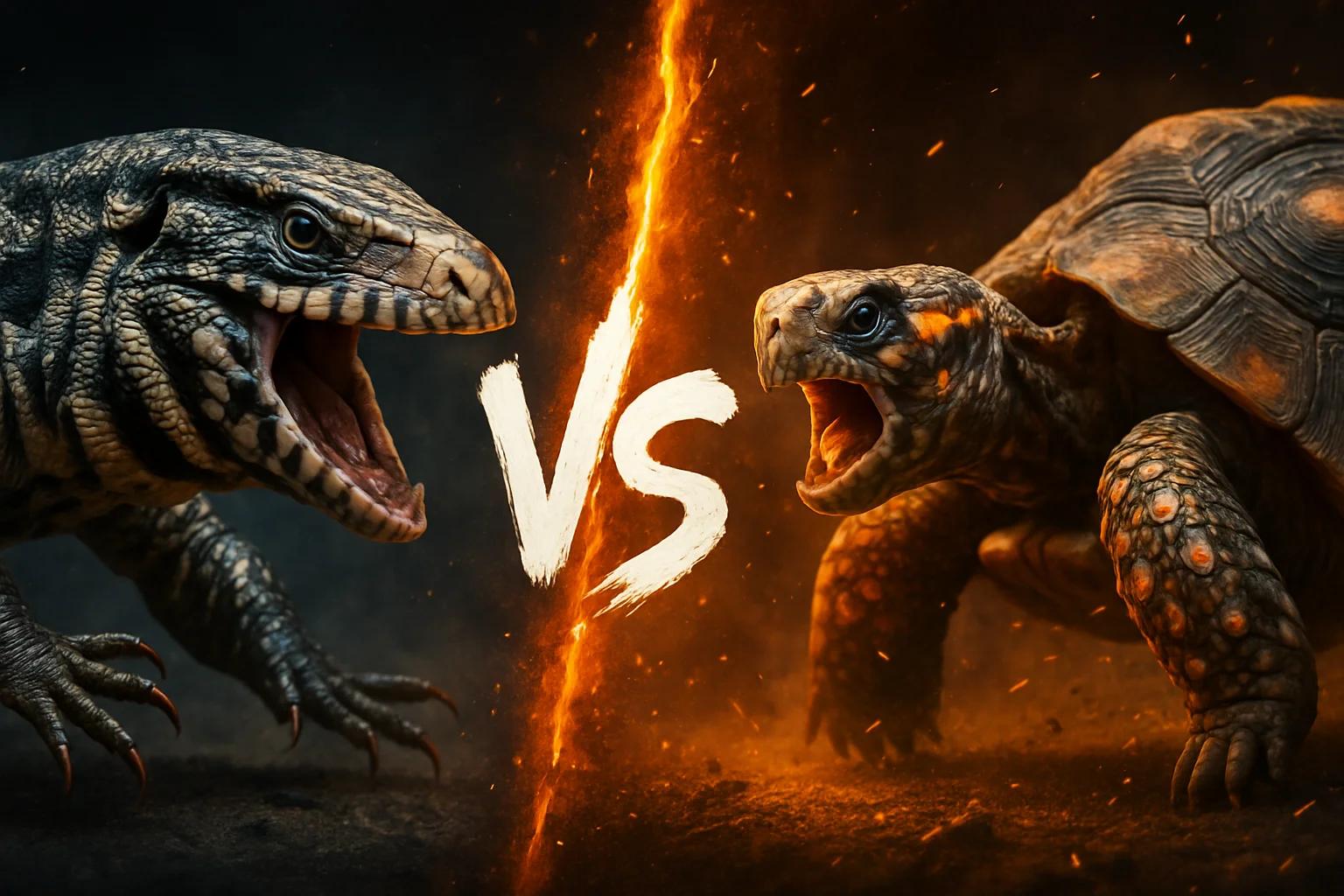
Argentine Black and White Tegu vs Red-footed Tortoise: Who Actually Wins?
Tegu vs red-footed tortoise: speed, bite power, and armor compared. See who wins in cover, open ground, and food contests, and why the tortoise's shell still matters.
Argentine Black and White Tegu vs Red-footed Tortoise
Matchup winner
Argentine Black and White Tegu
Quick verdict
Start with the direct answer, then use the structured comparison below to see what changes the outcome.
The Argentine Black and White Tegu wins clearly. It is a fast, muscular, heavy-jawed predator-scavenger that can reach about 1.2–1.4 m and weigh 5–7 kg or more. It also has the curiosity and mobility to control almost any encounter. The Red-footed Tortoise is a slow, mostly plant-eating forager whose real answer is its domed shell, not its beak. In a direct conflict, the tegu sets the pace, wins the food, and drives the tortoise off. It can also seriously injure exposed limbs, heads, or juvenile tortoises, which tegus are known to eat as eggs and hatchlings in the wild. An adult red-foot rarely 'loses' outright, though, because a fully withdrawn tortoise with a hard carapace is a poor return on effort. The tegu wins on control and dominance. The tortoise wins only at not being worth finishing.
Read the full explanation
Winner: Argentine Black and White Tegu. It is faster, stronger-jawed, more aggressive, and more adaptable.
The tegu controls the encounter, takes contested food, and can injure exposed parts or eat young tortoises.
An adult red-footed tortoise survives mainly by withdrawing into its shell, which often makes the tegu give up.
The tortoise wins nothing on offense. Its whole strategy is to outlast.
Reader vote
Who do you think wins?
Pick a side — no account needed. Results update live.
No votes yet — be the first to call it.
Editorial note
Why people disagree
'Can't hurt it' isn't the same as 'can't beat it.' Shells stop many bites, but the tegu still dominates the space and the food.
Explosive power
The tegu decides when contact happens. The tortoise can only react.
Bite and crushing jaws
Tegu jaws are true weapons. The tortoise beak is a feeding tool.
Close-range durability
This is the tortoise's one decisive edge, and it makes an adult very hard to finish.
Read the full explanation +
Size matters a lot. A hatchling or juvenile red-foot is prey for a tegu, while a large adult is mostly a wasted effort.
Both are popular pets, and calm captive tegus give people an underestimated sense of their wild predatory drive.
Comparison FAQ
Short, direct answers to the next questions readers usually ask after the headline verdict.
Would a tegu beat a red-footed tortoise?+
Yes. The tegu wins by dominating the encounter and taking resources. It can kill juveniles. Adult tortoises usually survive by withdrawing into their shells.
Which is stronger, a tegu or a red-footed tortoise?+
The tegu, in terms of usable strength. It has stronger jaws, a muscular body, and a powerful tail. The tortoise's strength lies in its armor and its pushing power, not in attack.
Can a tegu break a tortoise shell?+
It can damage the shells of hatchlings and young tortoises. A healthy adult red-foot's carapace is generally too hard and too large for a tegu to crush.
Why is the red-footed tortoise still dangerous to deal with?+
It isn't dangerous offensively. It is 'dangerous' as an energy sink. A withdrawn adult makes an attacker waste time and effort, and it can deliver a firm beak bite to a careless snout. Keepers should never house the two species together.
Do tegus and red-footed tortoises live in the same places?+
Their ranges overlap in parts of South America, including areas of Argentina, Paraguay, Bolivia, and Brazil, where both eat fallen fruit.
Head-to-head species stats
These are the same core AnimalDex stat dimensions used on the dedicated animal pages, pulled side by side so the matchup is faster to scan.
Argentine Black and White Tegu
Tier CRed-footed Tortoise
Tier DTrait-by-trait comparison
Only the categories that matter to this matchup are included. The goal is not filler stats, but the real design differences that change the result.
Fast lunges, sprint bursts, powerful tail
Explosive power
Argentine Black and White Tegu
Minimal; slow deliberate walk
Explosive power
Argentine Black and White Tegu
Strong jaws built to crush eggs, snails, and small vertebrates
Bite and crushing jaws
Argentine Black and White Tegu
Keratin beak made for fruit and leaves
Bite and crushing jaws
Argentine Black and White Tegu
Tough scaled hide but no armor
Close-range durability
Red-footed Tortoise
Domed bony carapace and plastron with retractable limbs
Close-range durability
Red-footed Tortoise
Quick, agile, active forager
Mobility and pursuit
Argentine Black and White Tegu
Among the slowest movers in the forest
Mobility and pursuit
Argentine Black and White Tegu
Notably curious, learns routines, opportunistic
Foraging intelligence
Argentine Black and White Tegu
Good at finding food and remembering fruiting spots, but cautious
Foraging intelligence
Argentine Black and White Tegu
High drive but gives up on unprofitable targets
Endurance under threat
Red-footed Tortoise
Can stay withdrawn for long periods
Endurance under threat
Red-footed Tortoise
How the verdict forms
Verdict timeline
01 · Explosive power
Argentine Black and White Tegu
02 · Bite and crushing jaws
Argentine Black and White Tegu
03 · Close-range durability
Red-footed Tortoise
04 · Mobility and pursuit
Argentine Black and White Tegu
05 · Foraging intelligence
Argentine Black and White Tegu
06 · Endurance under threat
Red-footed Tortoise
Change the conditions
Scenario breakdown
This is where shallow battle content usually fails. Terrain, spacing, timing, and engagement style can change the answer.
Scenario lean
Argentine Black and White Tegu
Verdict confidence
82%
The tegu dominates in leaf litter and brush.
In dense cover, the tegu's flicking tongue and active search find the tortoise quickly. The tortoise can wedge itself under roots, which helps its armor. Even so, the tegu controls the space and can probe for exposed limbs. Against juveniles, this is a predation scenario.
AnimalDex field profiles
Explore these animals
Argentine Black and White Tegu
Salvator merianae
savannah, scrub, forest edge, and seasonal grassland
Red-footed Tortoise
Chelonoidis carbonarius
Forest edge, savannah, scrub, and humid to seasonally dry tropical habitats.
Systems Intelligence & Hidden Purpose
See the animals behind this comparison as engineered biological systems: what each one is built to do, where it gains leverage, and why the matchup changes by scenario.
Specialized Hardware
large patterned lizard body, strong digging limbs, and broad omnivorous diet give the Argentine Black and White Tegu a body plan tuned for its niche.
Systems Script
Argentine Black and White Tegus operate through savannah, scrub, forest edge, and seasonal grassland Their design links movement, shelter, and feeding into one workable survival system.
Strategic Insight
Generalist systems last longer when the environment refuses to stay consistent.
Specialized Hardware
Dark domed shell, red or orange leg scales, and heavy slow walking gait give the Red-footed Tortoise a body plan tuned for its niche.
Systems Script
Red-footed Tortoises operate in forest edge, savannah, scrub, and humid to seasonally dry tropical habitats. Their design helps them match food access, shelter, and timing inside that environment.
Strategic Insight
Consistency can take a system farther than urgency.
Final take
The Argentine Black and White Tegu is the clear winner. It is the faster, stronger, more aggressive animal with real weapons, and it controls every realistic encounter, from leaf litter to a pile of fallen fruit.
Read the full explanation
The Red-footed Tortoise's shell is a masterpiece of passive defense, though. Against an adult, the tegu often wins the moment but not the kill, and the tortoise walks away later. That is the whole point of its evolutionary design.
Collect both animals in AnimalDex
Track the species behind this matchup, compare their real traits, and build the rivalry into your AnimalDex collection.
Related comparisons
Continue with nearby matchups to compare more real-world animal traits without dropping into junky who-wins filler.
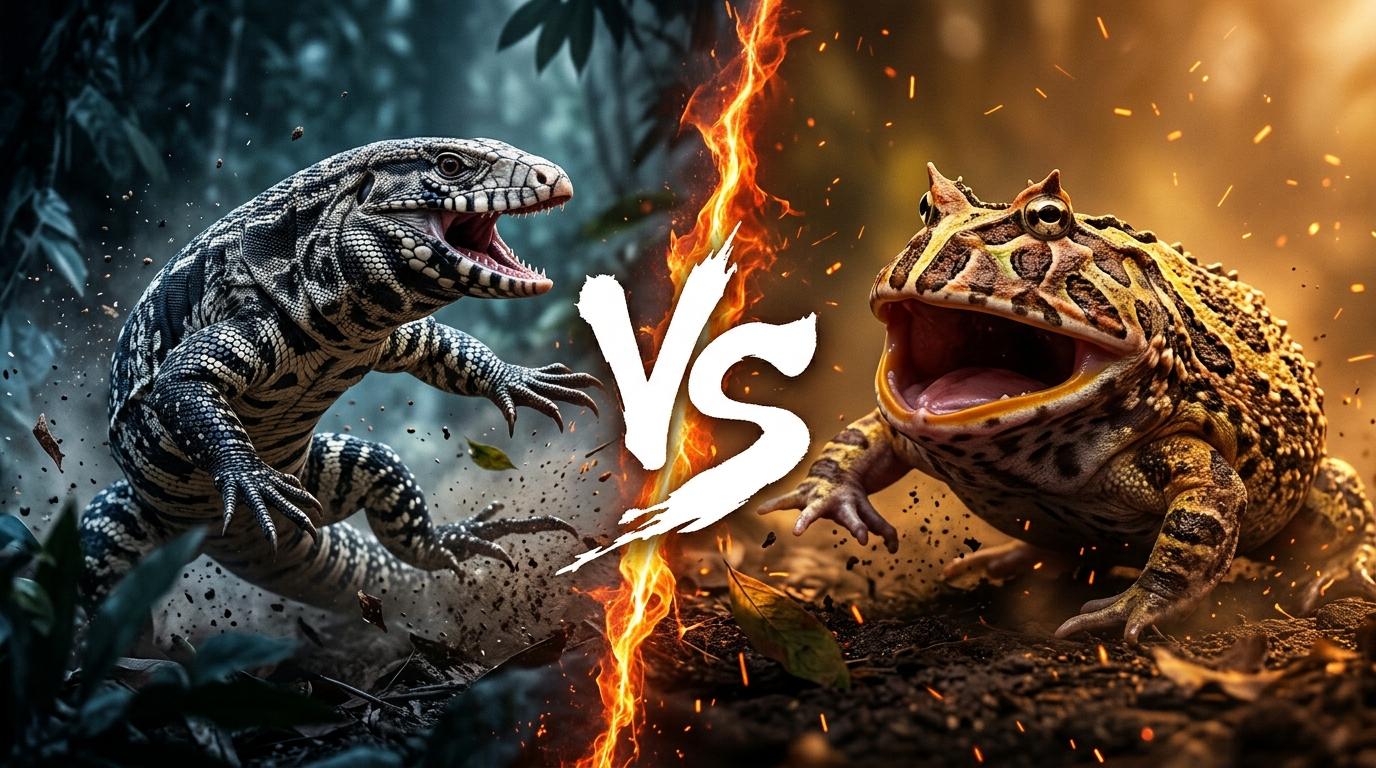
Argentine Black and White Tegu vs Ornate Horned Frog: Who Actually Wins?
The Argentine black and white tegu wins, and it isn't close. An adult tegu can reach about 1.2–1.4 m and 5–8 kg or more. It combines muscular jaws, crushing rear teeth, armored scales, sharp claws and active foraging intelligence. An ornate horned frog is roughly a 10–14 cm, half-kilo-class sit-and-wait predator. Its whole game depends on prey wandering within one lunge of its enormous mouth. The frog's gape and aggressive bite are real, and it can latch onto anything that fits. A tegu does not fit. In the wild, tegus are opportunistic omnivores that readily eat frogs, eggs and small animals. They are wide-ranging, alert, and built to find, flip and crush exactly the kind of buried, slow-moving prey a horned frog represents. The frog gets one surprise bite at best. The tegu gets the whole encounter.
Read comparison
Discussion
What do you think?
Share your reasoning with other readers. Be civil and stick to the animals.
Sign in to join the discussion.
Sign inNo comments yet. Start the conversation.